
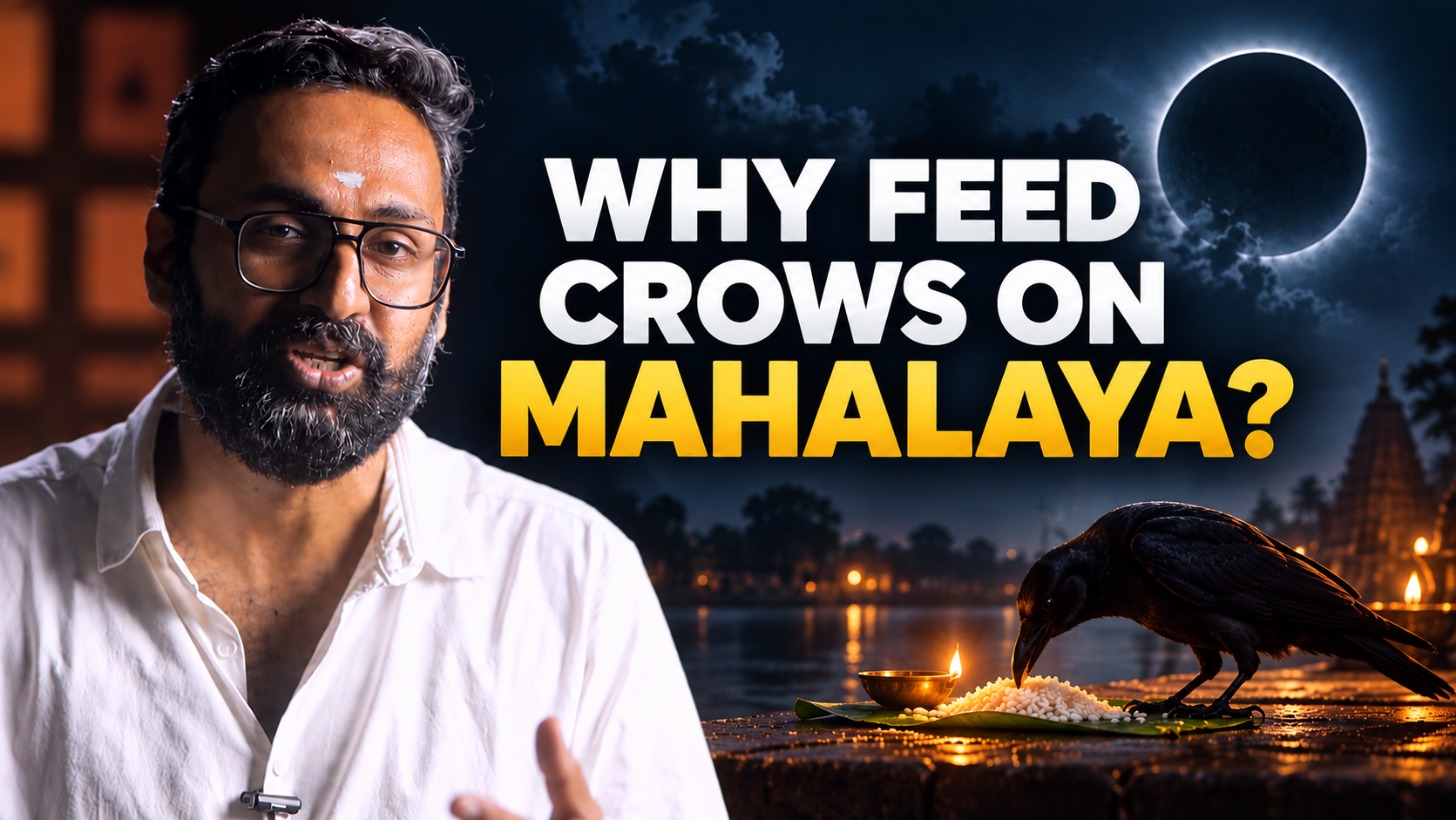
Have you ever wondered why we offer black sesame seeds and feed crows on Mahalaya Amavasya? Or why even the most charitable heroes in our epics had to seek forgiveness from their ancestors?
Every year, millions of Indian households observe this sacred day. It is believed to be the one night when the veil between our world and the world of our ancestors becomes thin enough to cross. Let us dive into the scriptural roots, ancient stories, and deeper meaning behind Mahalaya Amavasya.
What Does “Mahalaya” Really Mean?
To understand the day, we must first look at the Sanskrit word itself:
- Maha: Meaning great.
- Laya: Meaning dissolution or the merging of all things into one.
It is the very same root word used in Pralaya, which refers to the dissolution of the entire universe. Mahalaya Amavasya is not just a standard monthly ritual; it marks a day of cosmic significance. Scriptural texts explain that on this day, the path of the ancestors—known as Pitriyana—opens its gates. It provides a dedicated channel for the living to express gratitude and pay off ancestral debts.
The Journey from Preta to Pitru
In Hindu belief, when a soul leaves the physical body, it does not become an ancestor right away. According to the Puranas, the soul initially becomes a preta—a disembodied entity.
The scriptures describe a preta as having a body as massive as a mountain, yet a mouth as tiny as the eye of a needle. It experiences intense hunger and thirst but cannot easily satisfy it.
During the twelve days of rituals following a death, a subtle body is gradually built for the soul. On the twelfth day, through the ritual of sapindikaranam, the soul transitions from preta to pitru (ancestor), joining the previous three generations: parent, grandparent, and great-grandparent.
The Legend of Daanavir Karna
The tradition of observing Pitru Paksha and Mahalaya Amavasya is deeply connected to a powerful story from the Mahabharata featuring Karna.
Karna was renowned throughout the world as Daanavir Karna because he never turned away anyone who asked for charity. He gave away his wealth, jewels, and even his divine armor. When he died on the battlefield and ascended to heaven, he expected a peaceful reward.
However, when the gods served him food, the plates were filled with gold, diamonds, and silver thrones instead of actual grain or water.
When a starving Karna asked why he was given gold instead of food, the gods explained that while he had donated immense wealth to strangers, he had never offered food or water to his own ancestors. Because Karna grew up unaware of his real parents—being the hidden son of Surya, the Sun god—he had never performed ancestral rites.
Recognizing that his oversight was due to ignorance rather than neglect, the gods granted Karna a gift: fifteen days to return to Earth, locate his lineage, and perform the shraaddha rituals. Those fifteen days became known as Pitru Paksha, culminating in the final day of Mahalaya Amavasya.
| Character / Aspect | Significance in the Narrative |
|---|---|
| Karna | Known as Daanavir, gave away all material wealth. |
| The Heavenly Feast | Offered gold and jewels instead of edible food. |
| The Missing Duty | Never offered food or water (shraaddha) to his true ancestors. |
| Pitru Paksha | The 15-day grace period granted to return to Earth and fulfill ancestral obligations. |
Why Do We Feed Crows?
A common question regarding Mahalaya Amavasya is the practice of feeding crows before the family eats.
During the shraaddha meal, traditional households prepare an offering called Panchbali (five offerings). These offerings are set aside for five distinct entities:
- Cows
- Dogs
- Gods
- Ants
- Crows
In Puranic tradition, the crow is considered the messenger of Yama, the deity of justice and death. It is believed that during Mahalaya Amavasya, ancestors briefly take the form of crows to accept offerings directly from their descendants. When a crow accepts the food, it serves as a sign that the ancestral offering has been received and accepted.
The Astronomical & Scriptural Perspective
Why is this specific no-moon night chosen over others?
The Puranas describe a subtle cosmic alignment during this time. The distance between our earthly domain and Pitru Loka (the realm of the ancestors, situated near the moon) becomes minimal.
- Shiva Purana: Refers to this timing as an alignment in the cosmic mandala that facilitates communication between realms.
- Garuda Purana: Mentions Lord Vishnu’s boon allowing ancestors to descend during this fortnight to receive direct offerings from their families.
The Core Message: A Practice of Reciprocity
Mahalaya Amavasya is fundamentally about quiet reflection, debt, and gratitude rather than mourning. It reminds us that we do not exist in isolation; we are part of an unbroken chain connecting past generations to future ones.
By insisting that food is offered to animals, insects, and nature before humans sit down to eat, the ritual embeds universal compassion into an act of personal remembrance.
—
🎧 Watch Next Explore deep dives on Shiva, the Sahasranamas, Hindu mythology, and the hidden meanings behind our festivals, all on the Chaturya channel.
📖 My Books If you enjoyed this exploration of India’s lesser-known traditions and the extraordinary worlds within them, you may also enjoy my books:
NAAGA: Discovering the Extraordinary World of Serpent Worship
👉 https://www.amazon.in/Naaga-Discovering-Extraordinary-Serpent-Worship/dp/9369892656/
DAIVA: Discovering the Extraordinary World of Spirit Worship
👉 https://www.amazon.in/Daiva-Discovering-Extraordinary-Spirit-Worship/dp/9354899749/
📱 Stay Connected Join my WhatsApp Channel for new videos, stories, mythology and updates:
👉 https://whatsapp.com/channel/0029Vb7whX3GpLHSRUc0I61P
Follow me on Instagram:
👉 https://instagram.com/theharikumar
If this article made you look at our culture a little differently, share it with someone who might enjoy it too.
Frequently Asked Questions About Mahalaya Amavasya
What is Mahalaya Amavasya?
Mahalaya Amavasya is the final and most significant day of Pitru Paksha, a period traditionally dedicated to remembering and honouring one’s ancestors. It is observed on the Amavasya, or new-moon day, that marks the culmination of the ancestral fortnight. The observance centres on gratitude, remembrance and the performance of ancestral rites such as shraddha and tarpan.
What does the word Mahalaya mean?
The word Mahalaya can be understood through the Sanskrit roots maha, meaning “great,” and laya, meaning “dissolution” or “merging.” The term therefore carries the sense of a great dissolution or merging and is associated with the transition represented by this sacred period.
Why is Mahalaya Amavasya important for ancestors?
Mahalaya Amavasya is traditionally regarded as an especially important time to honour ancestors and fulfil ancestral obligations. Hindu traditions associate Pitru Paksha with offerings made to departed family members, with Mahalaya Amavasya marking the culmination of this period.
Why do Hindus feed crows on Mahalaya Amavasya?
Feeding crows is part of the wider tradition of panchbali, in which offerings are made to different forms of life and spiritual beings. In Puranic tradition, the crow is associated with Yama, the deity of death and justice, and is regarded as a messenger between the living and the ancestral realm. In some traditions, the acceptance of the offering by a crow is understood as a sign that the ancestral offering has been received.
What is Panchbali?
Panchbali refers to five traditional offerings made during certain Hindu household rituals. In the context of shraddha, these offerings are associated with cows, dogs, gods, ants and crows. The practice reflects the broader idea that food and gratitude should extend beyond human beings to other forms of life and the sacred world.
What is the story of Karna and Pitru Paksha?
According to the traditional story, Karna was renowned for his extraordinary generosity. After his death, however, he found himself unable to obtain ordinary food in heaven because, although he had given immense wealth to others, he had not performed ancestral offerings of food and water. The gods eventually granted him a period to return to Earth and perform the necessary rites. This period is traditionally connected with the origin of Pitru Paksha and its culmination in Mahalaya Amavasya.
What is the connection between Karna and Mahalaya Amavasya?
The legend of Karna provides one traditional explanation for why Pitru Paksha is observed. Karna’s experience in the afterlife illustrates the distinction between material charity and the ancestral obligations represented by shraddha. His story ultimately connects the fifteen-day period of Pitru Paksha with Mahalaya Amavasya.
What is Pitriyana?
Pitriyana, or the path of the ancestors, is a concept found in Hindu philosophical and scriptural traditions concerning the journey associated with ancestors and the departed. In the context of Mahalaya Amavasya, it represents the ancestral path through which the living symbolically connect with and honour previous generations.
What happens to a soul after death according to Hindu tradition?
According to traditions described in the Puranas, a departed soul initially enters a state known as preta rather than immediately becoming a pitru, or ancestor. Funeral and post-death rites are understood to assist the soul through this transition. The article describes the twelve-day ritual process and the subsequent sapindikaranam through which the soul is incorporated into the ancestral lineage.
Why is Mahalaya Amavasya observed on the new-moon day?
Amavasya is the lunar phase when the moon is not visibly illuminated from Earth. Hindu traditions attach particular significance to Amavasya for ancestral rites, and Mahalaya Amavasya marks the culmination of Pitru Paksha. The article also discusses traditional ideas concerning the relationship between the moon, Pitru Loka and the ancestral realm.
What is the difference between Pitru Paksha and Mahalaya Amavasya?
Pitru Paksha refers to the entire ancestral fortnight, traditionally consisting of fifteen lunar days dedicated to remembrance and ancestral offerings. Mahalaya Amavasya is the final Amavasya of this period and is regarded as its culmination.
What is the spiritual meaning of Mahalaya Amavasya?
Beyond rituals for the departed, Mahalaya Amavasya can be understood as a practice of gratitude and reciprocity. It reminds us that our lives are connected to previous generations and that we have responsibilities towards both those who came before us and those who will come after us.
Do you have to perform shraddha on Mahalaya Amavasya?
The specific form of ancestral observance varies according to family tradition, regional customs and lineage. Shraddha, tarpan and other ancestral rites may be performed according to one’s established practice and, where appropriate, with guidance from a knowledgeable priest or family tradition.





Leave a Reply