
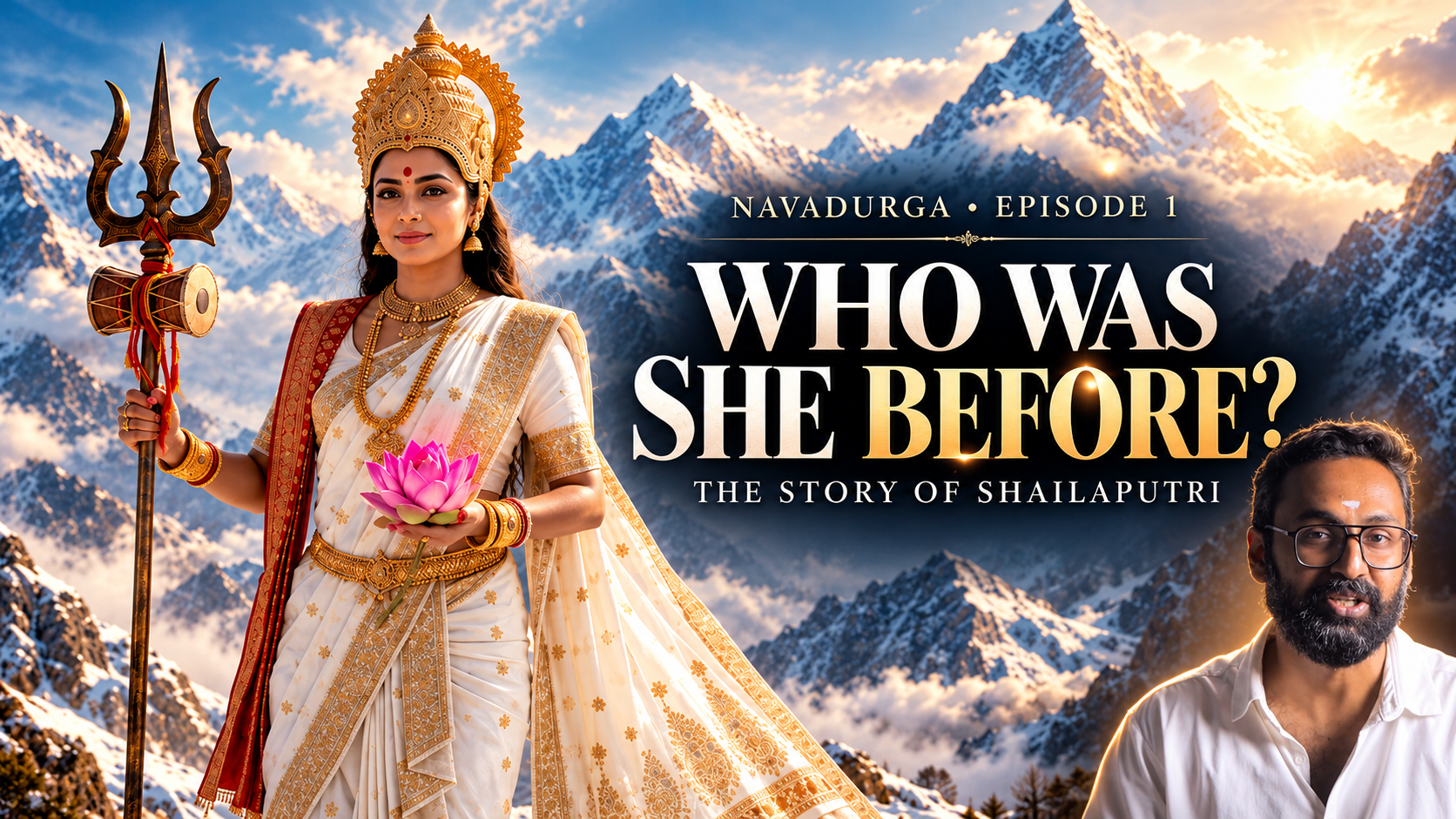
Who is Shailaputri, the daughter of the mountain whom we worship on the very first night of Navratri? And why does the entire nine-night journey of the Goddess begin with her?
Shailaputri is the first of the Navadurgas, the nine forms of Goddess Durga. Her story does not begin in the Himalayas. It begins long before, in the smoldering ash of Daksha’s sacrificial fire. In this article, let us walk through the complete Puranic story of Shailaputri, from Sati to Parvati, and understand the deeper spiritual meaning behind the first day of Navratri.
This is Part 1 of my nine-episode series on the Navadurgas.
What Does “Shailaputri” Mean?
The name itself is a clue:
- Shaila: Meaning mountain.
- Putri: Meaning daughter.
Shailaputri is, quite literally, the daughter of the Himalayan mountain. But to truly understand her, we have to go back to a time before she was born in the Himalayas. We have to return to a king who prayed for the Divine Mother herself to come to his home.
The Boon of King Daksha: How the Goddess Was Born as Sati
King Dakshaprajapati performed severe austerities to please Goddess Jagadamba, the mother of the universe. When she appeared before him, she granted him a blessing: she would be born as his daughter through his wife Virini.
But the blessing came with a warning. If Daksha ever dishonoured her, she would relinquish that very body and withdraw from that form.
In time, the Goddess was born as Sati. From her childhood, Sati held Mahadeva Shiva in her heart above all else. She observed vratas and performed severe penance, and by the strength of that devotion, she was united with Shiva in a cosmic wedding.
Why Did Daksha Dislike Shiva?
Daksha did not like Shiva, and there is a reason for it.
Once, at a grand assembly and yajna at Prayaga (this is a different yajna from the one Daksha later conducted at Kankhala), all the assembled gods rose in respect when Daksha arrived. All except Mahadeva Shiva, who remained seated in meditation.
In that moment of pride and anger, Daksha cursed Shiva: he would receive no share of sacrificial oblations in future yajnas. When Nandi, the sacred mount of Shiva, heard this, he cursed Daksha in return. Daksha would lose his spiritual wisdom, become entangled in worldly pride, and also lose his head.
The Daksha Yagna: The Sacrifice of Sati
Soon after, Daksha organised a colossal yajna at Kankhala. He deliberately left out both Mahadeva Shiva and Goddess Sati from the invitation.
When Sati learned of the yajna at her father’s house, she insisted on attending, despite Shiva’s gentle warning that she would face dishonour there. She travelled to the yajna along with the Ganas of Shiva.
There, Daksha ignored his own daughter and openly insulted Shiva before the assembled kings, mocking his appearance and his ascetic ways. Unable to bear the insult to her beloved Mahadeva, Sati sat in Padmasana in the sacrificial fire. She unified her mind completely with Shiva, and through her yogic fire, she gave up her body in that very hall.
Veerabhadra, Bhadrakali and the Beheading of Daksha
When Shiva learned of this, he created Veerabhadra and Goddess Bhadrakali from his matted hair. Angry and heartbroken, he destroyed the yajna and humbled the pride of the entire assembly. Daksha was beheaded.
Then Brahma and the surviving deities prayed for mercy. In his compassion, Shiva restored the yajna and brought Daksha back to life with a goat’s head.
Carrying the unbearable grief of separation, Mahadeva withdrew to the Himalayas and entered deep penance.
This is, of course, a fast-forward version of the original story. But the Puranas now take us to another thread, because the rebirth of the Divine Mother was prepared through another line of curses and blessings.
The Curse of Sanaka: How Maina Became the Mother of Parvati
A daughter of Daksha was married to the Pitris, and she had three daughters named Maina, Dhanya and Kalavati.
When the three sisters visited Vaikuntha, they failed to offer salutation to the ancient sages Sanaka and the others. The sages cursed them to be born as mortal women on earth. When the terrified sisters begged for forgiveness, the sages softened the curse with a divine blessing: Maina would marry King Himavan and give birth to Parvati, the rebirth of Sati.
Himavan and Maina, after their marriage, desired the Mother of the Universe as their own child.
The Birth of Shailaputri in the House of the Himalayas
At midnight on the ninth day of the bright fortnight of Chaitra, under the Mrigashira star, Goddess Shakti appeared as an infant girl to Queen Maina.
Shailaputri is the same Adi Shakti who was Sati, now reborn in the house of the Himalayas. That is why the tradition honours her as the daughter of Shaila, the mountain. She is also remembered as Hemavati and Parvati, and just as in her previous births, she was destined to be united again with Mahadeva Shiva.
| Aspect | Significance in the Narrative |
|---|---|
| Sati | The Goddess born as Daksha’s daughter, who gave up her body at the Daksha Yagna. |
| The Curse | Sanaka and the other sages’ curse on Maina, Dhanya and Kalavati, softened by a blessing. |
| Maina and Himavan | The parents who desired the Mother of the Universe as their own daughter. |
| Shailaputri | Adi Shakti reborn as the daughter of the mountain, also known as Hemavati and Parvati. |

Why Is Shailaputri Worshipped on the First Day of Navratri?
Among all the nine forms of the Navadurga, Shailaputri is the foundation. That is why she is worshipped on the first night of Navratri. The journey of the Goddess has to begin from the ground, from the mountain, before it can rise.
Shailaputri Iconography: Bull, Trishula and Lotus
Every element in the depiction of Shailaputri carries meaning:
- The white bull (Nandi): She rides the white bull and is therefore honoured as Vrusharoodha, the one mounted on the bull. The bull stands for dharma and a grounded, disciplined mind. Riding it signifies complete mastery over our animal instincts.
- The Trishula (right hand): Holds sovereignty over time and over the currents of our inner energy.
- The lotus (left hand): A flower that blooms in purity above the mud of the material world.
She is depicted with two hands. Her favourite flower is the jasmine (chameli), which devotees offer to her on the first night of Navratri.
It is also believed that Chandra, the moon, who governs fortunes, is guided by Goddess Shailaputri, and that any affliction of the moon can be overcome by worshipping this form of Adi Shakti.
The Spiritual Meaning of Shailaputri: Muladhara Chakra and Prithvi Tattva
In our yogic tradition, Shailaputri represents the dormant cosmic energy that rests at the Muladhara chakra, at the base of the spine.
The mountain stands for the prithvi tattva, the earth element: the densest and most stable ground of our existence. Worshipping her on the first day signifies that we must root our faith firmly in the earth before the Kundalini can rise upward through the remaining nights.
In the Puranic vision, Shailaputri as Parvati is Moola Prakriti, the primordial energy, while Mahadeva Shiva is pure consciousness. She is the first awakening of energy that moves consciousness towards creation and towards liberation.
The Core Message: From Sati to Shailaputri
The journey from Sati to Shailaputri is the journey of the soul from unbound, unrefined devotion to mountain-like resolve, now prepared for intense inner discipline.
So on the first night of Navratri, remember her full journey: from the yajna fire of Daksha to the snows of the Himalayas.
In the next episode of this series, we walk with her into the forest of austerity, where she becomes Brahmacharini, the ascetic seeker who gives up even leaves to win Shiva through endurance alone.
—
🎧 Watch Next Explore the rest of the Navadurga series, deep dives on Shiva, the Sahasranamas, Hindu mythology and the hidden meanings behind our festivals, all on the Chaturya channel.
📖 My Books If you enjoyed this exploration of India’s lesser-known traditions and the extraordinary worlds within them, you may also enjoy my books:
NAAGA: Discovering the Extraordinary World of Serpent Worship
👉 https://www.amazon.in/Naaga-Discovering-Extraordinary-Serpent-Worship/dp/9369892656/
DAIVA: Discovering the Extraordinary World of Spirit Worship
👉 https://www.amazon.in/Daiva-Discovering-Extraordinary-Spirit-Worship/dp/9354899749/
📱 Stay Connected Join my WhatsApp Channel for new videos, stories, mythology and updates:
👉 https://whatsapp.com/channel/0029Vb7whX3GpLHSRUc0I61P
Follow me on Instagram:
👉 https://instagram.com/theharikumar
Which part of the story of Devi Shailaputri moved you the most? Tell me in the comments below. And if this article made you look at the Goddess a little differently, share it with someone who might enjoy it too.
Frequently Asked Questions About Goddess Shailaputri
Who is Goddess Shailaputri?
Shailaputri is the first of the nine Navadurga forms of Goddess Durga, worshipped on the first day of Navratri. The name means “daughter of the mountain” (shaila meaning mountain, putri meaning daughter). She is the same Adi Shakti who was born earlier as Sati and is reborn as the daughter of King Himavan and Queen Maina.
Why is Shailaputri worshipped on the first day of Navratri?
Among the nine forms of the Navadurga, Shailaputri is regarded as the foundation. In the yogic reading, she represents the dormant energy at the Muladhara chakra and the earth element, so the nine-night journey begins with her before the Kundalini rises through the remaining nights.
What is the relationship between Sati and Shailaputri?
Shailaputri is the rebirth of Sati. Sati gave up her body at the Daksha Yagna after her father insulted Shiva, and the same Adi Shakti was reborn in the house of the Himalayas as the daughter of Himavan and Maina. In this form she is also remembered as Parvati and Hemavati.
Why did Sati give up her life at the Daksha Yagna?
Daksha deliberately left Shiva and Sati out of the invitation to his yajna at Kankhala. When Sati attended anyway, Daksha ignored her and insulted Shiva openly before the assembled kings. Unable to bear the insult to Mahadeva, Sati sat in Padmasana in the sacrificial fire and gave up her body through her yogic fire.
Why did Daksha dislike Shiva?
According to the Puranic account, at a yajna at Prayaga, all the gods rose in respect when Daksha arrived, except Shiva, who remained seated in meditation. Daksha took this as an insult and cursed Shiva that he would receive no share of sacrificial oblations in future yajnas.
Who were the parents of Shailaputri?
Her parents are King Himavan, the Himalayan mountain, and Queen Maina. Maina was one of the three daughters, along with Dhanya and Kalavati, who were cursed by sages to be born as mortal women, with the curse softened by the blessing that Maina would give birth to Parvati.
What is the meaning of the bull in Shailaputri’s iconography?
Shailaputri rides a white bull, which is why she is honoured as Vrusharoodha, the one mounted on the bull. The bull stands for dharma and a grounded, disciplined mind, and riding it signifies mastery over our animal instincts.
What do the trishula and lotus in her hands symbolise?
In her right hand, the Trishula holds sovereignty over time and over the currents of inner energy. In her left hand, the lotus symbolises purity blooming above the mud of the material world.
What is Shailaputri’s favourite flower?
Her favourite flower is the jasmine (chameli), which devotees offer to her on the first night of Navratri.
Which chakra is associated with Shailaputri?
Shailaputri is associated with the Muladhara chakra at the base of the spine, which is linked to the prithvi tattva (earth element) and the dormant cosmic energy of Kundalini.
Is Shailaputri connected to the moon?
It is believed that Chandra, the moon, is guided by Goddess Shailaputri, and that any affliction of the moon can be overcome by worshipping this form of Adi Shakti.
What are the nine forms of the Navadurga?
The nine forms worshipped across Navratri are Shailaputri, Brahmacharini, Chandraghanta, Kushmanda, Skandamata, Katyayani, Kalaratri, Mahagauri and Siddhidatri. This article covers the first, Shailaputri, and the next episode explores Brahmacharini.
What is the spiritual meaning of Shailaputri?
In the Puranic vision, Shailaputri as Parvati is Moola Prakriti, the primordial energy, while Shiva is pure consciousness. Her journey from Sati to Shailaputri represents the soul’s movement from unrefined devotion to mountain-like resolve, prepared for intense inner discipline.




Leave a Reply