

I did my schooling in Gurgaon — or Gurugram, as it is now known. Back then, it was a quieter city, its identity still rooted in dust roads, old kothis, and the gentle clang of temple bells in the early morning. Long before gleaming glass towers and expressways redefined its skyline, Gurugram held within it a secret that predated even the great war of the Mahabharata.
Every time we drove past sector 5, I would see the flags fluttering above a temple — the Shri Mata Sheetla Devi Mandir. As a child, I saw the endless stream of devotees. As an author of Hindu beliefs and folk deities, I now understand what I was truly looking at: one of the most layered, deeply humane, and historically rich goddess traditions in all of North India.
This is the story of Mata Sheetla Devi — a goddess who emerged not from the heavens alone, but from the soil of a city I once called home.
View this post on Instagram
When the Guru’s Ashram Was the World’s Classroom
To understand Mata Sheetla, we must travel back to the age of the Mahabharata — the Dvapara Yuga — when Gurugram was not a corporate hub but the sacred site of Guru Dronacharya’s ashram. It was here that the greatest warriors of the ancient world — the Pandavas and the Kauravas — came to learn the art of warfare, statecraft, and dharma.
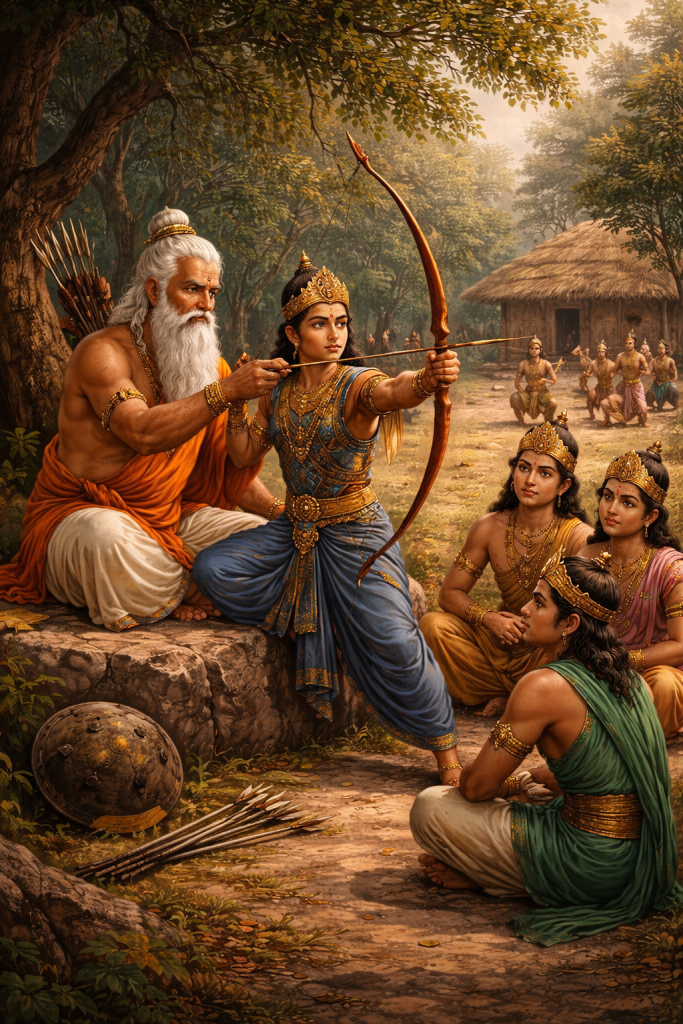
Guru Dronacharya’s wife was Kripi, the sister of Guru Kripacharya. While Drona shaped the warriors of a generation, Kripi was the quiet, compassionate force behind the ashram. She was their Gurumata — their spiritual mother. And it is this maternal role that became her most enduring legacy.
Kripi: The Guru-Mother Who Became a Goddess
The transformation of Kripi into the goddess Sheetla Mata is one of the most touching metamorphoses in Indian folk tradition. According to the legend, Kripi devoted herself entirely to the care of the sick — particularly children suffering from the dreaded pustular disease of smallpox. She tended to them with a compassion that transcended her role as a teacher’s wife.
As noted in the historical records of the temple itself (sheetlamatamandir.com), since the physical and mental suffering of human beings — especially children — was alleviated by her blessings, Guru Mata Kripi came to be revered as Sheetla Mata.
After her passing, the villagers erected a temple in her honour. She became Mata Masani — the Goddess of Smallpox — a deity who embodied both the cause of disease and its cure. This dual identity, rooted in ancient folk wisdom, speaks to a profound truth: healing begins with understanding the source of suffering.
Sheetla Devi in the Scriptures
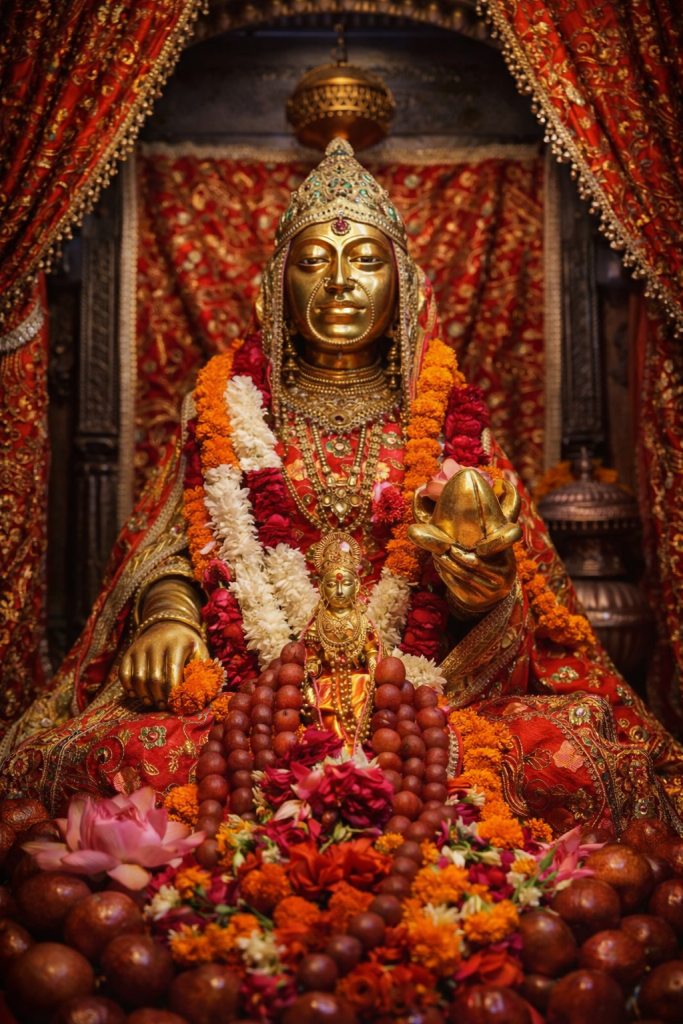
There is a popular misconception spread by some filmi folk that Sheetla Mata is not mentioned in any scriptures. However, that is not accurate. The worship of Goddess Sheetla is documented in ancient Hindu texts, most prominently in the Skanda Purana’s Prabhasa Khanda. In Sanskrit, her name derives from the root ‘sheetal’ — meaning ‘coolness’ or ‘that which soothes.’ The name itself is a diagnosis and a remedy: she is the cool breath that douses the fever of suffering.
In her iconography, she is depicted riding a donkey, holding a silver broom, a fan, neem branches, and a pot of Gangajal. Each symbol carries medical and ritual meaning: the broom sweeps away disease, the Gangajal purifies, the neem — long recognised by the Sushruta Samhita as an antipyretic and skin remedy — signals ancient India’s intuitive grasp of botanical medicine.
She is also described in the Narada Purana, where the Ashtami of Krishna Paksha in the month of Chaitra is prescribed as the ideal time of her worship. The festival of Sheetla Ashtami — also known as Basoda — observed eight days after Holi, remains one of the most widely celebrated festivals in Haryana, Rajasthan, and Uttar Pradesh to this day.
The Dream of Singha Bhagat
Every great temple has a founding story, and the Sheetla Mata Mandir in Gurugram is no exception. According to legend, a few centuries ago, Mata Sheetla Devi appeared in a dream to Chaudhary Singh Ram of village Gurugram and inspired him to build a temple for her. He obeyed the divine call and came to be known by the honoured title of “Singha Bhagat.”
Even after Singha Bhagat established her at Gurugram, the residents of neighbouring Keshopur — where Kripi had lived — disputed the goddess’s new abode. The matter was settled definitively during the reign of Begum Samru, the Governor of Jharsa under the Mughals, whose child afflicted with smallpox was cured after being consecrated before the goddess. From that point, it was acknowledged that Mata Sheetla had truly chosen to reside at Gurugram.
In the 18th century, the Jat king Jawahar Singh of Bharatpur rebuilt the current structure to commemorate his victory over the Mughals — layering this sacred site with yet another chapter of history.
The Melas, the Rituals, and the Living Faith
Today, the Sheetla Mata Mandir is not merely a relic of the past — it is a living, breathing centre of faith. Lakhs of devotees visit the temple throughout the year, with major melas (fairs) held during the months of Chaitra, Vaisakh, Ashadh, and the Sharad Navratras of the Hindu calendar. During peak seasons, the atmosphere is compared to a mini Kumbh Mela.
Healing Traditions
Ailments like boils, chickenpox, and historically smallpox are believed to be cured by the Mata’s blessings. The scientific community has noted that several rituals associated with Sheetla worship — the use of neem, the tradition of eating pre-cooked cold food on Ashtami, the avoidance of fire — align with sound principles of hygiene and cooling the body during the season transition from winter to summer when such diseases historically peaked.
Rites of Passage
The temple holds particular significance for two life milestones. Newlywed couples seek the goddess’s blessings for a prosperous life together. And one of the most sacred rites performed here is the Bal-Mundan — the ritual first haircut of an infant — offered at the feet of the Mata with a prayer for the child’s lifelong health and well-being.
A Pilgrimage That Does Not End at One Temple
The sacred geography around the main temple forms a constellation of devotion. Devotees also visit Choganan Mata, known as Chhoti Mata (the little mother), believed to be the younger sister of Sheetla Mata. Her temple is about a kilometre from the main gate.
A complete pilgrimage is considered to include visits to the villages of Mubarikpur, Tigaon, and Tighra for Devi Darshan. Together, these form a living circuit of faith that has been walked by millions of feet across centuries — a network of the sacred woven into the ordinary landscape of Haryana.
What the Ancients Knew That We Are Rediscovering
The story of Mata Sheetla Devi is not simply a religious legend. It is a story about how communities processed grief, disease, and the fear of the unknown. It is about how a woman’s compassion — Kripi’s devotion to sick children — was so profound that it outlived her mortal form and became divine.
It is also a story about the layers of India’s history: the Mahabharata era, the Mughal period, the Bharatpur Kingdom, the British era — all of them woven together in the walls of a single temple on the outskirts of what is now one of India’s most modern cities.
When I walk past that temple in my memory, I see something different now. I see not just the flags and the devotees, but the thousands of years of yearning, healing, and gratitude that built those walls — brick by sacred brick.
Explore More Stories from Indian Mythology
If this story moved you, there’s a whole universe of such tales waiting to be discovered — stories that are ancient yet deeply relevant today. Author K. Hari Kumar has spent years weaving these mythological threads into compelling narratives that bring India’s rich spiritual heritage to life.
📖 Discover K. Hari Kumar’s books on Indian mythology and folklore — available on Amazon and leading bookstores near you.
📱 Follow @theharikumar on Instagram for daily doses of mythology, folklore, and forgotten legends from across India.
Because every temple has a story. Every goddess has a legend. And every legend has something to teach us.
References & Further Reading
- Official Temple Website: sheetlamatamandir.com
- Wikipedia — Sheetla Mata Mandir Gurgaon: en.wikipedia.org
- Wikipedia — Shitala (Goddess): en.wikipedia.org/wiki/Shitala
- Haryana Tourism — Sheetala Devi Temple: haryanatourism.gov.in
- Skanda Purana (Prabhasa Khanda), Chapter 135 — Greatness of Shitala Gauri. Trans. G. V. Tagare (2024). Available at: wisdomlib.org
- Hindu Temple Talk — The Mythology and Significance of Goddess Sheetla: hindutempletalk.org
- Sushruta Samhita — Ancient Ayurvedic text referencing neem (Azadirachta indica) as antipyretic and anti-inflammatory.
- Cisindus — Devi Shitala: The Divine Mother Who Heals: cisindus.org
© K. Hari Kumar. All rights reserved. Follow @theharikumar on Instagram for more stories from the world of Indian mythology and folklore.





Leave a Reply