
Bhramari Devi Story and Legend | Indian Mythology & Sacred Legends
View this post on Instagram
In the beginning, before the trouble started, there was an asura who wanted to live forever.
Deep in the roots of the world, in the shadow-realm of Patala, lived Arunasura. He was not content with the dark; he wanted the sun, the stars, and the thrones of the gods. He climbed the spine of the Himalayas and sat by the silver waters of the Ganga.
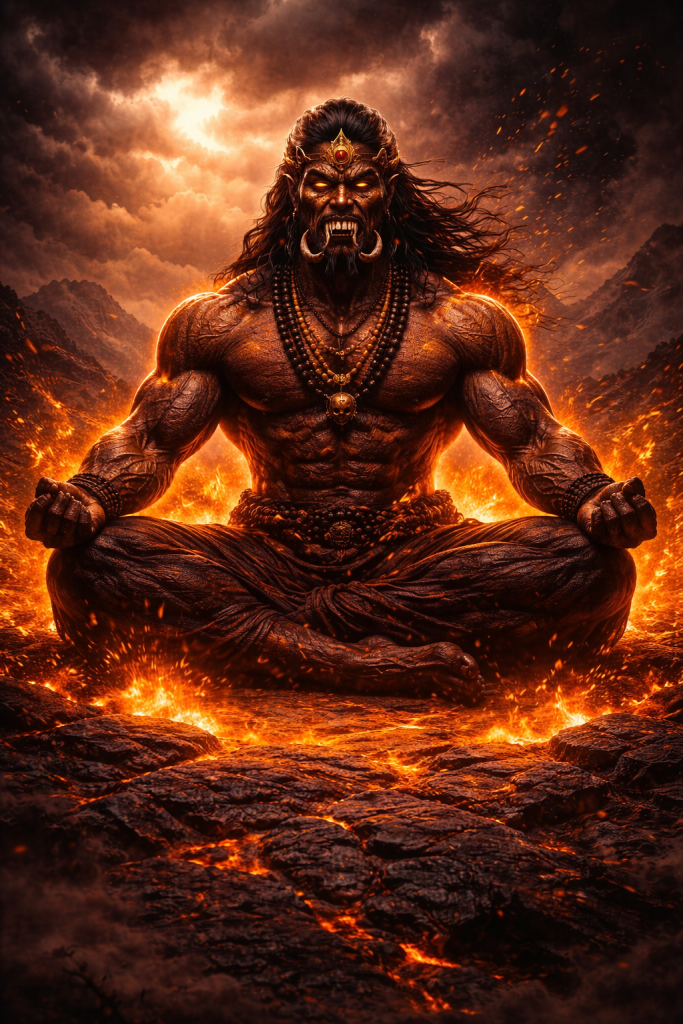
For ten thousand years, he ate nothing but dry, dead leaves. For ten thousand years more, he licked only the morning dew from the stones. His ribs became a cage; his skin became parchment stretched over bone. But inside that brittle frame, a fire was cooking. He chanted the sacred Gayatri mantra with such ferocity that his body began to glow with a violet, ghostly heat. The heat grew until the clouds began to singe and the earth began to crack.
The gods, shivering in the heat of his prayer, begged the Creator, Brahma, to stop him. Brahma descended on a swan, his breath smelling of lotus and ancient books.
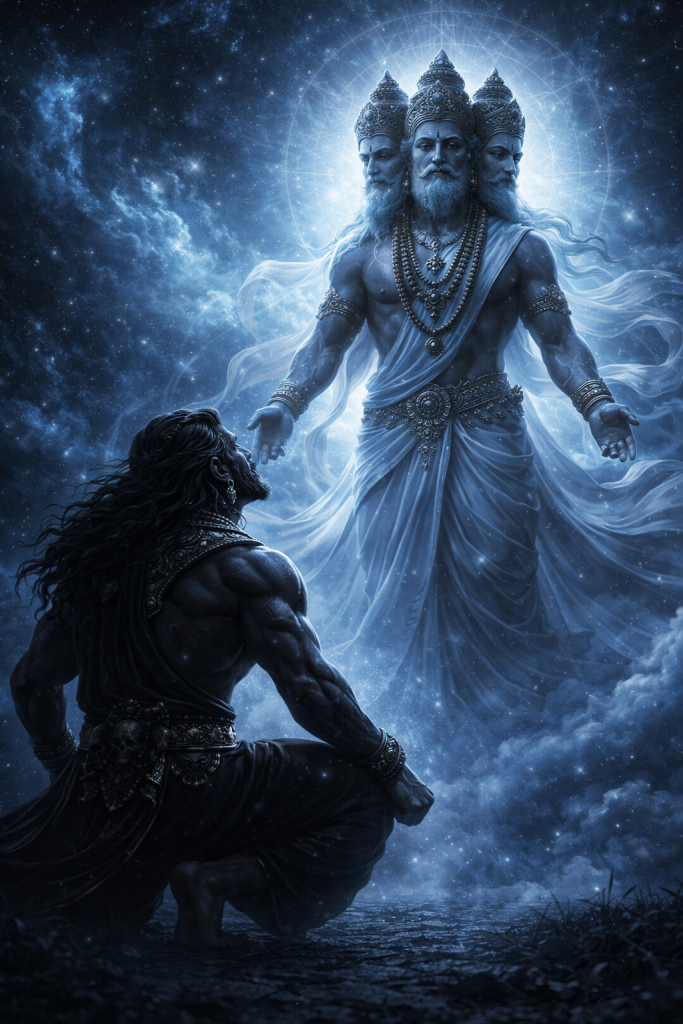
“Ask,” Brahma sighed.
“Make me immortal,” Arunasura rasped.
“No,” said Brahma. “Everything that has a beginning must have an ending. It is the Law.”
Arunasura smiled—a thin, cruel line. “Then grant me this: I shall not be killed in any war. I shall not be slain by any weapon of gods or men. No man shall kill me, nor woman, nor bird, nor beast.”
Brahma nodded. The Law was satisfied, and the trap was set.
The King of the Three Worlds
With the boon wrapped around him like invisible armor, Arunasura became a storm. He marched out of the underworld with an ocean of demons at his back. He tore the crown from Indra’s head and kicked the gods out of their golden palaces.
He was invincible. But he had a secret strength: he still chanted the holy mantra. His power stayed rooted in his devotion.
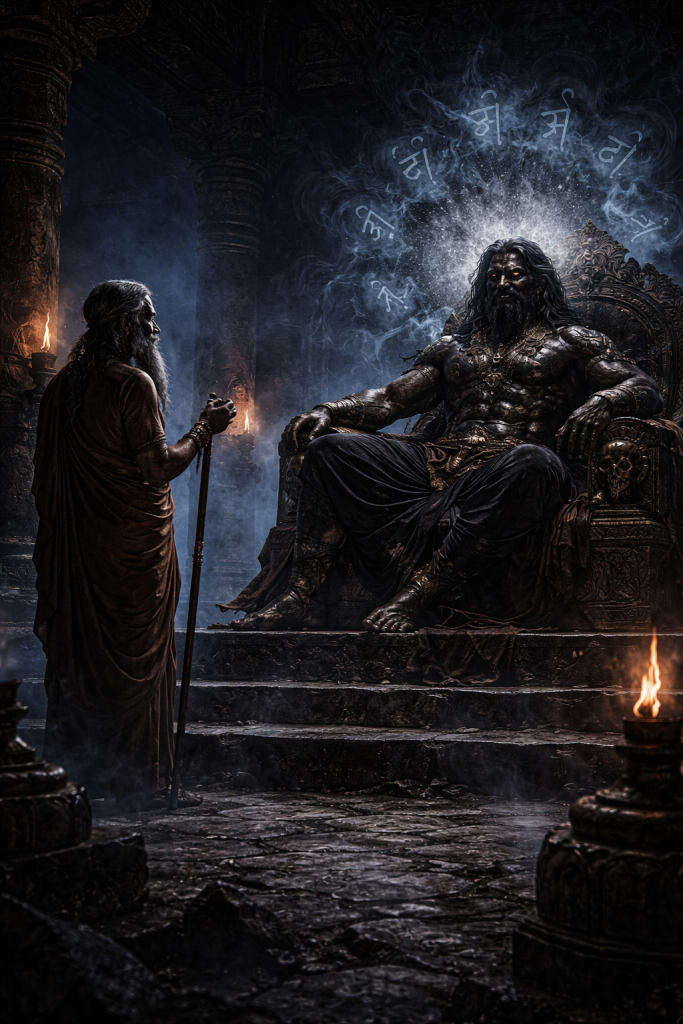
The gods went to Brihaspati, the cleverest of teachers. Brihaspati put on the robes of a wandering monk and walked into the demon’s throne room.
“Great King,” Brihaspati said, bowing low. “I see you worship the Goddess Gayatri. How wonderful! Since I worship her too, that makes us brothers. We are practically the same person!”
Arunasura’s pride was his undoing. He looked at the humble monk with disgust. “I am the Emperor of the Three Worlds! I am nothing like you cowardly weaklings. If you worship her, then I am done with her!”
In a fit of arrogance, he stopped his chanting. He threw away his shield.
The Humming Goddess
The gods seized the moment. They cried out to the Great Mother, using the secret sounds of the universe.
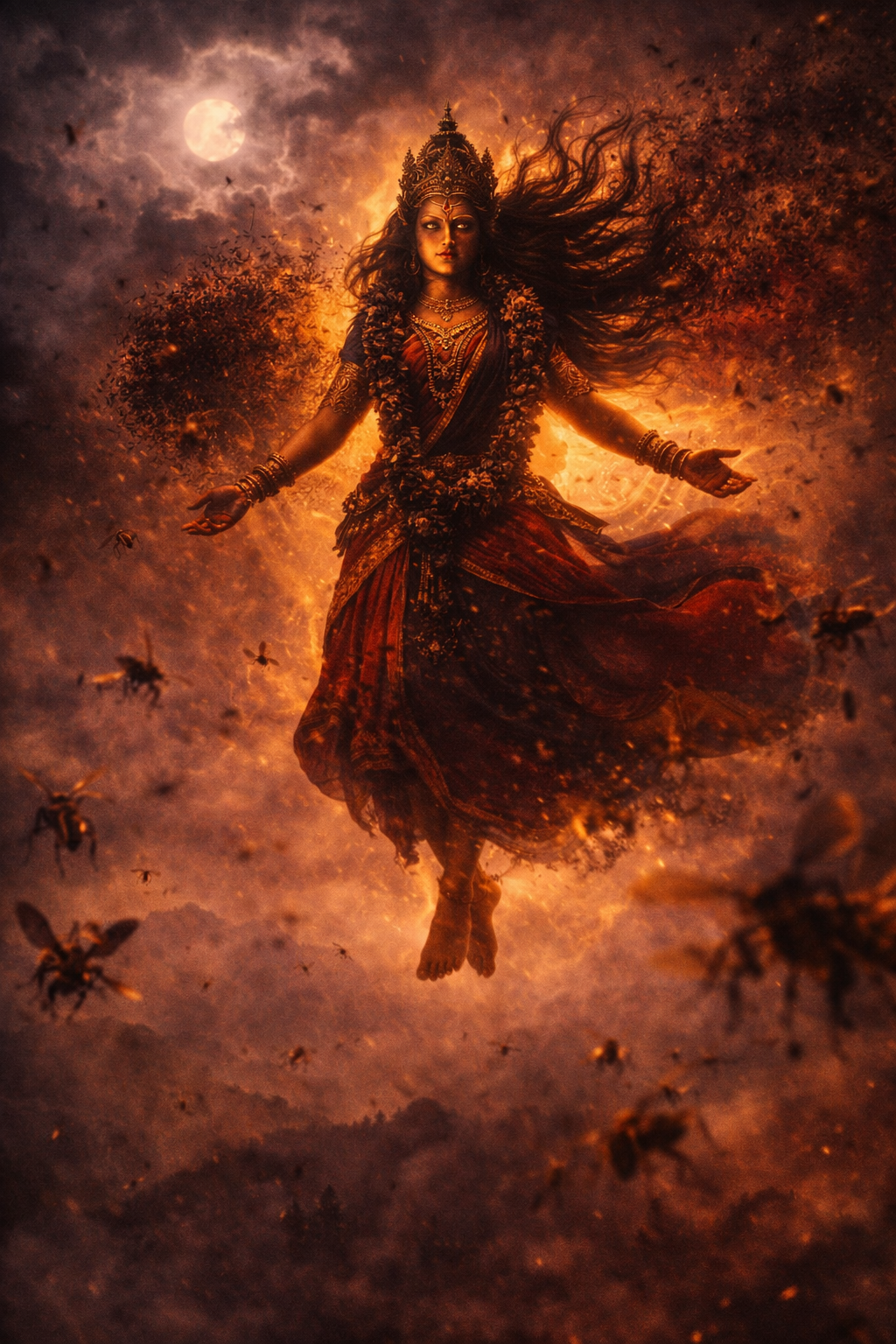
She did not appear as a mother. She appeared as a Nightmare of Gold and Black.
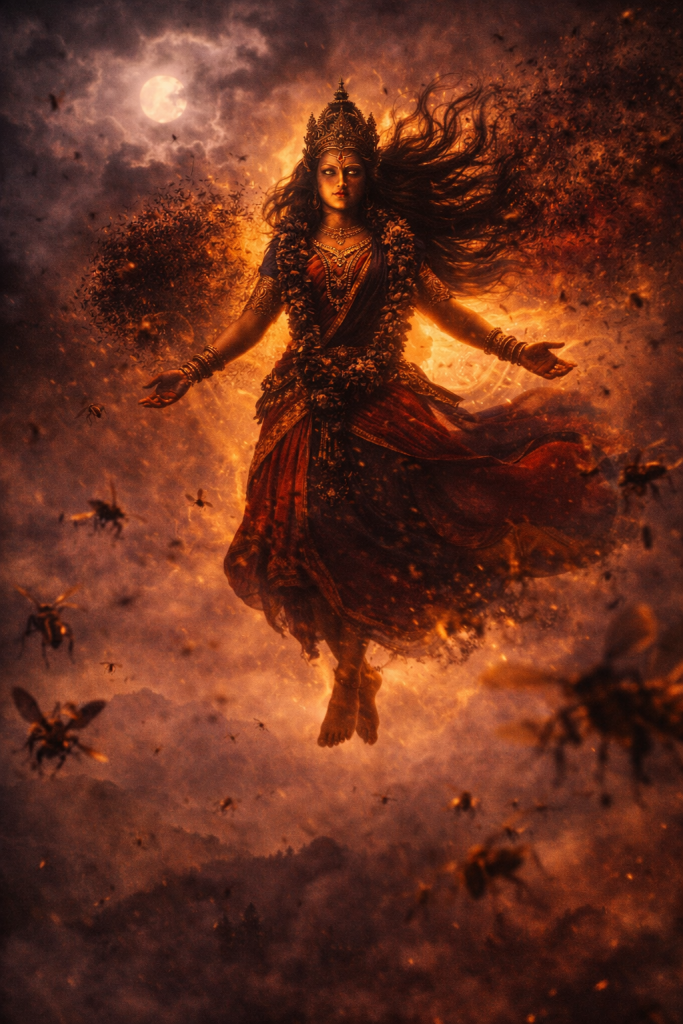
She was Bhramari Devi. Her skin was the color of a gathering storm. Around her neck hung garlands that did not wilt, but moved. They were made of millions of black bees and golden hornets, their wings vibrating in a low, bone-shaking hum: Hrim… Hrim… Hrim… Her fists were clenched tight.
Arunasura laughed when he saw her. “A woman? I am protected against women! A goddess? I am protected against gods!”
The Devi smiled, and it was the most terrifying thing Arunasura had ever seen. “I have brought your end,” she whispered, “and they are neither gods, nor men, nor birds, nor beasts.”
She opened her hands.
The Black Sun
It began as a trickle, then a flood. From her palms, from her hair, from every single pore of her glowing skin, billions of bees, wasps, and hornets exploded into the air.
They blotted out the sun. The sky turned from blue to a vibrating, fuzzy black. The sound was not a noise; it was a physical force that shattered glass and made the mountains tremble.
The swarm descended.
Arunasura’s weapons were useless. You cannot sword-fight a cloud. You cannot spear a million stings. The insects ignored his armor and crawled into the gaps. They were the “Six-Legged Ones,” the creatures that bypassed his boon.
In one hour, the screaming stopped. The demon army was gone, dissolved into the earth. The tyrant who wanted to own the world was silenced by the smallest creatures in it.
The swarm turned as one, a great living ribbon of gold and black, and flew back to the Goddess. They vanished into her skin like raindrops into an ocean. The sun came out again, the gods played their harps, and the world began to breathe.
What Her Name Means
Bhramari — the name comes from Bhramara, meaning bee. She is the Goddess of Bees, the Goddess of Black Bees. The one who is like the black bee. The one from whom the swarm is born.
But her name means something else too, if you listen for it.
In yoga and pranayama, there is a breathing exercise called Bhramari Pranayama — the humming breath. You close your eyes, block your ears, and make a low humming sound from deep in your throat. Like a bee. Practitioners say it quiets the mind, dissolves anxiety, stills the endless noise inside a person’s head.
The bee’s hum — Hrim Hrim — is itself considered her mantra. The first beings to worship Bhramari were the bees themselves, making this very sound. It is one of the oldest mantras in the tradition, vibrated by creatures who never read a scripture in their lives.
There is something in that worth sitting with.
Where She Lives
In temple tradition and regional lore, she appears as Bhramarambika, particularly at the Srisailam Shakti Peetha in Andhra Pradesh — one of the most sacred sites in all of India — where she is worshipped as a form of Parvati who adopted a bee-like form to worship Shiva, symbolising devotion and transformative power.
There is also a Bhramari Shakti Peetha near Guwahati in Assam, nestled in the hills along the banks of the Brahmaputra River, where it is believed the left leg of Goddess Sati fell. These are not separate goddesses. They are the same energy, remembered differently across the landscape of India, the way the same river is called by different names as it passes through different villages.
What I Think This Story Is Really About
I have spent a long time with the Bhramari Devi story and legend. And the more I sit with it, the more I think it is not really about a demon at all.
Arunasura is patient. He accumulates power slowly, through discipline. He gets a boon that seems to make him untouchable. And then he uses all of that carefully built power to take things that were not his, silence things that needed to be heard, and bring the world to a standstill.
We all know someone like that. Sometimes we are someone like that.
And the Goddess’s answer is not a thunderbolt. It is not a sword. It is not even a clever trick, exactly. It is something more fundamental — she finds the gap that arrogance always leaves behind. Arunasura was so busy listing everything that could not kill him that he forgot to think about everything else that existed in the universe.
He forgot about the small things.
The swarm of bees is a symbol of unity and focused energy — a reminder that collective strength, when properly directed, can bring down even the most invincible-seeming force.
She did not fight him with power. She answered power with presence — with the deep, humming, ancient energy that moves through every living thing. The sound your own chest makes when you breathe and hum at the same time. The sound the forest makes on a still afternoon.
Hrim. Hrim. Hrim.
The Goddess of Bees was there before the gods needed her. She will be there after the story ends. She hums through the living world whether we are paying attention or not.
All we have to do is go quiet enough to hear her.
These are the stories that have stayed with me for years — the ones hidden in the margins of our epics and Puranas, waiting for someone to tell them simply. I write them so they don’t get lost.
📖 Explore K. Hari Kumar’s books on Indian mythology and folk traditions — available on Amazon and at bookstores near you.
📱 Follow @theharikumar on Instagram for more untold stories from the ancient world — delivered daily, in plain language.
Jai Bhramari Devi.
Sources & References:
- Wikipedia — Bhramari
- Devi Bhagavata Purana, Book X, Chapter XIII — Glory of Goddess Bhramari (Referenced in WisdomLib)
- Markandeya Purana, Chapter 91 — The Devi Mahatmya, translated by Bibek Debroy, Penguin 2019 (WisdomLib)
- Amar Chitra Katha — Arunasura and Brahmari
- InBrindavan — Brahmari Devi and Arunasura
- Grokipedia — Bhramari
- Bhramari Shakti Peetha Guide — ChardhamTicketsToTrip



Leave a Reply