
Ancient city found beneath Puri Jagannath Temple | Indian Heritage, Sacred History & Archaeology
View this post on Instagram
For millions of Hindus across the world, Puri is not just a city. It is one of the sacred dhams — the holy corners of Bharat that a devout Hindu aspires to visit at least once in a lifetime. The city belongs to Bhagawan Jagannath. Every stone in it, every lane leading to the great temple, feels ancient. Feels chosen.
As it turns out, even the ground beneath our feet there has been keeping secrets.
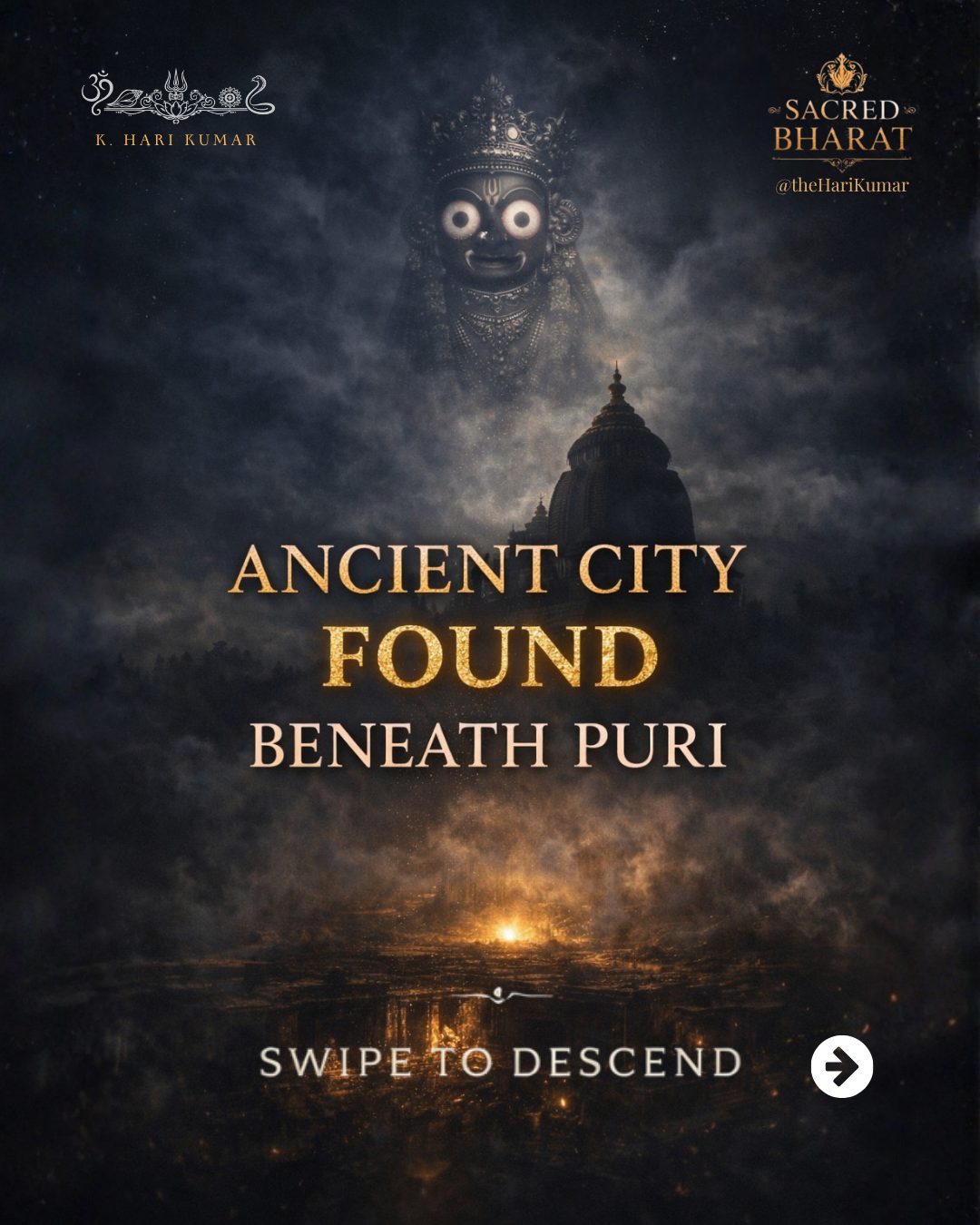
In one of the most significant archaeological discoveries in recent years, a scientific survey has found evidence of an entire buried ancient city lying beneath the present-day town of Puri. And along with it, signs of what appears to be an underground tunnel — stretching from the Shree Jagannath Temple all the way to the Bay of Bengal.
For devotees and historians alike, this is not merely news. It is a confirmation that what our scriptures and traditions have always pointed to is real — and still waiting to be fully understood.
What Exactly Was Found
Experts from IIT Gandhinagar conducted a Ground Penetrating Radar (GPR) survey at a cost of ₹40 lakh, commissioned through the Odisha Bridge Construction Corporation on behalf of the temple administration. The survey detected structural anomalies across a 21.6 square metre area — including possible chambers, walls, and a tunnel-like formation believed to extend from the temple precincts directly toward the Bay of Bengal.
GPR is a non-invasive technology. It works by sending radar pulses into the ground and measuring how they bounce back. Think of it as an X-ray for the earth beneath our feet. Nothing is dug up. Nothing is disturbed. And yet, the technology can detect walls, chambers, buried objects, and hollow passageways that have been hidden for centuries.
In total, 43 potential heritage sites were identified across multiple locations, including Emar Math, Nrusingha Temple, Budhi Maa Temple, and roads adjoining the Jagannath Temple. Pottery, metal objects, and daily-use items were also found underground.
What this tells us is significant: the buried remains are not isolated. They stretch across large parts of the city. Puri, it seems, was built on top of an older Puri.
How This Discovery Was Made
The story begins not with scientists, but with construction workers.
During excavation work for the Srimandir Parikrama Project in May 2022, a broken lion sculpture was found at the site where the ancient Emar Math once stood — within the 75-metre periphery of the Jagannath Temple. Along with it, a 30-foot-long wall was unearthed, along with a chamber measuring 7.6 metres by 3 metres, with speculation that it may have once housed golden idols.
Responding to public demand for a detailed scientific assessment, authorities commissioned the GPR survey. The findings indicate the presence of an ancient, possibly urban settlement beneath large parts of Puri city.
Initial discoveries were believed to date back to the Ganga dynasty period. The East Ganga dynasty ruled Kalinga — the ancient name of Odisha — from the early 5th century to the early 15th century. They were also the builders of the Jagannath Temple as we know it today. The broken lion sculpture found during the excavation was believed to potentially date back to this same dynasty.
The lion, of course, is not just a decorative motif. In the tradition of Kalinga, the lion was a symbol of divine guardianship — placed at the entrances of sacred spaces to protect them across time. Even broken, buried underground, it was still standing guard.
The Tunnel: Ancient Escape Route, Sacred Passage, or Something Else?
The most extraordinary finding in the report is the suggested presence of a tunnel running from the Jagannath Temple toward the sea.
This is not the first time such a tunnel has been spoken of. In popular memory — in the stories passed down among sevayats, priests, and long-time residents of Puri — a tunnel connecting the temple to the ocean has always existed as a half-whispered tradition. Some believed it was used by the priests to escape during the temple’s many invasions. Some believed it was a sacred passage used to carry the deities to safety when foreign armies attacked the city.
The Jagannath Temple has been invaded and plundered 18 times in recorded history. To protect and safeguard the temple, ancient weapons were stored in the Ratna Bhandar — the temple’s treasury — and ancient kings took extraordinary measures to protect the deities. The idea of a secret tunnel, in that historical context, is not mythology. It is practical history.
Whether the tunnel found in the GPR survey is the same one spoken of in tradition — or something entirely different — remains to be determined. But the technology has found something. And it points toward the sea.
What Our Scriptures Already Knew
For those of us who grew up reading about Puri, none of this feels entirely surprising.
The Skanda Purana calls Puri “Srikhetra” — the sacred field, the land of Bhagawan Vishnu. Ancient texts describe it as a city of immense spiritual and cosmic significance, a place where the divine and the human world overlap in ways that cannot always be explained by logic alone. The Brahma Purana devotes entire chapters to the glories of Puri, describing it as a place where liberation — moksha — is available to every soul that arrives with devotion.
What archaeology is slowly uncovering is that this ancient literary reverence was not merely poetic. There was a real, thriving, architecturally sophisticated city here — one that predates the current temple, one that was built with the kind of care and complexity that only a deeply organised civilisation can achieve.
The revelations have sparked fresh interest in the hidden history of Puri, raising questions about the extent of ancient urban settlements beneath this revered pilgrimage city.
The questions being asked today by archaeologists are the same questions our texts have pointed to for centuries: how old is this city, really? What was here before the current temple? And how much of what we believe as tradition is, in fact, documented history — simply buried under layers of time?
The history of Bhagawan Jagannath’s abode is the history of every Hindu who has ever taken that journey to the sea, walked through the great lion gate of the temple, and stood before Bhagawan with folded hands.
Why This Matters — For Faith, and For History
There is sometimes a tendency to see archaeology and religion as being in tension with each other — as if the discovery of physical evidence somehow complicates or challenges spiritual belief.
But for those of us who hold Bhagawan Jagannath in our hearts, this discovery does not raise doubt. It deepens wonder.
The idea that a great civilisation existed here — that kings and priests and ordinary devotees built an entire city around this sacred space, generation after generation — only reinforces what the tradition has always said: that this place is special. That it has always drawn people. That something about this particular stretch of land, where the temple stands between the Adi Ganga and the Bay of Bengal, has always made human beings want to stay, build, protect, and worship.
The buried city is not a mystery that contradicts our faith. It is a testament to it.
Every civilisation that lives and dies leaves its layers in the earth. And Puri, it turns out, has been a living, breathing, sacred city for far longer than any of us fully knew.
Bhagawan Jagannath has watched it all. The construction. The invasions. The rebuilding. The centuries of devoted footfall. And now, perhaps, the slow, careful work of uncovering what has always been there — waiting, patiently, beneath our feet.
Jai Jagannath.
Stories like this one — where ancient tradition and modern discovery come together — are what I love most to write about. If this moved you, there is so much more to explore.
📖 Explore K. Hari Kumar’s books on Indian mythology, temple traditions, and sacred heritage — available on Amazon and at bookstores near you.
📱 Follow @theharikumar on Instagram for daily stories from India’s sacred history — told simply, told with reverence.
Sources & References:
- OdishaBytes — Puri’s Hidden Past Unearthed: GPR Survey Hints At Lost City, Temple-To-Sea Tunnel (March 2026)
- OdishaTV — Buried Ganga Dynasty City Found Beneath Puri (March 2026)
- OdishaTV — Secret Tunnel from Puri Jagannath Temple to the Sea (March 2026)
- Pragativadi — Ancient City Hinted Beneath Puri, Tunnel to Sea Suspected (March 2026)
- Organiser — ASI to Resolve Mystery of Secret Tunnel Inside Puri’s Jagannath Temple (July 2024)
- Economic Times — Ancient City Found Beneath Puri Along With Secret Tunnel from Jagannath Temple to the Sea





Leave a Reply