
In a sacred city once called Mokshapuri—the City of Liberation—stands a temple that is said to be the Earth itself, made divine. This is the story of the Ekambareswarar Temple legend, one of Hinduism’s most ancient and revered shrines, and the extraordinary act of love that brought it into being.
View this post on Instagram
The Five Temples of Creation
In the philosophical tradition of Hinduism, the universe is made of five primordial elements: Earth (Prithvi), Water (Jal), Fire (Agni), Air (Vayu), and Space (Akasha). Ancient sages believed that Shiva, as the source of all creation, manifests His presence through each of these elements at five specific sacred locations. These are the Pancha Bhoota Stalams—five temple abodes, each one a living portal to a different face of the divine.
Among these five, the Ekambareswarar Temple in Kanchipuram, Tamil Nadu, represents the element of Earth. It is called the Prithvi Sthalam—the place where Shiva dwells as the ground beneath our feet, the very foundation of existence. And the story of how this sacred ground came to be is one of the most moving tales in all of Hindu mythology.
The Pancha Bhoota Stalams at a Glance
- Earth (Prithvi) — Ekambareswarar Temple, Kanchipuram
- Water (Jal) — Jambukeswarar Temple, Thiruvanaikaval
- Fire (Agni) — Arunachaleswarar Temple, Thiruvannamalai
- Air (Vayu) — Kalahasti Temple, Srikalahasti (Andhra Pradesh)
- Space (Akasha) — Nataraja Temple, Chidambaram
The Origin Legend: A Cosmic Mistake

When the Universe Went Dark
The story begins at the top of the world—at Mount Kailasa, the icy Himalayan peak where Mahadeva Shiva and Goddess Parvati reside. One day, in a playful moment, Parvati crept up behind Shiva and covered his eyes with her hands.
It sounds innocent enough. But in Hindu cosmology, Shiva’s eyes are no ordinary eyes. The Sun and Moon are considered the two eyes of Shiva—they are what give light to the world. The moment Parvati closed them, the universe was plunged into total darkness. Time stopped. Life faltered. The natural order of existence was disrupted.
Shiva immediately opened his third eye to restore light and save living beings from the chaos. But Parvati’s act, however unintentional, had disturbed the cosmic balance. Shiva, in his wisdom, decided that she must atone for this transgression—not as punishment, but as a path to deeper understanding and union.
He commanded her to descend to Earth and perform penance—to prove, through the weight of devotion, that she was worthy to stand beside him as his eternal consort.
— The Sthala Purana of Ekambareswarar Temple
The Journey to Kanchipuram
Parvati descended to Earth and was born as Katyayani, raised by the sage Katyayana. Before she set off for her penance, her father-figure gave her thirteen sacred items—sand from the holy Ganges, a rosary, a sacred book, and others. He told her that these objects would transform into ritual tools once she arrived at the sacred site of Kanchi.
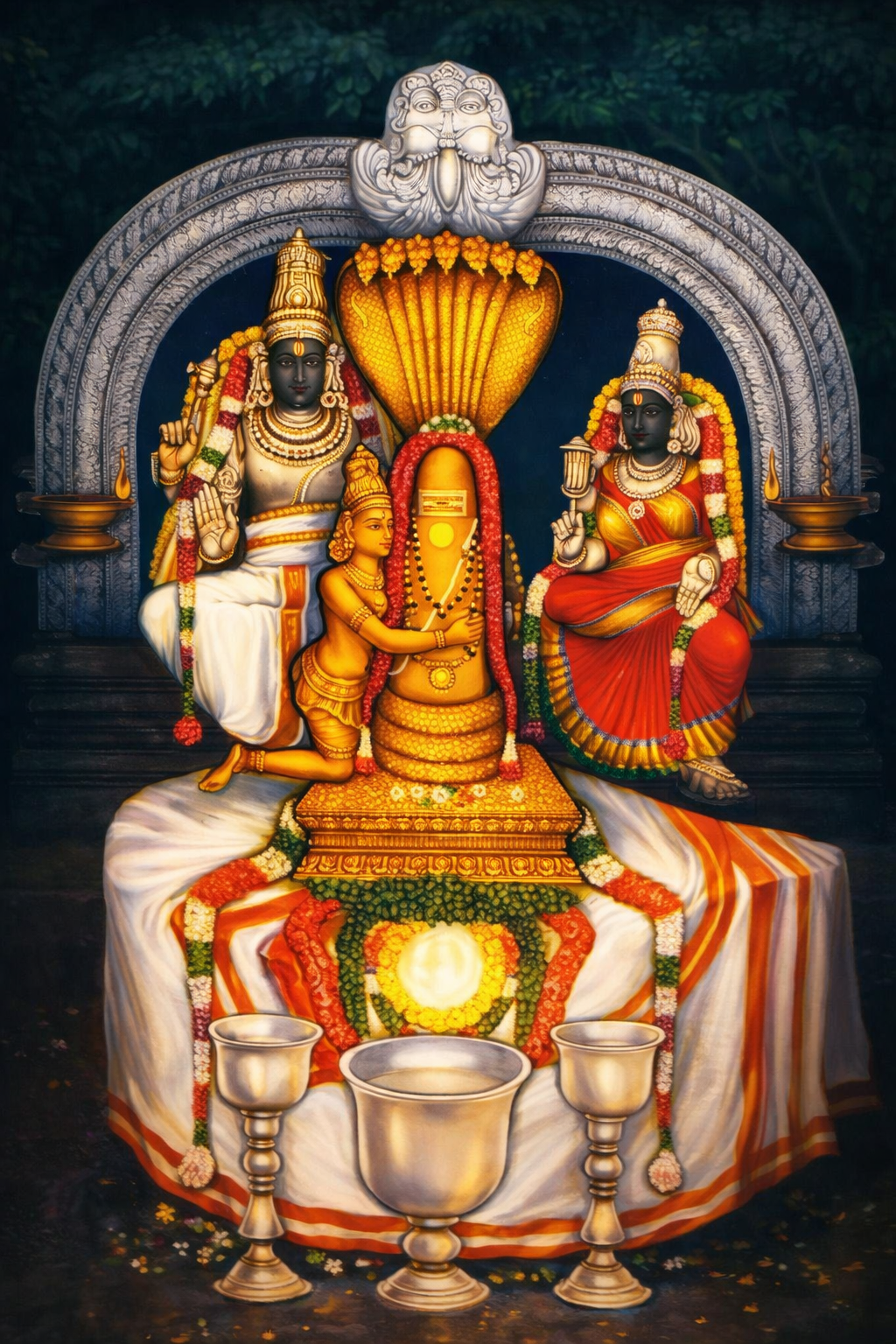
She made her way to Kanchipuram and settled on the banks of the Vegavati River, a city already ancient and already holy. There, beneath a solitary mango tree—called Ekamra, meaning “the one mango tree”—she gathered sand from the riverbank and fashioned it into a Shivalinga with her own hands.
And then she began to pray.
Her penance was not gentle. She stood on the tip of a single needle, surrounded by five sacred fires (Panchakagni) burning in the scorching heat. This extreme practice, known as Panchakagni Tapas, is considered one of the most severe forms of austerity in Hindu tradition—it represents absolute, unwavering surrender of the self.
The Tests of Fire and Flood
Fire Cannot Break Her
Shiva, ever the great teacher, was not yet ready to accept her devotion without testing it. He sent a divine fire to disrupt her meditation. The flames threatened to consume everything around her—including the precious sand Lingam she had made.
Parvati called upon her brother, Bhagawan Vishnu, for help. Vishnu took the Moon from Shiva’s head and directed its cool, silver light toward the earth, creating a protective shield that subdued the fire and sheltered the mango tree from the heat. The test had failed. Her penance continued, unbroken.

The River Rises
Shiva sent a second trial, far more terrifying than the first. He caused the River Ganga to overflow her banks and flood the sacred ground where Parvati was meditating. The waters rose rapidly, threatening to wash away the sand Lingam she had formed with such care.
Parvati appealed to Ganga, reminding her that they were sisters in spirit—both devoted to the same divine source. But the flood did not relent. As the water rose higher and higher around her, Parvati faced a simple, terrible choice: step back and save herself, or embrace the Lingam and risk everything.
She chose the Lingam.
She wrapped her arms around it and held on with all her strength—shielding it with her own body, pressing herself against the sand form as the river raged around her. She would not let go. She would not let it be swept away. Even if the waters took her, she would not release her hold.
In that moment of total surrender—body, life, and will offered to the divine—Shiva could hold back no longer.

The Sacred Embrace
Moved beyond measure, Shiva appeared before her in human form. The floods receded. The fires died. And in the stillness that followed, he accepted Parvati as his eternal consort.
In the Tamil Shaiva tradition, Shiva at this moment is called Tazhuva Kuzhainthaar—“He who melted in her embrace.” It is one of the most tender names given to the Lord anywhere in Hindu scripture: the idea that even the Supreme Being, the master of creation and destruction, was moved to surrender by the depth of a devotee’s love.
According to temple tradition, the sand Lingam still bears the physical marks of that embrace: the impressions of Parvati’s bangles and her form, pressed into the sand over countless ages of worship. To this day, the presiding deity of the inner sanctum—the Prithvi Lingam—is made of sand, and is never bathed in water or anointed with oil, lest it dissolve. Only sandalwood paste is applied, a practice observed since the very first day.
The wedding of Shiva and Parvati is said to have taken place under the ancient mango tree where her penance was performed. The tree, believed to be over 3,500 years old, still stands within the temple complex today—a living witness to the union of the human and the divine.
Sacred Details Unique to This Temple
- The Prithvi Lingam is made of sand and cannot be bathed in water
- The ancient mango tree is said to be over 3,500 years old and still bears fruit
- The marriage of Shiva and Parvati is celebrated here every year during Panguni Uthiram
- Four branches of the mango tree are said to produce fruits with four different tastes
The Architecture: A World Built in Stone
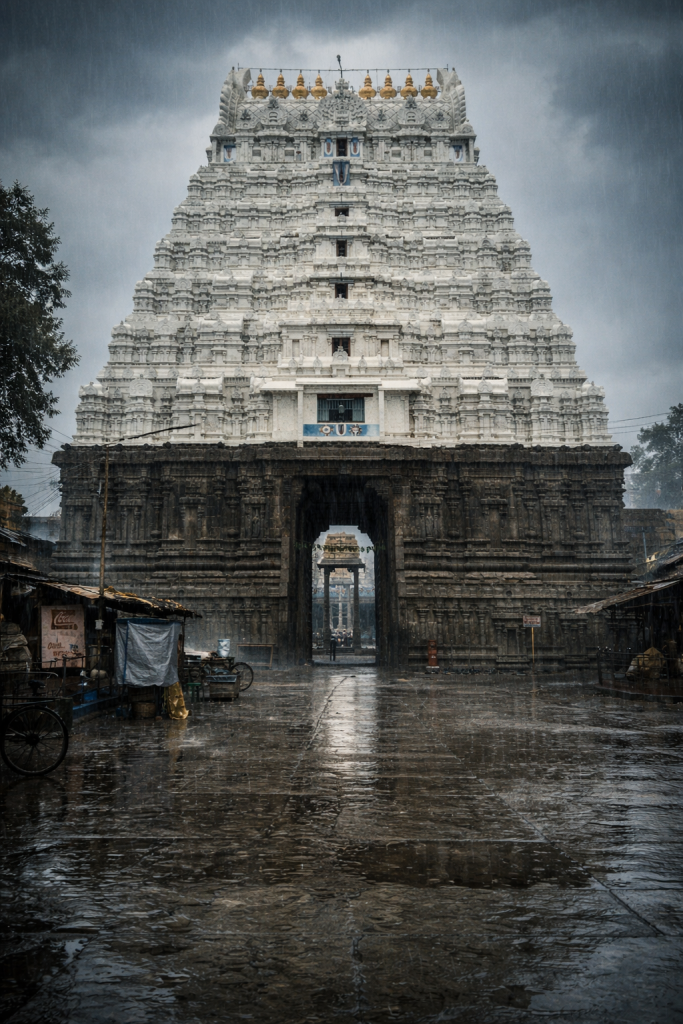
The Ekambareswarar Temple complex is one of the largest temple enclosures in South India, covering between 23 and 40 acres of land. Walking through its gateways is an experience designed to humble and awe in equal measure—and every element of its architecture was built with that intention.
The Raja Gopuram
The southern tower soars nearly 192 feet across 11 storeys, covered in intricate carvings. Its scale is deliberate: to make every visitor feel small before the infinite.
The Pillar Hall
Built during the Vijayanagara period, the thousand-pillar hall is a forest of carved granite — gods, goddesses, mythical animals and flowers on every surface.
The Sahasra Lingam
A single massive stone into which 1,008 miniature Shiva lingams have been carved — representing the infinite nature of Shiva, the One manifesting as the many.
Musical Pillars
Ten granite pillars in the inner corridor produce distinct musical notes when struck — a testament to the advanced acoustic knowledge of ancient Indian craftsmen.
The Zodiac Ceiling
One of the lesser-known but deeply significant features of the temple is the ceiling of the inner corridor, which is carved with the twelve signs of the zodiac. Devotees believe that praying to their specific zodiac sign within this sanctified space can help resolve astrological imbalances or Jataka doshas—malefic planetary influences in one’s birth chart.
This reflects the ancient Hindu understanding that the temple is not just a place of worship—it is a microcosm of the universe. Earth, sky, time, and the divine are all held within its walls.
Why This Temple Still Matters
The Ekambareswarar Temple has stood for over a thousand years, shaped by dynasties—the Pallavas, the Cholas, the Pandyas, and the Vijayanagara kings—each of whom added to its structure and deepened its sanctity. Yet at its heart, it remains the site of a single, eternal story: a goddess who loved so completely that she held on through fire and flood, and in doing so, brought the divine down to Earth.
That is, at its essence, what the Prithvi Sthalam teaches. The earth does not reach for the sky—it simply holds. It is patient, constant, and immovable. And in that stillness, the divine finds its home.
If you ever find yourself in Kanchipuram, walk under that ancient mango tree. Remember what happened here—under one tree, beside one river, in the heart of a goddess who would not let go.





Leave a Reply