
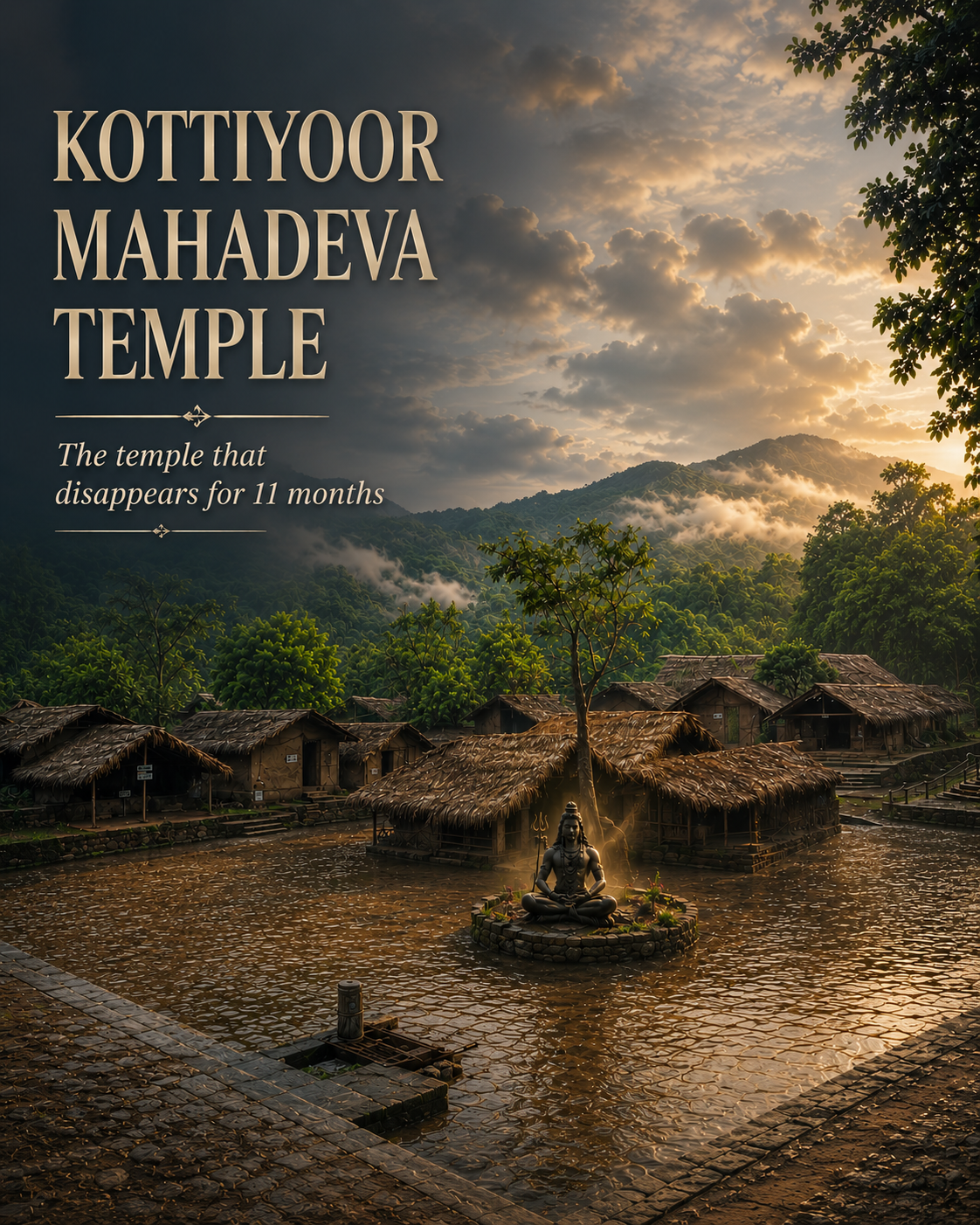
Deep within the monsoon-swept valleys of the Western Ghats lies a sacred space where modern architecture is entirely forbidden by divine decree. If you visit the Kannur district of Kerala, you will find the Kottiyoor Mahadeva Temple. To most people, a traditional temple is a permanent building made of heavy stone walls, towering gateways, and locked doors. But Kottiyoor completely shatters this definition. It operates on a rare, dual-shrine system that splits the temple across the banks of the Vavali River.
On the western bank stands Ikkare Kottiyoor. This is the permanent, structured world of human settlement. Built in the classic Kerala style, it features sloping tiled roofs designed to handle heavy rains, solid walls, and beautiful wood carvings. It serves as the local administrative center for eleven months of the year.
But cross the cold waters of the river to the eastern bank, and the rules of human civilization completely disappear.
At Akkare Kottiyoor, no permanent structures of stone, brick, or concrete are allowed. There are no walls, no roofs, and no doors. The central deity is a Swayambhu—a self-manifested Shiva Linga that sits completely exposed to the elements on a simple circular platform of river stones called the Manithara.
For most of the year, this entire bank is abandoned to the wild, creeping jungle. No human is allowed to step onto this ground. But during the annual 28-day Akkare Kottiyoor Vysakha Mahotsavam, the forest transforms into a bustling open-air hermitage. Using only organic materials like bamboo and palm leaves, priests build a temporary village of thatched huts. The moment the festival ends, everything is torn down, and nature instantly reclaims the land.
The Ground of the Daksha Yaga: A Cosmic Tragedy
Why does this land refuse to hold permanent buildings? The answer lies in the ancient texts of the Puranas, which mark this forest as the actual Daksha Yaga site in Kerala.
According to the legend, King Daksha organized a grand sacrifice here to show off his imperial supremacy over all mortals and gods. However, Daksha held a deep contempt for Lord Shiva, who had married his youngest daughter, Sati Devi. While Daksha lived in royal luxury, Shiva led a radical, simple life, wandering through cremation grounds and wearing serpents as ornaments.
Daksha deliberately refused to invite Shiva and Sati to the sacrifice. Hoping to fix the family conflict, Sati attended anyway. But upon her arrival, Daksha launched into a cruel, public insult against her husband. Devastated and unable to tolerate the humiliation of Shiva’s divine status, Sati withdrew her life force and immolated herself in the sacrificial fire.
When Shiva learned of her death, his grief turned into absolute cosmic rage. Performing his destructive Tandava dance, he tore a lock of his hair and slammed it against the ground, creating the fierce warrior deities Veerabhadra and Bhadrakali. They descended upon this very forest, destroyed the sacrifice, and decapitated King Daksha.
They also targeted Sage Bhrigu, who had mocked Shiva’s simple life by patting his own long, white beard. In retaliation, Shiva’s warriors ripped the beard completely off the sage’s face.
To save the universe from total collapse, Lord Vishnu and Lord Brahma intervened, calming Shiva down. Shiva agreed to restore Daksha’s life to complete the ritual, but because his original head was destroyed in the fire, a lamb’s head was fixed to his body to break his ego forever. The name Kottiyoor comes from Koodiyoor, meaning “the place where the gods met” to resolve the crisis.
The Tribal Discovery and the Rule of Shankaracharya
Following this destruction, the Kottiyoor temple origin story takes an interesting turn when it was rediscovered centuries later by the Kurichyas, an indigenous hill tribe.
While hunting in the thick jungle, an archer paused to sharpen his arrow on a stone sticking out of the ground. The moment the arrow hit the stone, it began to ooze blood. Terrified, the hunters ran to the local Namboothiri Brahmin family, who realized that a powerful deity was manifest there. They tried pouring water, milk, and ghee to stop the bleeding, but nothing worked until they cracked open a tender coconut and poured its water over the stone. This established the central ritual used at the temple to this day.
Later, in the 8th century, the great philosopher-saint Adi Shankaracharya visited the area and formalized the ritual structures. Sensing the raw, volatile presence of Lord Shiva on the eastern bank, Shankaracharya refused to step onto the sacred ground. He prayed from the western bank and left, establishing the ironclad rule that no human may cross the Vavali River outside of the 28-day festival window.
Blood, Fire, and the Bamboo Beard: The Rituals
Today, the Vysakha Mahotsavam is a highly intense, living re-enactment of the ancient Daksha Yaga tragedy.
The festival features unique, dramatic events. Thousands of pilgrims carry tender coconuts on their shoulders over long distances for the Ilaneerattam ceremony, pouring massive amounts of coconut water over the Shiva Linga to cool his ancient anger.
Late at night, in complete silence, a ritual performer dresses up as the Kiratha Moorthi—Shiva in the guise of a forest hunter. Backed by a tribal convoy, they rush into the temple’s royal quarters and violently overturn everything inside. This intentional act of chaos represents Shiva’s wild forest forces destroying Daksha’s proud, structured court.
But the most famous symbol of this festival is the Odapoo, a unique bamboo beard ritual artifact that every pilgrim takes home. Handcrafted by local artisans, the Odapoo is made by beating and combing native bamboo reeds until the outer layer strips away, leaving long, silky white fibers. This object is a direct physical reminder of Sage Bhrigu’s torn beard—a permanent warning against human pride and ego.
The Geopolitical Mystery: Where is the Real Yaga Site?
While the open-air rituals of Kottiyoor have been preserved for thousands of years, this Kerala forest temple without roof is not the only place in India that claims this story.
If you travel thousands of kilometers north to the foothills of the Himalayas, near Haridwar, you will find the ancient Daksheswara Mahadev Temple in Kankhal. The local traditions there firmly state that Kankhal was the capital of King Daksha and the true site of Sati’s self-immolation. Other historical sites in Assam and Himachal Pradesh make the exact same claim.
This shows the incredible, decentralized nature of Indian folklore—where a single cosmic story is mirrored across different landscapes, allowing every corner of the country to feel connected to the divine.
💬 Over to You
Which site do you believe is the original ground of Daksha’s Yaga? Do you know of any other hidden places across India that claim this legendary story? Let’s get a discussion started in the comments below!


Leave a Reply