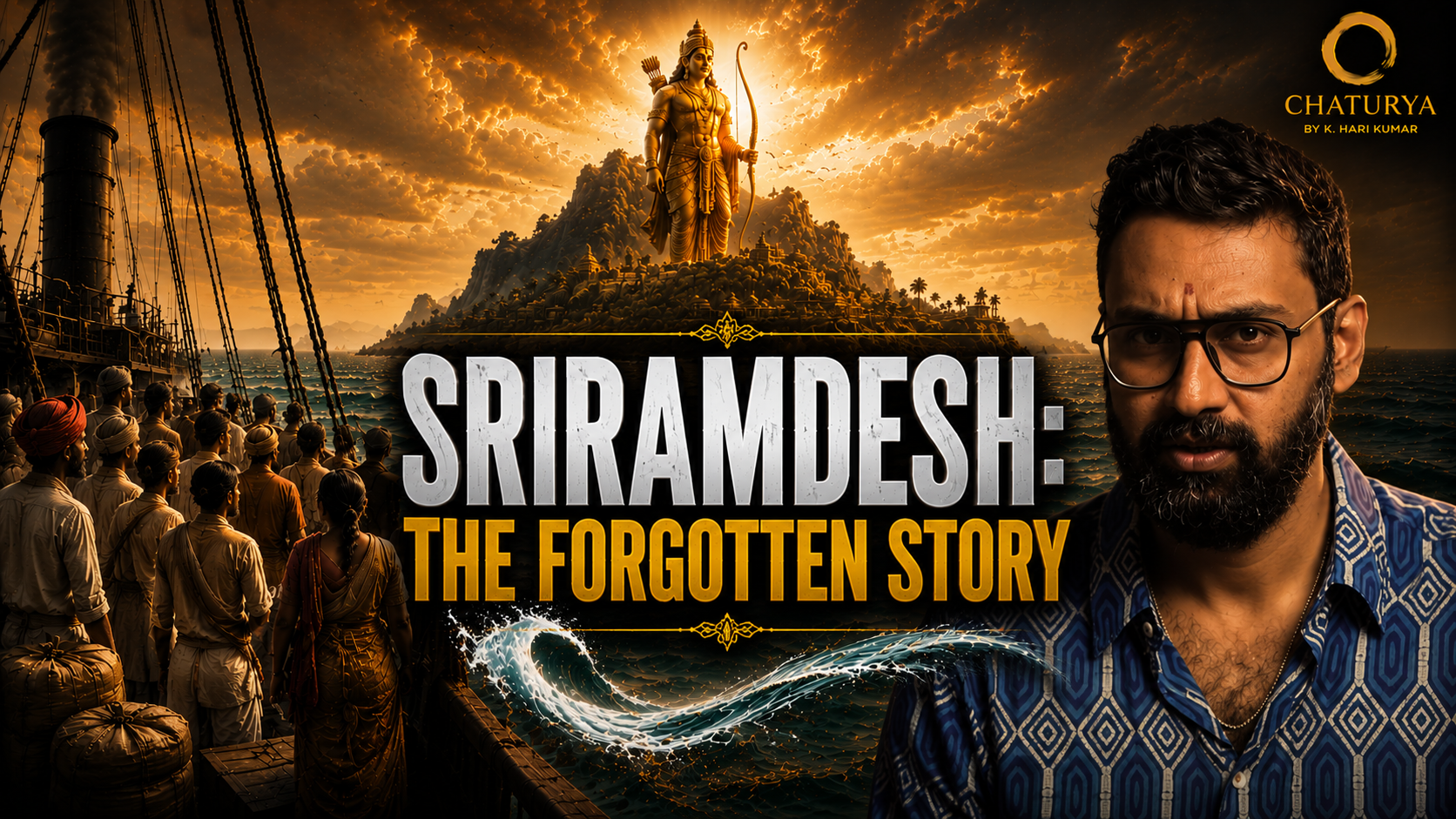
There is a word that exists nowhere on an official map, in no atlas, in no government record — and yet it lives, still, in the memory of a people scattered across South America. That word is Sriramdesh. It is not the name of a kingdom that was conquered, nor a colony that was founded by charter. It is something rarer: a spiritual and civilizational identity, carried across an ocean by people who had almost nothing else left to carry.
This is the story of the Kalkatiyas and the Kantrakis — the Indians who were taken from their homeland in the late nineteenth century, transported across the dreaded Kala Pani to the plantations of Dutch Guyana, in what is today the Republic of Suriname. It is a story that has been passed down far more often in oral tradition than in written history, which is precisely why so few in India know it, and why it deserves to be told with the seriousness of a civilizational record, not just a footnote in colonial labor history.
Who Were the Kalkatiyas and the Kantrakis?
To understand Sriramdesh, you first have to understand the system that created it. In the decades following the abolition of slavery across the British and Dutch colonial empires, plantation economies in the Caribbean and South America faced a crisis of labor. The solution the colonial administrations arrived at was indenture — a system that, in practice, bore many of the coercive hallmarks of the institution it claimed to replace.
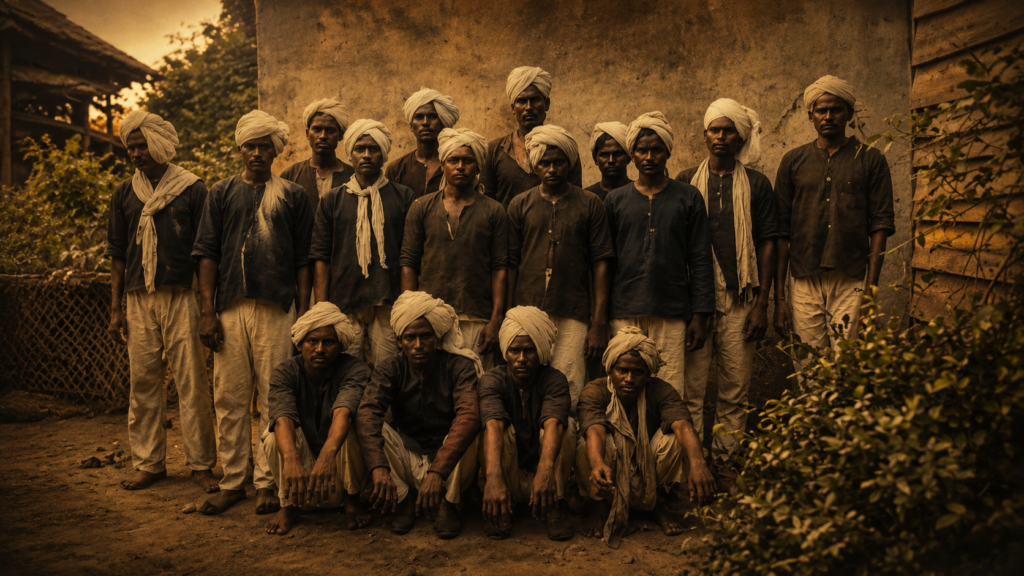
Recruiters, often working on commission, fanned out across the villages of the Bhojpuri- and Awadhi-speaking heartland of North India, in regions corresponding to today’s eastern Uttar Pradesh and western Bihar. Men and women were recruited — and in many documented cases, misled or coerced — into signing contracts (girmit, a corruption of the English word “agreement”) that bound them to years of labor on distant plantations. Because so many of these recruits were processed and shipped from the port of Calcutta, they came to be known in Suriname and the wider Caribbean as Kalkatiyas — literally, “those from Calcutta.” The contract itself gave rise to another term still used across the Hindustani diaspora today: Kantrakis, a vernacular rendering of “contract” labourers.
Between the 1870s and the early twentieth century, tens of thousands of these Kantrakis were transported to Dutch Guyana. The figure most commonly cited for the total number of Indians brought to Suriname under this system runs into the tens of thousands — a scale of displacement that, despite its enormity, remains startlingly absent from mainstream Indian historical memory.
Crossing the Kala Pani
For the Hindu recruits among them, the voyage itself was not merely a physical ordeal — it was a spiritual rupture. Crossing the Kala Pani, the “black water” of the ocean, was traditionally believed to sever a person from caste, community, and the ritual continuity of home. To cross it was, in the eyes of many left behind, to cease to exist as one had been. It is difficult to overstate what this meant for people whose entire cosmology was built around lineage, land, and ritual belonging.
And yet they crossed. Packed into the holds of ships for a journey lasting months, carrying almost nothing beyond what became known as the Jahaji bundle — the small cloth bundle of belongings that came to symbolize the entire migration — the Kalkatiyas arrived on a continent that shared no language, no climate, and no immediate cultural anchor with the one they had left behind.
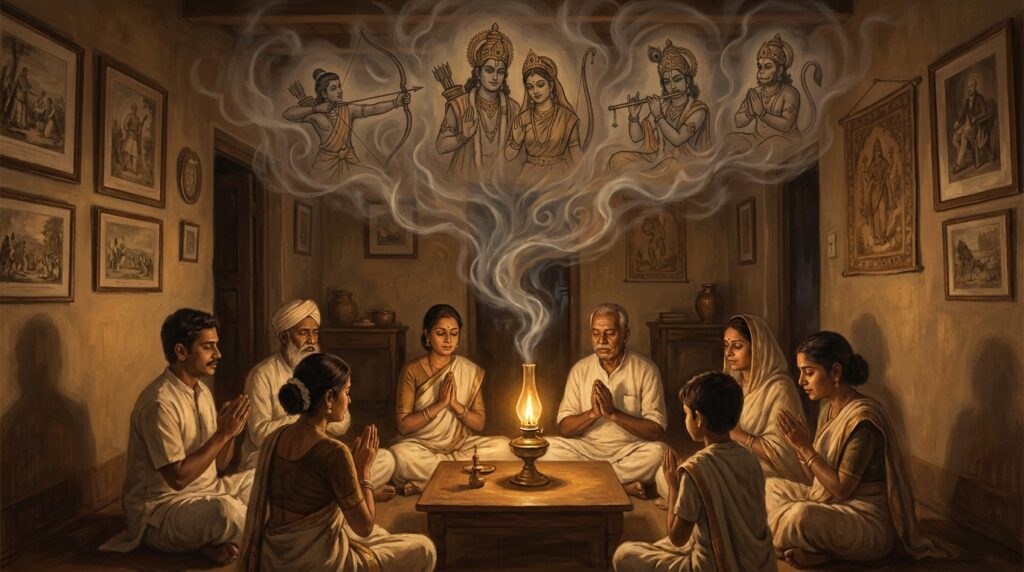
What they did carry, in memory if not always in material form, was the Ramcharitmanas — Tulsidas’s Awadhi retelling of the Ramayana. In a population where literacy was far from universal, the epic survived less as a physical book in every household and more as a living oral inheritance: recited, sung, half-remembered, and passed down through the chowtal and kathaa traditions that Hindustani communities preserved on the plantations. It became, in effect, a portable homeland — a civilizational anchor that required no soil to take root, only voice and memory.
The Frontier That Became a Homeland
Life on the Suriname plantations was defined by exploitation — grueling labor, minimal wages, and a colonial system with little regard for the humanity of those it had imported. But it was also, out of sheer necessity, a frontier: a space where the rigid social structures of the villages left behind began to loosen, where communities from different regions, castes, and even religious backgrounds were thrown together and had to reconstitute a shared identity from scratch.
Out of this frontier condition emerged something that oral tradition among the descendants of the Kalkatiyas came to call Sriramdesh — “the land of Sri Ram.” It was not a formally declared territory. It did not appear on Dutch colonial maps. It was, instead, an idea: the belief that wherever the Ramcharitmanas was recited, wherever the rituals of Sanatan Dharma continued to be observed, a piece of sacred India had been re-planted in South American soil. Temples were built. Panchayat-style community structures re-emerged. Bhojpuri and Awadhi speech patterns, folk songs, and ritual calendars persisted — not as museum pieces, but as a living, evolving culture.
A Civilization That Still Breathes
Today, the descendants of the Kalkatiyas and Kantrakis make up a significant part of Suriname’s population, generally referred to as Hindustanis. Hindu temples stand across the country. Bhojpuri folk traditions, though evolved by more than a century of distance from their origin, remain audible in songs and speech. Diwali is a public holiday. The Ramcharitmanas is still recited.
And yet, in India — the land this entire civilizational thread traces back to — the story of Sriramdesh remains almost unknown. It exists in academic corners, in the painstaking work of scholars like Prof. Chan Choenni who have documented the Hindustani migration in detail, and in the oral memory of the diaspora itself. It has not, until now, entered India’s popular historical consciousness in the way it deserves to.
This article, and the accompanying video, are an attempt to change that — to place Sriramdesh where it belongs: not as a forgotten footnote of colonial labor history, but as one of the most remarkable stories of cultural resilience and spiritual continuity in the entire Indian diaspora.
If your own family carries memories of this migration — whether from Suriname, Guyana, Trinidad, Fiji, or any of the other lands the Kantrakis were taken to — I would love to hear that history in the comments below. Oral tradition survives only when it continues to be spoken. Let this be one more place where it is.
This article accompanies the Chaturya episode on Sriramdesh. For more deep dives into India’s sacred history, regional traditions, and living folklore, explore my books, including DAIVA: Discovering the Extraordinary World of Spirit Worship.
Leave a Reply