
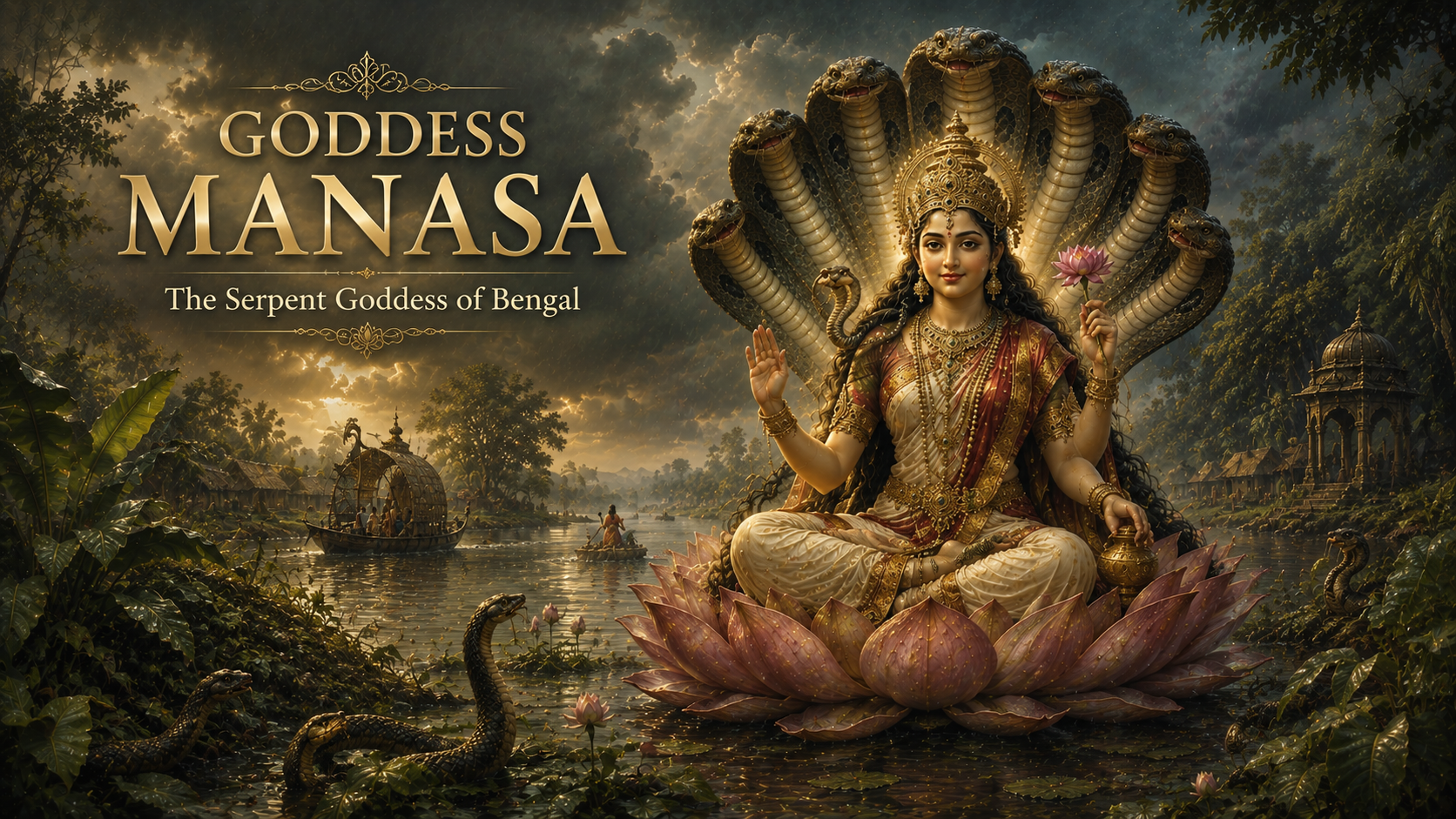
Few Hindu goddesses occupy a space quite like Goddess Manasa. She is at once beautiful and terrifying, a guardian and a destroyer, a deity associated with the fertility of the earth and the deadly venom of the serpent. Across Bengal and the wider cultural landscape of eastern India, her name has for centuries been invoked during the monsoon, when swollen rivers leave their banks and snakes emerge from flooded fields and burrows. To the farmer, she is the goddess who can protect a household from the bite of a cobra. To the devotee, she is Vishahari, the dispeller of poison. And within the great Bengali tradition of Manasamangal, she becomes something even more complex: a goddess demanding recognition from a proud merchant who refuses to accept her place within the sacred order.
Watch full video on Chaturya by K. Hari Kumar’s Youtube Channel
The result is a goddess who cannot be confined to a single origin story. She belongs simultaneously to the world of Puranic mythology, regional folklore, serpent worship and the living religious traditions of Bengal. Her story stretches from the forests and rivers of eastern India to the cosmic world of the Naagas, from humble household rituals to elaborate literary epics. And somewhere in the middle of all these traditions stands a proud merchant named Chand Sadagar, a young woman named Behula, and a goddess who simply refuses to remain forgotten.
The Many Origins of Goddess Manasa
The origins of Manasa are among the most intriguing aspects of her mythology because they reveal how different strands of Hindu sacred tradition gradually converged around a single deity.
In one Puranic account, Manasa is connected with Sage Kashyapa and the sacred knowledge required to counter the venom of serpents. The goddess emerges from manas, the mind, giving rise to the name Manasa itself. In this form, her purpose is unmistakably protective. She is the divine answer to one of the oldest fears of agrarian life: the serpent hidden beneath the grass, inside the walls of a house or beneath the flooded earth.
Yet in Bengal and other parts of eastern India, the story takes a more intimate and distinctly Shaivite direction. Regional traditions connect Manasa with Mahadeva Shiva, Vasuki and the subterranean realm inhabited by the Naagas. These traditions differ in their details, but they share an important idea: Manasa is not merely a goddess associated with snakes. She belongs to the larger sacred world of serpent beings, where the boundaries between the earthly, subterranean and divine realms are far less rigid than they appear to us today.
This is one reason the study of Manasa becomes so interesting when placed alongside the broader traditions of Naaga worship in India. Serpents are not simply animals within these traditions. They can be guardians of water, fertility, territory, treasure and hidden knowledge. They inhabit the threshold between the visible world and the unseen. In South India, these ideas survive in sacred serpent groves and ancient shrines; in Kerala, for example, the worship of serpents remains woven into the landscape of sacred groves and temples. The story of Kottiyoor Mahadeva Temple offers another glimpse into the extraordinary ways in which the worship of Shiva and the sacred landscape intersect within India’s living traditions.
Manasa therefore belongs to a much larger story.
She is the serpent goddess, but she is also part of India’s ancient attempt to understand the mysterious presence of the serpent in human life.
From the Manasa Ghat to the Goddess Beneath the Serpent Hood
Long before Manasa was represented in elaborate human form, her presence could be invoked through something much simpler.
In parts of Bengal, the goddess was worshipped through the Manasa ghat, an earthen pot associated with water, fertility and divine protection. During the monsoon, when rivers swelled and snakes became more visible around human settlements, such a vessel could become a sacred focus within the household. It was not simply an object placed before a deity. It represented a connection between the domestic world and the larger forces of nature upon which rural life depended.
This is an important detail because it reminds us that Hindu sacred traditions have not always required an elaborate image before worship can take place. Sometimes the sacred enters a home through a pot filled with water, a branch of leaves, a stone, a serpent symbol or a simple altar. The form changes, but the relationship remains.
Over time, the iconography of Goddess Manasa became increasingly elaborate. She came to be represented in human form, often seated upon a lotus and sheltered beneath a canopy of serpent hoods. In some images, her son Astika sits upon her lap, while the serpent king Vasuki and her husband Jaratkaru may appear beside her. Seven serpent hoods rising above her head became one of the most recognisable features of her iconography.
The transformation is fascinating. What began as a raw and intimate relationship between rural communities, the monsoon and the serpent gradually acquired a sophisticated theological and artistic language.
The goddess who was once invoked through an earthen vessel could now be seen enthroned beneath a royal canopy of cobras.
And yet, the underlying purpose remained remarkably consistent.
Protection.
The monsoon would arrive.
The fields would turn green.
The rivers would rise.
And with the water would come the snakes.
Manasa stood at that dangerous intersection between fertility and fear.
The Goddess and the Merchant
But the story that truly transformed Manasa into one of Bengal’s most enduring cultural figures is found in the Manasamangal Kavya.
The Mangalkavya tradition developed in medieval Bengal, and Manasamangal is generally regarded as its oldest major example. At its heart is a simple but extraordinary conflict: a goddess wants to be worshipped, and a human being refuses to worship her.
That human being is Chand Sadagar.
Chand is wealthy, powerful and deeply devoted to Mahadeva Shiva. His ships travel across the seas, his household is prosperous, and his social position gives him little reason to bow before anyone he does not consider worthy of worship. To Manasa, however, his refusal is not a harmless matter of personal preference. She wants her worship established upon earth, and she knows that the submission of a man as influential as Chand would give her cult an authority it currently lacks.
Chand will not yield.
The conflict therefore becomes much larger than a quarrel between a merchant and a goddess. It becomes a confrontation between two forms of sacred authority. Chand stands firmly within a devotional world centred upon Shiva. Manasa represents a regional deity whose worship is demanding recognition and legitimacy. The Manasamangal story transforms this theological tension into a deeply human drama, one in which pride becomes the weapon wielded by both sides.
Manasa begins to destroy the things Chand values most.
His ships are lost at sea. His wealth disappears. His sons die.
And still Chand refuses to bow.
This is one of the most remarkable aspects of the story. Manasa is a goddess capable of overwhelming an immensely wealthy and powerful man, yet she cannot simply compel him to offer genuine devotion. She can destroy his ships. She can take his sons. She can reduce his worldly fortune to nothing.
But she cannot command the human heart to recognise her.
And so the conflict continues.
Behula and Lakhindar
Eventually, only one son remains.
His name is Lakhindar, or Lakshmindar in some versions.
Chand Sadagar knows that Manasa’s anger has not been exhausted, and when Lakhindar is to be married to the virtuous Behula, the family takes extraordinary precautions. Chand orders an iron bridal chamber to be constructed, a fortress designed to prevent even the smallest serpent from reaching the newly married couple.
It is an image that has become inseparable from the Behula and Lakhindar story.
The chamber is sealed.
The walls are made of iron.
Every possible entrance is guarded.
Yet mythology has little interest in walls that human beings believe to be absolute.
A tiny opening is left in the structure, and through it a serpent enters. On the wedding night, Manasa’s power reaches Lakhindar, and the young bride wakes to find her husband dead from a snakebite.
For Behula, however, death is not the end.
She refuses to accept that her husband’s life should simply disappear because a goddess has demanded recognition from his father. Instead of allowing Lakhindar’s body to be cremated, she places him upon a raft made from banana stems and begins a journey down the river towards the realm of the gods.
What follows is one of the most haunting journeys in Bengali sacred literature.
Behula travels with the dead body of her husband while the river carries her further and further away from the familiar world. She encounters danger, temptation and suffering, yet refuses to surrender. Her determination becomes so extraordinary that she eventually reaches the celestial realm and presents her plea before the gods.
The power of the Behula story lies precisely here.
She is not a goddess.
She does not possess Manasa’s supernatural powers.
She has no army, no divine weapon and no cosmic authority.
She has only love, courage and an almost impossible refusal to accept the fate that has been imposed upon her.
And somehow, that proves to be enough.
The gods are moved by her devotion. Manasa agrees to restore Lakhindar and the other sons of Chand, along with the merchant’s lost prosperity, but there is one condition.
Chand Sadagar must finally worship her.
Chand Sadagar Finally Bows
The ending of the Chand Sadagar and Manasa story is not a simple victory for one side.
Chand has lost almost everything.
Manasa has demonstrated her power.
Behula has demonstrated the power of human devotion.
And the final act becomes a compromise of extraordinary symbolic force.
Chand finally offers worship to Manasa, but the gesture is deliberately reluctant. In the popular Bengali tradition, he offers the flower with his left hand while continuing to face Mahadeva Shiva.
It is a small gesture, but it carries the weight of the entire story.
Chand does not abandon Shiva.
Manasa does not disappear.
Instead, the two traditions are brought into a complicated coexistence.
The regional goddess has gained recognition, while the merchant’s devotion to Shiva remains intact.
This is one reason the Manasamangal tradition is so much more interesting than a simple story about a snake goddess. Beneath the supernatural events lies a profound cultural conversation about who gets to occupy sacred space, how regional deities become part of wider Hindu traditions, and how devotion changes when two different forms of religious identity encounter one another.
The story is not really asking us to choose between Shiva and Manasa.
It is showing us how a living religious tradition can grow by accommodating both.
Is Manasa Mentioned in the Mahabharata?
This is where the story becomes particularly fascinating—and where popular retellings often blur traditions that deserve to be distinguished.
The Mahabharata, particularly the Adi Parva’s Astika Parva, contains the story of the sage Jaratkaru, Vasuki’s sister Jaratkaru, and their son Astika. The serpents are facing destruction because of the future snake sacrifice of King Janamejaya, and Astika is destined to intervene and save them. The Mahabharata explicitly identifies Vasuki’s sister as Jaratkaru, the same name as the ascetic whom she marries.
What it does not do is explicitly identify this woman as the goddess Manasa.
That distinction matters.
Later Puranic traditions, including versions found in the Brahmavaivarta Purana and Devi Bhagavata, develop the Manasa tradition further and connect Manasa with Jaratkaru and Astika. In these later accounts, Manasa becomes the mother of Astika and therefore an important figure in the salvation of the Naaga race. Banglapedia notes this distinction explicitly: the Mahabharata tells of Jaratkaru, sister of Vasuki, while later Puranic accounts modify and develop the story around Manasa.
So, is Manasa mentioned in the Mahabharata?
The goddess Manasa, as such, is not named in the Mahabharata’s Astika Parva. The Mahabharata does, however, preserve the story of Vasuki’s sister Jaratkaru, her marriage to the sage Jaratkaru, and the birth of Astika—the very narrative that later becomes connected with Manasa in Puranic and regional traditions.
This distinction is important because Hindu mythology is not a single, frozen body of stories. Traditions evolve. Regional deities enter wider theological frameworks. Earlier narratives are reinterpreted by later texts. A goddess who appears in one cultural landscape may acquire new genealogies and identities as her worship spreads.
Manasa is a particularly beautiful example of this process.
Manasa, Astika and the Salvation of the Naagas
The story of Astika and Manasa takes us away from the rivers of Bengal and into one of the great serpent narratives of the Mahabharata.
The serpent race faces annihilation because of a curse associated with Kadru, the mother of the Naagas. King Janamejaya later undertakes the Sarpa Satra, or snake sacrifice, intending to destroy the serpents in the sacrificial fire.
But the destruction of the Naagas is not allowed to reach its conclusion.
Astika arrives.
Through his wisdom, restraint and sacred authority, he persuades Janamejaya to stop the sacrifice and thereby saves the serpent race.
In the later Manasa tradition, this makes the goddess far more than a protector against snakebite. Through her son Astika, she becomes associated with the preservation of the Naagas themselves.
This is one of the reasons I explored these interconnected traditions in my book Naaga. The serpent in Indian sacred culture is never merely an animal. Across different regions and texts, the Naagas appear as guardians, ancestors, divine beings, inhabitants of subterranean realms and custodians of hidden treasures and sacred waters.
If you would like to explore these traditions in greater depth, Naaga brings together the mythology, folklore, serpent worship and sacred traditions surrounding India’s Naagas.
Read more about the book:
Buy Naaga on Amazon India · Amazon Global · Flipkart
Vishahari: The Goddess of the Monsoon
There is another side to Goddess Manasa that can easily disappear beneath the story of Manasamangalkavya.
She is Vishahari—the dispeller of poison.
Her worship is closely associated with the monsoon, particularly in Bengal and other parts of eastern India. This is not difficult to understand when we consider the realities of agrarian life. Heavy rains transform the landscape. Rivers swell, fields flood, vegetation becomes dense, and snakes are driven from their usual hiding places.
The same rain that promises a successful harvest can therefore bring danger.
Manasa occupies that contradiction.
She is the goddess of protection in a season when nature is both generous and dangerous.
Devotees traditionally seek her protection from snakebite, while also praying for prosperity, fertility, the welfare of children and the wellbeing of the household. Her worship has historically been observed during the rainy months, including Ashadha and Shravan.
This is one of the reasons Manasa should not be understood simply as a “snake goddess” in the modern, simplified sense of the phrase. Her mythology is inseparable from the agricultural landscape in which her worship developed. She belongs to the monsoon, the river, the field and the household.
She represents the precarious balance between human life and the natural world.
And perhaps that is why her worship has survived so powerfully.
The Jhapan Festival
That living relationship between Manasa and the monsoon can still be witnessed in Bengal.
One of the most striking traditions associated with her is the Jhapan festival, particularly associated with Bishnupur in West Bengal. The festival brings together ritual, community and serpent symbolism, with snake-handlers displaying live serpents as part of the traditional observance.
Here again, the mythology becomes tangible.
The serpent that appears in a Manasa image is no longer simply an artistic symbol. It is connected to the living landscape around the worshipper—the creature that may appear in a flooded field, beneath a roof or near a village path during the rains.
The goddess is therefore invoked not in opposition to nature, but in recognition of nature’s power.
This is one of the things that makes regional Hindu traditions so compelling. A festival can preserve an ancient relationship between human beings, landscape, animals and the sacred without needing to explain the philosophy in abstract terms.
The ritual itself becomes the explanation.
A Goddess Who Would Not Be Forgotten
Perhaps the most fascinating thing about Manasa is that her story is, in many ways, a story about recognition.
She begins at the margins.
A regional deity.
A serpent goddess.
A presence invoked in the monsoon.
A goddess represented through an earthen pot.
And then, over generations, she enters increasingly elaborate literary, Puranic and artistic traditions.
The Manasamangal Kavya gives her a dramatic human story. Chand Sadagar gives her an opponent. Behula gives her a devotee whose courage challenges even divine power. Astika connects her, in later traditions, with the salvation of the Naagas. Her images give her a royal form, crowned by serpents and associated with her son.
The goddess who demanded a place in the sacred order eventually became impossible to ignore.
And perhaps that is why Manasa remains such a compelling figure in the religious landscape of Bengal and eastern India.
She is not a remote goddess preserved only in old manuscripts.
She lives wherever the monsoon arrives and a family remembers to invoke her name.
She lives in the village shrine, in the Manasa ghat, in the serpent hood carved above her image, in the songs of the Manasamangal poets, and in the story of a young woman who refused to allow death to have the final word.
She lives in the uneasy space between fear and faith.
Between the serpent and the farmer.
Between the goddess and the devotee.
Between the established sacred order and the deity demanding to be recognised.
And perhaps this is the deeper reason the story of Goddess Manasa has endured.
She reminds us that the sacred is not always found where we expect it.
Sometimes it emerges from the river.
Sometimes from the earth.
Sometimes from the mind of a sage.
And sometimes, like the serpent itself, it waits quietly beneath the surface until the rains arrive.
Frequently Asked Questions
Who is Goddess Manasa?
Goddess Manasa is a Hindu serpent goddess particularly revered in Bengal and other parts of eastern India. She is associated with protection from snakebite, fertility, prosperity, children and the monsoon. She is also known as Vishahari or Bishahari, the dispeller of poison.
What is the story of Goddess Manasa?
The story of Manasa varies across Puranic and regional traditions. In Puranic accounts, she is connected with Sage Kashyapa and the power to counter snake venom. In Bengali tradition, the Manasamangal tells of her conflict with the merchant Chand Sadagar, who refuses to worship her. The story eventually centres on Behula’s extraordinary journey to restore her husband Lakhindar to life.
What is Manasamangal?
Manasamangal, or Manasamangal Kavya, is a major medieval Bengali literary tradition centred on the establishment of Goddess Manasa’s worship. Its most famous narrative involves Manasa, Chand Sadagar, Lakhindar and Behula.
Who was Chand Sadagar?
Chand Sadagar was the wealthy merchant and devotee of Shiva who becomes Manasa’s principal opponent in the Manasamangal tradition. He refuses to acknowledge Manasa as a goddess worthy of worship, leading to the destruction of his ships and the deaths of his sons before he eventually agrees to honour her.
Who was Behula?
Behula is the heroine of the Manasamangal tradition and the wife of Lakhindar. After Manasa causes Lakhindar’s death through a snakebite, Behula carries his body on a banana raft and journeys towards the realm of the gods, where her devotion ultimately leads to his restoration.
What is the story of Behula and Lakhindar?
Behula marries Lakhindar, the youngest son of Chand Sadagar. Despite an iron chamber designed to protect him from Manasa’s serpent, Lakhindar is bitten and dies on his wedding night. Behula refuses to accept his death and begins a dangerous river journey with his body, eventually reaching the gods and securing the restoration of Lakhindar and the other sons of Chand.
Why did Chand Sadagar refuse to worship Manasa?
Chand Sadagar was a devoted worshipper of Mahadeva Shiva and refused to recognise Manasa as a deity worthy of his worship. In the Manasamangal narrative, Manasa’s determination to establish her worship and Chand’s refusal create the central conflict of the story.
Why is Manasa called Vishahari?
Manasa is called Vishahari, or Bishahari, because she is associated with the removal or protection against the effects of snake venom. Her worship is particularly connected with the rainy season, when increased snake activity creates a greater danger for agrarian communities.
Is Manasa mentioned in the Mahabharata?
The Mahabharata’s Astika Parva contains the story of Jaratkaru, the sister of Vasuki, her marriage to the sage Jaratkaru and the birth of Astika, who later saves the Naagas from Janamejaya’s snake sacrifice. The Mahabharata does not explicitly identify Vasuki’s sister as the goddess Manasa. Later Puranic and regional traditions connect this figure with Manasa.
Is Manasa the same as Jaratkaru?
The answer depends on the textual tradition. In the Mahabharata, Vasuki’s sister is explicitly named Jaratkaru and becomes the mother of Astika. Later Puranic traditions identify Manasa with Jaratkaru or incorporate this genealogy into the mythology of Manasa. It is therefore more accurate to say that later Manasa traditions are closely connected with the Mahabharata’s Jaratkaru tradition rather than claiming that the Mahabharata itself names her as Manasa.
Who is Astika?
Astika is the sage who saves the Naagas from King Janamejaya’s Sarpa Satra, or snake sacrifice. In the Mahabharata, he is the son of the sage Jaratkaru and Vasuki’s sister Jaratkaru. Later Manasa traditions identify Manasa with this mother.
What is Sarpa Satra?
Sarpa Satra, also called the serpent sacrifice, is the great sacrifice performed by King Janamejaya to destroy the Naagas. Astika intervenes and persuades the king to stop the sacrifice, thereby saving the serpent race. This story is narrated in the Astika Parva of the Mahabharata.
When is Manasa Puja celebrated?
Manasa worship is particularly associated with the rainy season in Bengal and eastern India. Traditional worship occurs during months including Ashadha and Shravan, when devotees seek protection from snakebite as well as blessings for prosperity, children and household welfare.
What is the Jhapan festival?
The Jhapan festival is a traditional celebration associated with Goddess Manasa in Bengal, particularly known in Bishnupur. It incorporates serpent symbolism, ritual observance and traditional snake-handling practices and reflects the close relationship between Manasa worship and the monsoon landscape.
Where is Goddess Manasa worshipped?
Goddess Manasa is particularly associated with Bengal and is also worshipped in other parts of eastern and northeastern India, including Assam, Bihar and Jharkhand. Her worship has historically been especially connected with agrarian communities and the rainy season.
Why is Manasa important in Hindu mythology?
Manasa is important because her traditions connect several dimensions of Hindu sacred culture: serpent worship, fertility, monsoon rituals, regional goddess traditions, Puranic mythology and the preservation of the Naagas. Her story also provides an extraordinary example of how a regional deity became deeply embedded within the wider religious and literary traditions of eastern India.





Leave a Reply