
There are temples you visit. And then there are temples that visit you — that stay somewhere inside you long after you have left. Kalighat is the second kind. In this article, we will explore the Kalighat Temple history and legend. Standing in the heart of South Kolkata, on the banks of the Adi Ganga — the ancient channel of the Hooghly river — the Kalighat Kali Temple is not a quiet, meditative space. It is loud. It is intense. It is alive in a way that is difficult to explain unless you have stood inside it. The air hums. The incense is thick. The devotees are endless. And somewhere in the middle of all that human longing, the goddess sits — dark, fierce, gold-tongued — and watches everything.
She has been watching for a very long time.
View this post on Instagram
A City Born from a Goddess
Before we talk about the temple, we need to talk about the city it may have named.
Kalighat was originally called Kali-Kshetra — the realm of Kali — which is widely accepted as the origin for the word Kalikata, and in turn, Calcutta or Kolkata. Think about that for a moment. One of the greatest cities in Asia — a city of poets, revolutionaries, Nobel laureates, and trams — may have taken its very name from this goddess and this temple.
The temple has references in 15th century texts. The original structure was a small hut. Long before Kolkata became a colonial capital, before the East India Company arrived, before the grand buildings went up — there was this hut on a riverbank, and inside it, a goddess.
The Story That Broke the Cosmos
To understand why Kalighat is sacred, you have to go back to one of the most heartbreaking stories in all of Hindu mythology. The story of Sati and Shiva.
Sati was the daughter of Daksha, a powerful king, and the devoted wife of Lord Shiva. But Daksha despised his son-in-law. He considered Shiva — the ash-smeared, matted-hair wanderer — unworthy of his daughter. When Daksha organised a grand yajna, a sacred fire ritual, he invited everyone in the heavens and on earth. Everyone except Shiva.
Sati, heartbroken and humiliated on her husband’s behalf, went to her father’s ceremony anyway. There, she was subjected to insults about Shiva that she could not bear. In protest — and in grief — she walked into the sacred fire and gave up her life.
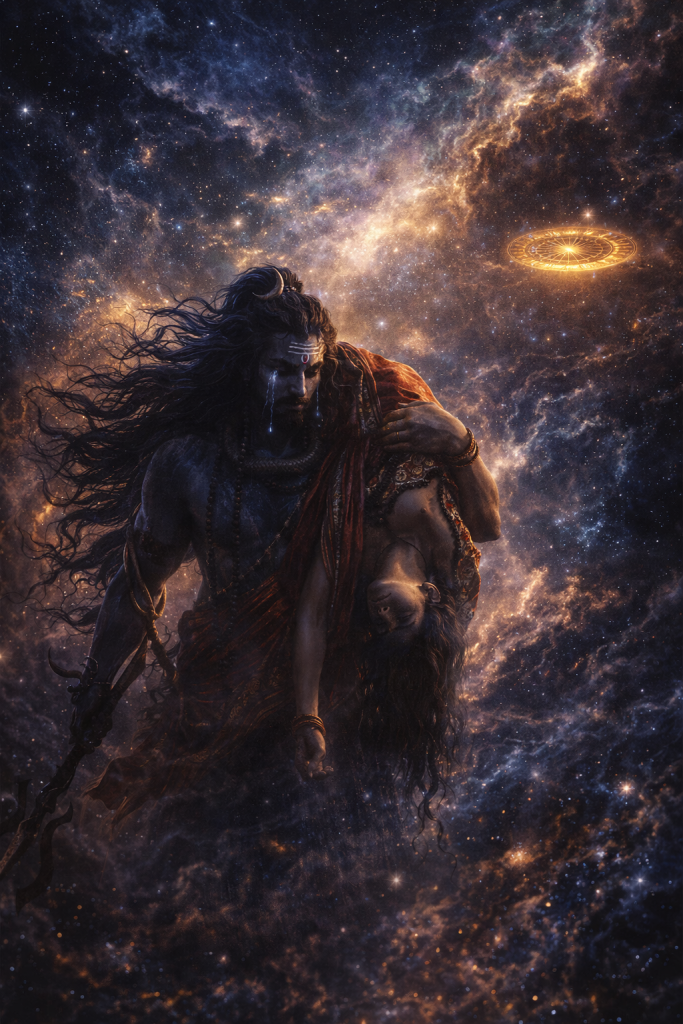
When Shiva learned what had happened, something in the universe cracked. In grief and rage, Shiva lifted Sati’s body and performed the Tandava — the cosmic dance of destruction — that threatened the balance of the universe itself. The gods watched in horror. If Shiva did not stop, everything would end.
Lord Vishnu intervened. Using his Sudarshan Chakra, he splintered Sati’s body into many parts to calm Shiva’s rage during his cosmic dance. Each piece fell on a different location across the Indian subcontinent, creating a Shakti Peetha. Wherever a part of Sati’s body touched the earth, that earth became sacred. That earth became a seat of the divine feminine.
There are 51 such Shakti Peethas.
At Kalighat, the toes of the right foot of Goddess Sati fell.
The Brahmin Who Found a Toe in the River
Mythology explains why the site is sacred. But how did people discover it?
The story goes that a devotee named Atmaram Brahmachari was once sailing on the Hooghly river when he saw a bright light emanating from the bank. He followed the light and found a stone image — shaped like a human toe. A divine realisation came over him and he recognised it as the sacred relic of Sati’s right toe. He installed the stone in a small hut and began worshipping it.
Later, around 1570, Padmabati Devi — the mother of Laksmikanta Roy Choudhury of the Sabarna Roy Choudhury family — had a divine vision and rediscovered the right toe of Sati in a lake called Kalikunda in Kalighat. This confirmed Kalighat’s status as one of the 51 Shakti Peethas.
The saint Chouranga Giri — after whom the Chowringhee area of Kolkata is named — is credited with discovering an impression of Kali’s face and building the original Kali temple there. A saint who found a goddess left his name on an entire neighbourhood of the city. That is how deep this connection runs.
The present temple was built by the Sabarna Roy Choudhury family of Barisha in 1809. In 2024, the 200-year-old temple received its first major modern era renovation, undertaken at a budget of ₹200 crore, with ₹165 crore from the Kolkata Municipal Corporation and ₹35 crore contributed by Mukesh Ambani from the Reliance Foundation. Even today, the temple moves between the ancient and the contemporary without losing its soul.
The Goddess Who Stands Before You
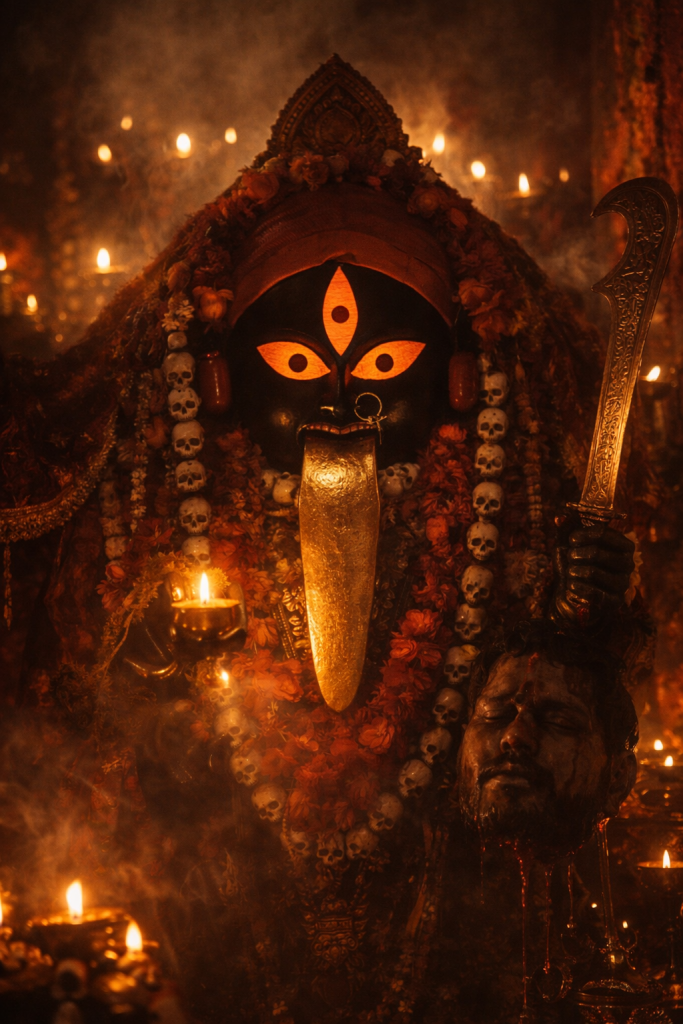
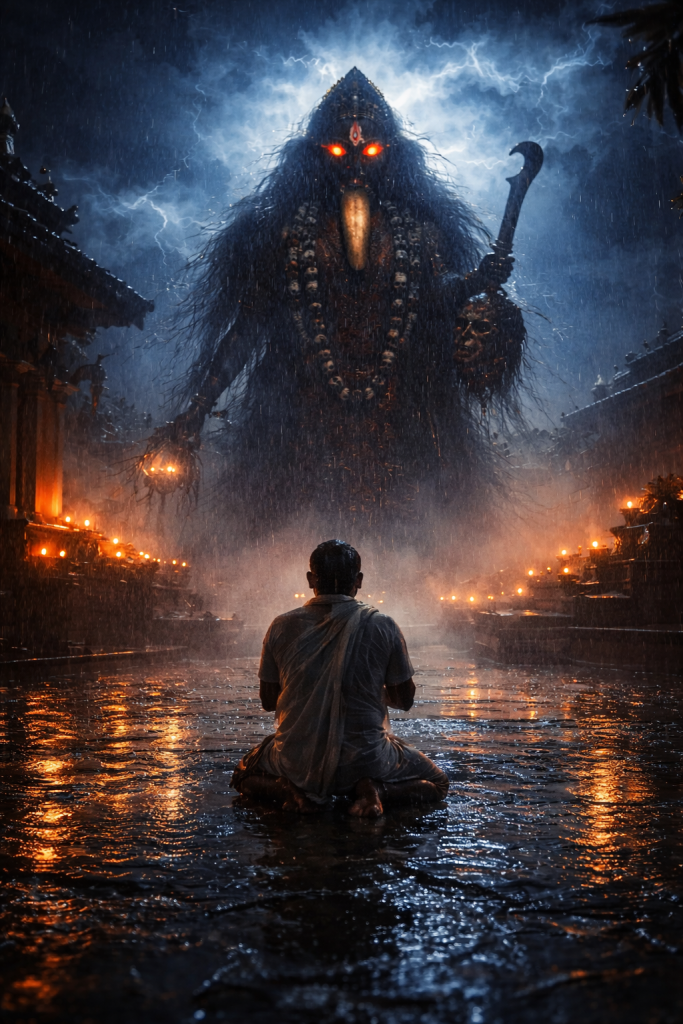
The idol of Kalighat Kali Maa is unique — made of black stone with a protruding gold tongue and silver lotus eyes. Shakti is known as Dakshina Kali — the benevolent mother — here, and the Bhairava as Nakuleshwar Mahadev.
The scimitar and severed head clutched in Kali’s hands represent the conquest of divine knowledge over the human ego — an allegory for spiritual enlightenment and liberation.
This is what most people miss about Kali. They see the skulls, the sword, the fierce eyes — and they see destruction. But Kali destroys only what needs to be destroyed. The ego. The illusion. The attachment to things that were never really ours. Devotees believe she offers protection from evil, liberation from ego, and maternal compassion. Beneath the ferocity is a mother. And that is what millions of people come here to find.
The Temple That Inspired an Entire Art Form
Kalighat gave something extraordinary to the world beyond religion — it gave India a whole school of painting.
Kalighat painting, or pata, is a style of Indian painting that derives its name from this very place. It is characterised by generously curving figures — bold, vivid, immediately recognisable. For centuries, artists set up along the temple’s approach to sell paintings to pilgrims. The tradition evolved into a folk art form that now hangs in museums across the world. The goddess created not just devotion, but creativity.
It is fitting. Kali has always been a goddess of raw creative power.
What It Feels Like to Stand There
I have written about many temples. But there are some that I approach with a particular kind of quiet — not because they are peaceful, but because they carry a weight that makes you instinctively lower your voice.
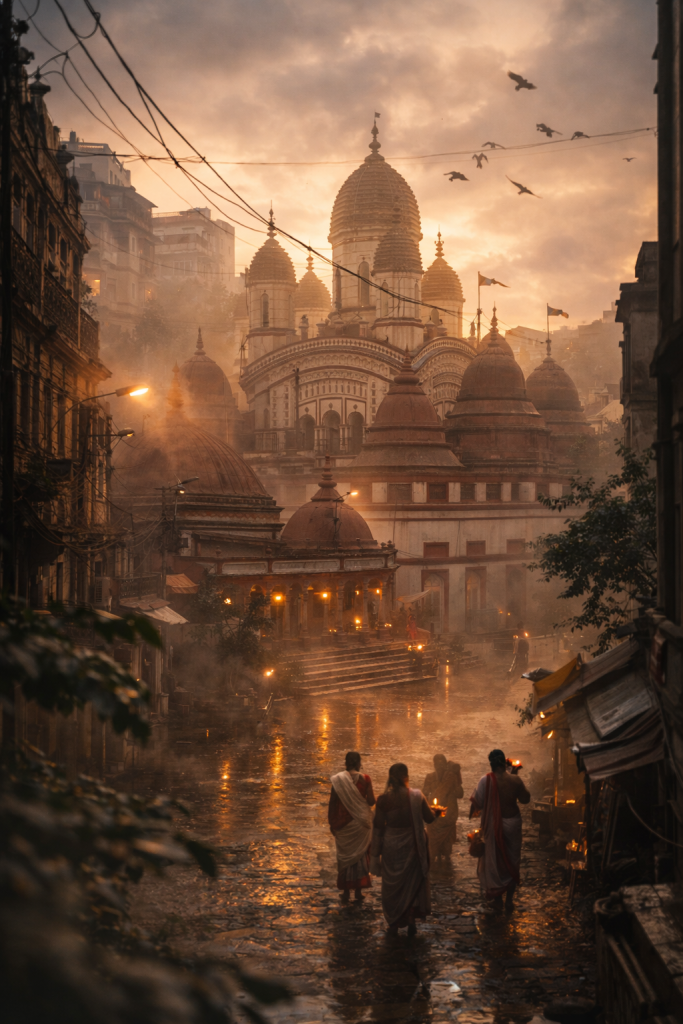
Kalighat is one of those places. You hear it before you see it. The chanting, the bells, the vendors, the crowd. And then you step inside and the noise somehow becomes stillness, because you are standing in a place where grief became grace. Where a husband’s love for his wife — the most human of all emotions — was transformed, through cosmic pain, into the sacred geography of an entire civilisation.
Sati is everywhere here. In the stone beneath your feet. In the river that still flows, even if it has moved away from the temple’s walls. In the goddess who wears her memory like a crown.
The deity at Kalighat is not invoked — she is inherently present.
The Shakta philosophy makes this distinction carefully. You are not calling her here. She is already here. You are simply arriving.
These are the stories I live to tell — the ancient legends behind the temples we visit, the myths encoded in the stones beneath our feet. If this moved you, there is so much more waiting.
📖 Explore K. Hari Kumar’s books on Indian mythology and sacred traditions — available on Amazon and at leading bookstores near you.
📱 Follow @theharikumar on Instagram for daily stories from India’s temples, epics, folk deities, and forgotten legends.
Jai Maa Kali.
Sources & References:
- Wikipedia — Kalighat Temple
- Wikipedia — Kalighat
- Discovering Kolkata — Kalighat Temple History
- Incredible India — Kalighat Temple
- Durlabh Darshan — Kalighat Shaktipeeth
- Sanatan Vasudev Kutumb — Kalighat Kali Temple Guide