
By K. Hari Kumar | Indian Mythology, Folk Deities & Sacred Heritage
View this post on Instagram
My mother has told me this story more times than I can count. In the early 1990s, during Navratri, my parents made a journey to the Mookambika Devi temple in Kollur, Karnataka. The crowds were enormous — a vast, moving ocean of devotees, thousands deep, all pressing forward with the same quiet determination. And somewhere in the middle of all that, they carried me — an infant — through the throngs, all the way to the feet of the goddess, for my Vidyarambham ceremony.
Vidyarambham is the sacred ritual where a child is initiated into the world of learning. A finger is guided to write the first letters. A prayer is offered. And at Kollur, it is believed that Mookambika Devi herself blesses the child’s mind and tongue. Even today, thousands of students, writers, artists, and people from all walks of creative life make this pilgrimage — not just for darshanam, but for that specific blessing of knowledge and creative expression.
I didn’t understand any of this as an infant, of course. But perhaps the goddess did.
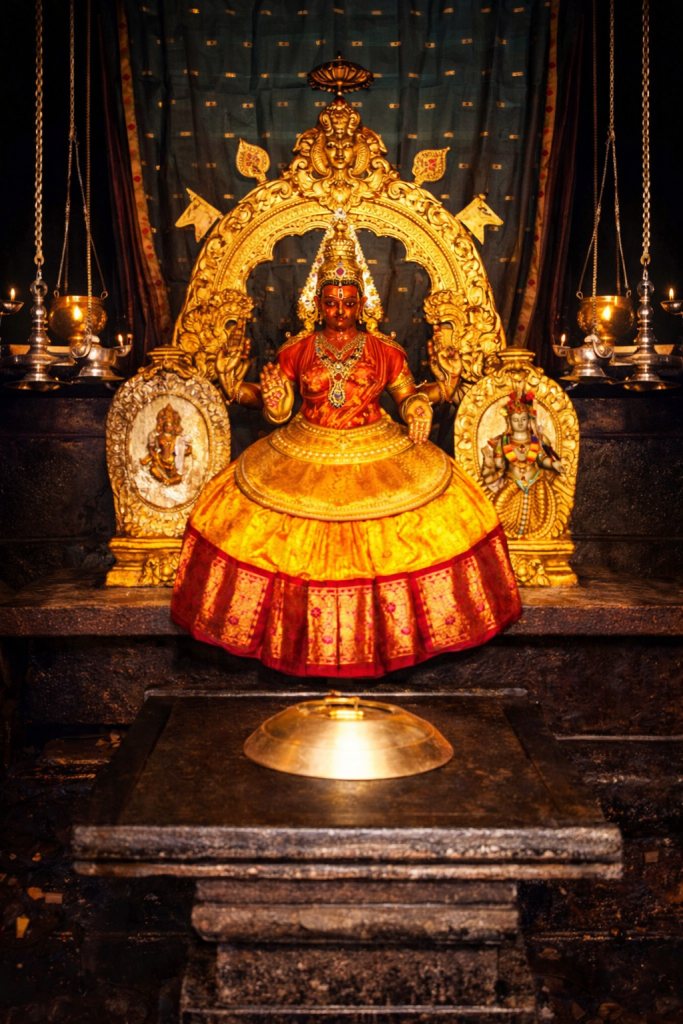
Where is Kollur, and Why Does It Matter?
The Mookambika temple is located in Kollur village in coastal Karnataka, nestled in the folds of the Western Ghats, on the banks of the Souparnika River. Surrounded by dense forest and rolling hills, the landscape itself feels like it was designed for devotion.
The name “Kollur” has ancient roots — it is said that the sage Kola Maharshi once meditated here. He was enchanted to witness a cow spontaneously pouring milk from her udder onto a Linga rising from the earth. He began to worship it, and the place came to be called Kolapura, which over time became Kollur. The cow’s hoof mark is said to be visible on the Lingam even today.
The Legend of Mookasura: How a Demon Gave the Goddess Her Name
Every great temple carries a story of battle — a moment when the divine intervened to restore order. The story of Mookambika begins with a demon.
An asura named Kaumasura undertook severe penance to appease Lord Shiva and become invincible. He had already received a boon that only a woman could kill him. Alarmed by the death of Mahishasura, he sought to strengthen himself further through penance. But the goddess Saraswati — at the request of the devas — intervened. She silenced his speech at the crucial moment, making him incapable of asking Shiva for a boon. This rendered Kaumasura mute, and so he came to be known as Mookasura — “mooka” meaning dumb in Sanskrit.
Enraged, Mookasura defeated Indra, seized his kingdom, and unleashed chaos across the three worlds. To restore cosmic balance, the Trimurti — Brahma, Vishnu, and Shiva — called upon their wives, the Tridevi — Saraswati, Lakshmi, and Parvati — to combine their energies into a single, supreme force. This combined goddess rode a lion and slew Mookasura, and from that moment she was called Mookambika — the goddess who silenced and destroyed the mute demon.
It is a name that carries both victory and compassion within it.
The Jyotirlinga That Is Both Shiva and Shakti
What makes Kollur unique among temples is the nature of the deity herself. The Trimurti and Tridevi, having combined their energies to defeat Mookasura, became a Linga with a golden line splitting it in the middle — one side representing the Trimurti and the other the Tridevi.
A gold chain divides this Jyotirlinga into left and right portions — the left side representing Shakti and the right representing Shiva. This is not common. Most temples are devoted to either the masculine or feminine aspect of the divine. At Kollur, both are present in one form. The goddess Mookambika is thus in the form of a Jyotirlinga incorporating both Shiva and Shakti, which is why the temple features in both the 108 Shivalayas and 108 Durgalayas of ancient Kerala tradition.
The goddess is venerated as Saraswati in the morning, Lakshmi at noon, and Parvati in the evening. She is all three, and she is one.
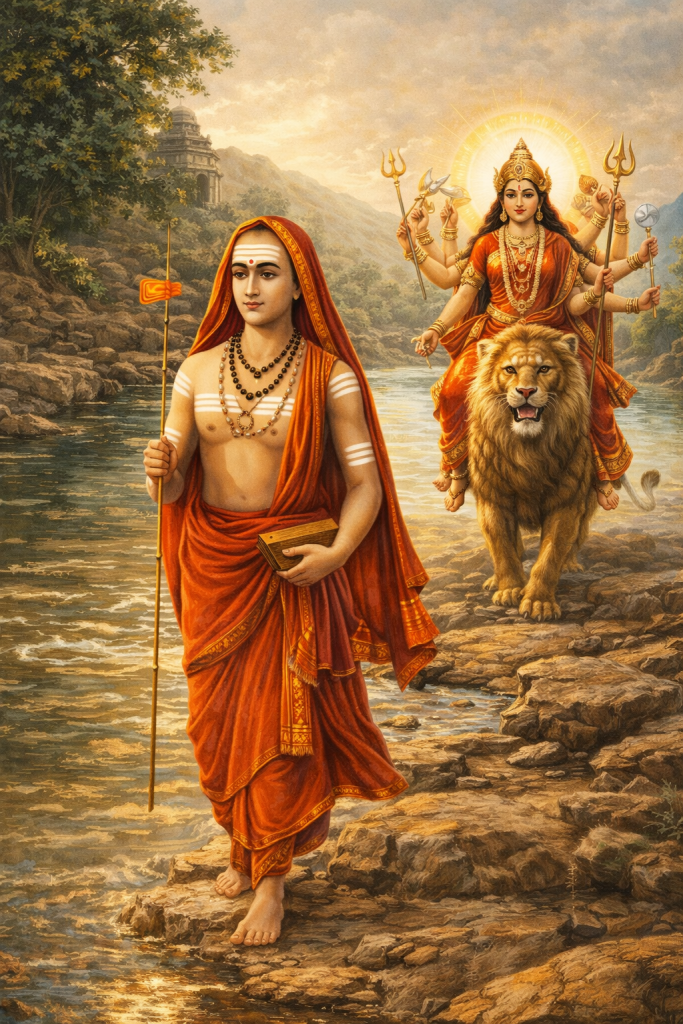
Adi Shankaracharya and the Goddess Who Stopped Walking
The story of how the temple was formally established is one of the most beloved tales in South Indian religious tradition.
According to legend, the goddess appeared to Adi Shankaracharya during his meditation and agreed to his wish to install her idol — but with one condition: she would follow him to his destination, and he must not look back. When they reached Kollur, Shankaracharya turned around in doubt, wondering whether she was still following. At that moment, the goddess declared that this was where she would stay, and asked him to install her idol right there.
Adi Shankaracharya founded the temple in the 8th century following this divine vision. He consecrated the idol on a Sri Chakra Yantra, and the system of worship he established — the Vijayagama system — continues at the temple to this day.
The idol of Mookambika Devi is made of Panchaloha — five metals: gold, silver, copper, iron, and lead. It is installed behind the Swayambhu Linga, forming the garbagriha that pilgrims travel hundreds of kilometres to behold.
View this post on Instagram
A Temple for Writers, Students, and Seekers
This is not just a temple of power. It is a temple of knowledge.
Saraswati, who is one aspect of Mookambika, is worshipped as the goddess of education and fine arts. Students come with their parents to seek her blessings for great heights in education.
The ritual of Vidyarambham — the ceremonial beginning of a child’s education — performed here is considered especially auspicious. Families travel from Kerala, Tamil Nadu, Karnataka, and beyond to have their children write their first letters at the goddess’s feet. It is a tradition that stretches back centuries, and my own family is part of that long, unbroken line.
Famous personalities have long had a personal connection with this temple. The temple’s reach extends beyond religion into culture, art, and identity.
Visiting the Temple
The best time to visit is from October to March. The nearest airport is Mangalore, about 130 km away, and the nearest railway station is Kundapura and Byndoor Road, around 40 km from the temple. Regular bus services connect Kollur from Mangalore, Udupi, and Kundapura.
A Thread That Connects Us
Every time I write about a temple like Kollur, I feel the weight of what these places carry. They are the accumulated longing of every person who stood in that queue, pressed their hands together, and asked for something — a healthy life, a sharp mind, a creative life.
My parents asked for all of those things for me, in a queue of thousands, in the early 1990s. I have spent my life as an author, screenwriter and filmmaker, telling the stories that these temples hold. Perhaps the Devi kept her word.
If these stories move you, there is much more to explore. K. Hari Kumar has spent years bringing the legends of India’s folk deities and mythology to life through his writing — stories that have been passed down for centuries and deserve to be read today.
📖 Explore K. Hari Kumar’s books on Indian mythology — available on Amazon and leading bookstores.
📱 Follow @theharikumar on Instagram for daily stories from the world of Indian mythology, temple legends, and forgotten folklore.
Because every temple has a story. And every story deserves to be told.
Sources & References:
- Wikipedia — Mookambika Temple, Kollur
- Official Temple Website — kollurmookambika.org
- Mookambika Infoline — mookambika.co
- Rosebazaar India — Kollur Mookambika Temple History
- Trawell.in — Temple Guide & Timings
- Wikipedia — Mookambika (Goddess)