
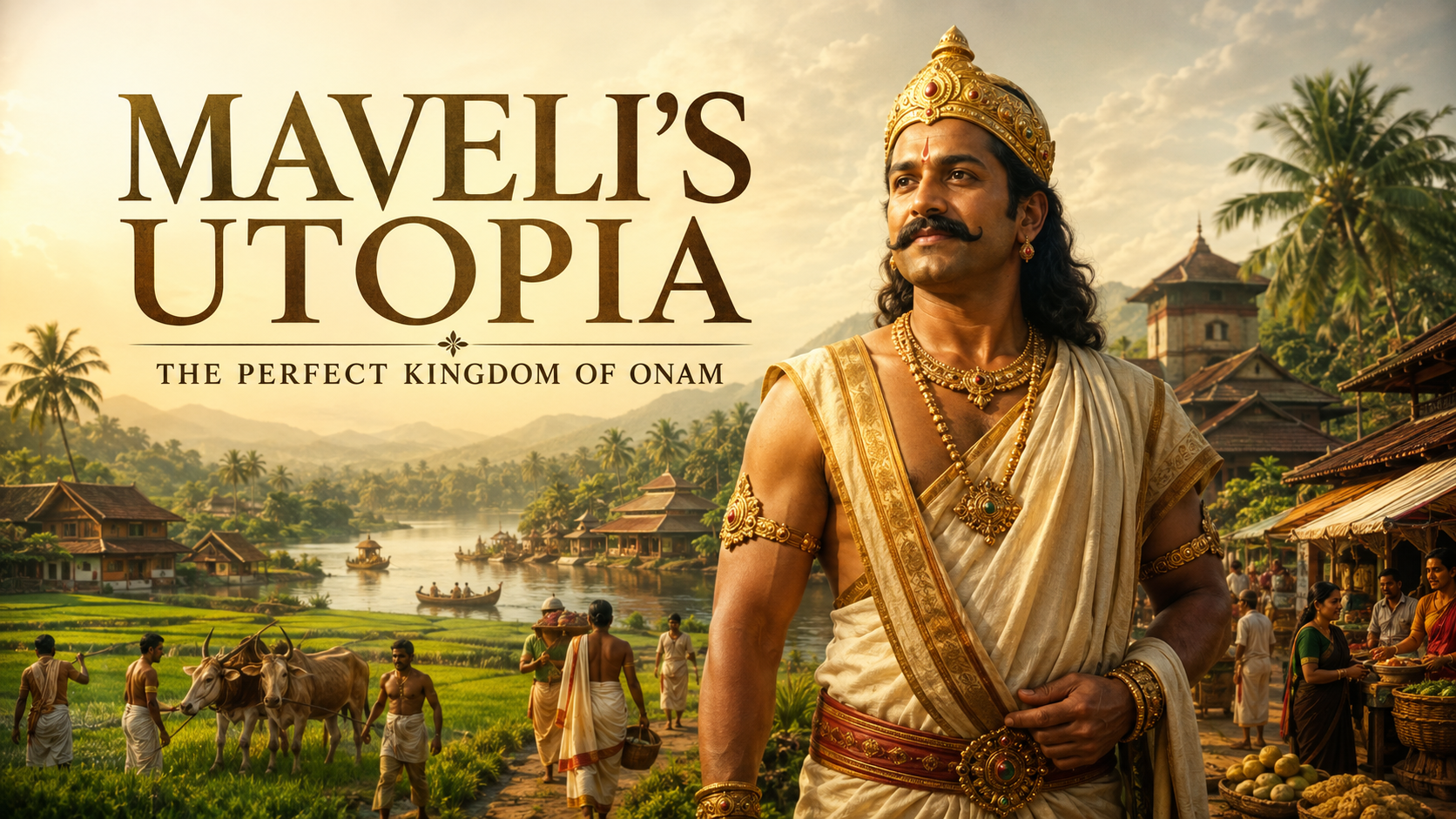
When we think of Onam, we usually think of pookalam, Onasadya, Vallamkali and the familiar story of King Mahabali returning to Kerala once every year. But there is another way in which the memory of this legendary king has survived, one that is perhaps even closer to the heart of Kerala’s popular culture. It survives in a song. The familiar words, “Maveli naadu vanneedum kaalam,” meaning “When Maveli ruled the land”, are heard across Kerala during Onam. Yet the song is more than a celebration of a king. Listen carefully to its lyrics and you will find a remarkably detailed picture of the society that Maveli is remembered to have ruled, a world where people were equal, theft and deception were absent, merchants were honest and prosperity was shared.
The Kingdom We Remember
The Maveli song does not describe a kingdom through its palaces, armies or royal treasures. Instead, it describes the everyday lives of its people. There was no theft, no deceit and no falsehood, while trade was conducted without dishonest weights or measures. These details are important because they tell us what Kerala’s folk tradition considered the true measure of a great kingdom. Maveli’s greatness was not simply that he was a powerful ruler. It was that ordinary people could live without constantly fearing exploitation by one another. The marketplace becomes almost as important as the palace in this vision of Maveli’s kingdom, because justice is experienced not in grand declarations but in the simple act of buying and selling without being cheated.
This is what makes the idea of Maveli’s utopia so fascinating. It is not necessarily a description of a society in which everyone possessed exactly the same wealth or lived identical lives. Instead, the song remembers a world in which people possessed a sense of equal dignity and could participate in society without being defined by hierarchy, dishonesty or fear. The ideal is surprisingly practical. A farmer should be able to sell his produce honestly. A merchant should be able to trade without deception. A neighbour should be able to trust another neighbour. Prosperity should make life more secure for the community rather than becoming another instrument of exploitation.
Maveli in Kerala’s Folk Memory
The historical origins of the Maveli folk song are difficult to establish with certainty, but its importance within Kerala’s oral tradition is unmistakable. It has survived because it carries something more enduring than historical information. It carries cultural memory. A manuscript can preserve the name of a king, while an inscription can record a victory, but a folk song can preserve what generations of people believed a good society ought to look like. In this sense, the song tells us as much about Kerala’s social imagination as it does about Maveli himself.
The idea of a lost golden age is not unique to Kerala. Many cultures remember an earlier time when society was believed to have been more harmonious and human beings more virtuous. Within the wider Hindu imagination, the idea of an age governed by truth and dharma can be seen in the conception of Satya Yuga. The Maveli tradition offers a distinctly Kerala expression of a similar longing. Whether or not such a society existed exactly as the song describes it is a separate historical question. What matters for understanding the tradition is that generations of Malayalis chose to remember Maveli’s kingdom in precisely these terms: prosperous, honest, harmonious and free from the everyday forms of injustice that make ordinary life difficult.
A Kingdom of Abundance
There is another reason this vision fits so naturally into the celebration of Onam. The festival arrives during the Malayalam month of Chingam, after the great monsoon season, when Kerala’s landscape is associated with agricultural renewal and abundance. The pookalam fills the courtyard with flowers, the Onasadya fills the banana leaf with food, families return home and the rivers become the stage for Vallamkali. Onam is, in many ways, a celebration of abundance shared with others.
Seen in that context, Maveli’s kingdom becomes more than a political ideal. It becomes an image of a society in which prosperity reaches the community. The land produces, people work, markets function honestly and families have enough to celebrate together. The festival’s physical abundance therefore echoes the moral abundance remembered in the Maveli song. Food, flowers and prosperity are not presented merely as possessions. They become things to be shared.
Perhaps that is why the song has endured so powerfully. It does not ask us to admire Maveli simply because he was a great king. It asks us to remember what life was supposed to have been like for the people who lived under him.
Why Maveli Still Matters
Every Onam, the song returns. It can be heard in homes, schools, cultural programmes and public celebrations, and its opening words are familiar to generations of Malayalis. There is something remarkable about this continuity. A king whose story belongs to a distant legendary past continues to live in the cultural imagination, not because his battles or royal achievements are remembered, but because the society associated with his name continues to represent an aspiration.
That aspiration is surprisingly contemporary. We still want honest markets, social dignity, security and prosperity that is not built upon another person’s suffering. We still understand the value of being able to trust the person standing across the marketplace. We still long for communities in which people are not constantly competing to prove their worth. The world described in the Maveli song may belong to folklore, but the values within it remain very much alive.
This is perhaps the real significance of Maveli’s kingdom. It does not have to be treated simply as a literal historical account in order to matter. It can be understood as a cultural memory of an ideal society, passed from one generation to another through one of Kerala’s most beloved Onam traditions. The song remembers a world that may have existed only in the imagination, but it preserves a dream that has never entirely disappeared.
The Utopia That Returns Every Onam
There is a beautiful irony at the heart of the Maveli tradition. Every year, Kerala waits for the return of a king from the past, but what people are really remembering is the world that he represents. When the pookalam is made, the Onasadya is served and families gather for Thiruvonam, the old song brings that imagined kingdom back into the present.
Maveli naadu vanneedum kaalam. When Maveli ruled the land.
Those words evoke more than nostalgia. They evoke a society in which prosperity did not require greed, trade did not require deception and social life did not depend upon fear. In the folk imagination, Maveli’s greatest achievement was not the splendour of his kingdom, but the trust that existed within it.
Perhaps that is why Maveli’s utopia continues to feel so close to us. It is not preserved on a map or within the walls of a ruined palace. It survives in the memory of Kerala, in the songs sung during Onam and in the simple hope that a good society is one in which prosperity, dignity and justice are available to everyone.
Every Onam, Maveli returns.
And perhaps, along with him, comes a reminder of the kind of world we would still like to build.
Maveli Nadu Vaanneedum Kaalam Lyrics and English Translation
Maveli Naadu Vaanidum Kaalam Meaning
Stanza 1
Maveli Naadu vaanidum kaalam
Manushyarellarum onnu pole
Aamodathode vasikkum kaalam
Aapathangarku-mottilla thaanum
English translation:
When Maveli ruled the land,
All human beings lived as equals.
It was a time when everyone lived in happiness,
And no one had to suffer any misfortune.
The opening establishes the central idea of the entire song. Maveli’s greatness is not described through his wealth or military power. His kingdom is remembered through the condition of its people. Equality and happiness become the defining characteristics of his reign.
Stanza 2
Aadhikal vyaadhikal onnumilla
Baalamaranangal kelkkanilla
Dushtare kankondu kaanmanilla
Nallavarallathe illa paaril… illa paaril
English translation:
There were no troubles or diseases,
There was no news of children dying young.
No wicked people were seen anywhere,
For there were none but good people upon the earth.
This takes the vision further. Maveli’s kingdom is imagined as a society free from disease, suffering and premature death. Even moral corruption seems absent. The line “Nallavarallathe illa paaril” literally evokes a world in which there are no people except the good.
Stanza 3
Kallavumilla chathiyumilla
Ellolamilla polivachanam… polivachanam
Vellikolaadikal naazhikalum
Ellam kanakkinu thulyamaayi… thulyamaayi
English translation:
There was no theft and no deceit,
Not even the slightest trace of false speech.
The silver measuring rods and measures,
Were all perfectly equal and accurate.
This is perhaps the most interesting section for our “Maveli’s Utopia” article.
The song moves from broad ideals such as equality to something remarkably practical: honest trade. The vellikol refers to a measuring rod, while naazhi refers to a traditional measure of capacity. The point is that weights and measures were accurate and trustworthy.
In other words, Maveli’s utopia was not merely a philosophical ideal. It extended into the marketplace.
A merchant did not cheat his customer. A customer did not have to worry about being deceived. The basic transactions of everyday life were governed by honesty.
Stanza 4
Kallapparayum cherunazhiyum
Kallatharangal mattonnumilla
Kallavumilla chathiyumilla
Ellolamilla polivachanam… polivachanam
English translation:
There were no false measures or dishonest vessels,
No other forms of deception existed.
There was no theft and no deceit,
Not even the slightest trace of false speech.
The song returns to the marketplace, reinforcing its central argument. The absence of dishonesty is not expressed merely as an abstract moral virtue. It is demonstrated through the measures and instruments used in everyday commerce.
The kingdom’s prosperity therefore rests upon trust.





Leave a Reply