
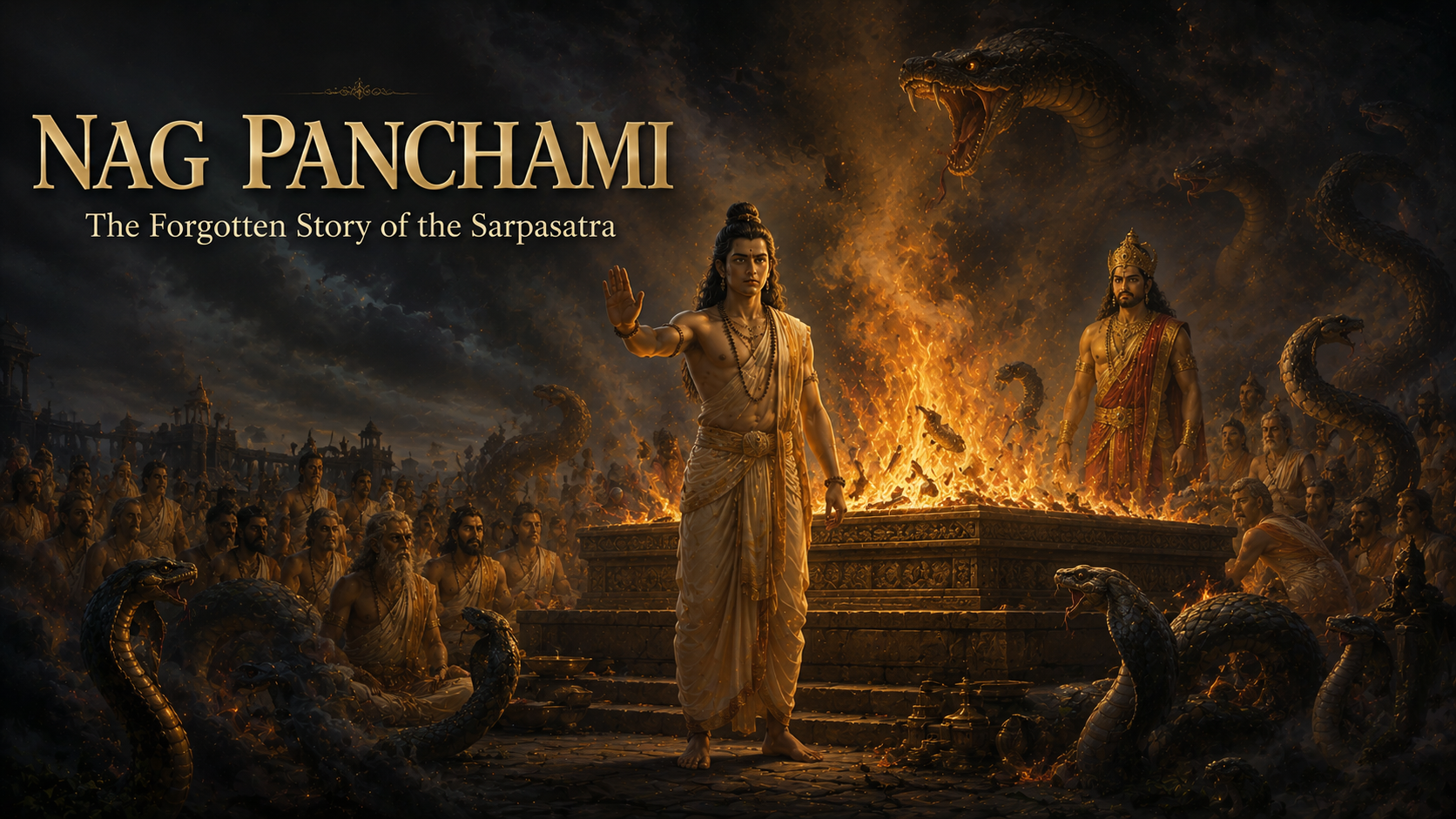
Every year, when the rains arrive and the earth of Bharat turns green, millions of Hindus observe Nag Panchami, offering prayers to the Naagas and remembering the ancient serpent beings who occupy such a mysterious place in our sacred traditions. In some homes, the worship is simple. A serpent image is decorated with turmeric and flowers. At a sacred anthill, milk or traditional offerings are placed with reverence. In serpent groves, families remember the Naagadevatas who have been worshipped there for generations. To someone unfamiliar with the tradition, it may appear to be a festival dedicated simply to snakes. But the story behind Nag Panchami reaches much deeper into the Mahabharata, the Puranic imagination and the ancient relationship between humanity and the serpent.
Watch Full Video on Chaturya by K. Hari Kumar on Youtube
The Nag Panchami Vrat Katha takes us into a world of curses and prophecies, kings and sages, celestial serpents and sacrificial fires. It begins not with a festival, but with an ancient curse uttered by a mother against her own children. It passes through the death of King Parikshit, the vengeance of his son Janamejaya and the terrifying Sarpasatra, the great serpent sacrifice in which an entire race of Naagas was threatened with annihilation. And at the very edge of that destruction appears a young sage named Astika, whose wisdom brings the slaughter to an end.
The story is one of the most remarkable episodes preserved in the Mahabharata. It is also the story that gives Nag Panchami one of its deepest meanings: that even when grief becomes anger and anger becomes vengeance, there must eventually come a moment when someone chooses to stop the fire.
Before Nag Panchami: The Curse of Kadru
To understand the Nag Panchami story, we have to travel back to the earliest generations of the Naagas.
Among the ancient mothers of creation was Kadru, the mother of the serpent race. She and her sister Vinata became rivals in a dispute concerning the celestial horse Uchchaihshravas. Kadru attempted to secure victory through deception, ordering her serpent sons to conceal the true colour of the horse’s tail by covering it with their dark bodies.
But not all of her children were willing to participate in the deception.
Those Naagas who refused to obey their mother angered her. In a moment of terrible fury, Kadru uttered a curse: her own serpent children would one day be consumed in the flames of a great sacrifice.
The curse became part of the destiny of the Naaga race.
Generations would pass before it began to unfold, but the ancient words of Kadru had already set something in motion. The Naagas would eventually face a king whose grief would become so powerful that he would attempt to destroy them all.
That king was Janamejaya.
But first came his father.
King Parikshit and the Sage’s Curse
King Parikshit, the grandson of Arjuna, ruled the Kuru kingdom with the authority inherited from one of the greatest royal lineages of the Mahabharata. Yet even kings are not beyond the consequences of a moment of human weakness.
One day, while hunting in the forest, Parikshit became exhausted and desperately thirsty. He eventually reached the hermitage of Rishi Samika, hoping to receive water and hospitality.
But Samika was observing mouna-vrata, a vow of silence, and remained immersed in meditation.
Parikshit did not understand the reason for the sage’s silence.
Already weakened by hunger and fatigue, the king became angry. In an act that he would later deeply regret, he lifted a dead serpent with the end of his bow and placed it around the meditating Rishi’s shoulders before leaving the hermitage.
When Samika’s son Sringin returned and saw what had happened, his anger was immediate. Believing that his father had been gravely insulted, he pronounced a terrible curse.
Within seven days, King Parikshit would die from the venomous bite of Takshaka, the great Naagaraaja.
The curse could not simply be taken back.
When Parikshit learned what had happened, however, he did not respond with further anger. He recognised his own mistake and accepted the consequences with remorse. But the kingdom still had to be protected, and elaborate measures were taken to prevent the prophesied serpent from reaching him.
A fortified palace was constructed. Physicians were brought in. Sacred herbs were prepared. Priests recited protective mantras. Every possible entrance was watched.
The king believed himself protected.
But the story of Takshaka was not yet over.
Takshaka and the Duel with Kashyapa
As the seventh day approached, another figure entered the story: Sage Kashyapa, a master of the knowledge associated with counteracting serpent venom.
Kashyapa was travelling towards the king’s palace when he encountered Takshaka.
The Naagaraaja understood that the sage possessed the power to counter his venom, and so he decided to test him.
Before Kashyapa stood a magnificent banyan tree.
Takshaka struck it.
The venom of the serpent was so powerful that the great tree was reduced to ashes almost instantly.
But Kashyapa did not retreat.
Gathering the ashes, the sage invoked his sacred knowledge. Slowly, the impossible happened. From the ashes came the tree once again—the sprout, the stem, the branches and finally the leaves.
The banyan lived.
Takshaka now understood that Kashyapa truly possessed the ability to save Parikshit.
What happened next is one of the more morally complex moments in the story. Recognising that the king’s death had been ordained by the curse, Kashyapa accepted wealth from Takshaka and turned away from his journey.
Takshaka continued towards the palace.
The fortress that had been constructed to keep him out would prove useless.
The Death of Parikshit
The Mahabharata gives this episode an almost cinematic quality.
Takshaka did not simply approach the palace in his enormous serpent form.
Instead, he concealed himself within a fruit as a tiny worm.
When the fruit reached King Parikshit, the seemingly harmless creature emerged. In an instant, it transformed into the mighty Takshaka.
The serpent struck.
The curse was fulfilled.
King Parikshit died.
And with his death, another chapter of the story began.
His son, King Janamejaya, inherited the throne of Hastinapura. But he also inherited his father’s unfinished story.
When Janamejaya learned that Takshaka had caused Parikshit’s death, grief became fury.
And fury demanded revenge.
Janamejaya’s Sarpasatra
Janamejaya decided that killing Takshaka would not be enough.
He would destroy the entire serpent race.
The king ordered the Sarpasatra, also known as the Sarpa Satra—a vast sacrificial ritual intended to annihilate the Naagas.
The sacrificial enclosure was prepared.
The fires were kindled.
The priests began their chants.
And the ancient curse of Kadru appeared to be reaching its terrible fulfilment.
Through the power of the ritual, serpents from across the worlds were drawn towards the sacrificial fire. Naagas were pulled from the earth, the heavens and the subterranean realm of Paataala, falling helplessly into the flames.
The destruction was immense.
The Naagas were not merely being defeated.
They were facing extinction.
This is the point at which the story of Nag Panchami becomes something much larger than a tale about serpent worship. The festival tradition preserves the memory of a moment when an entire species of divine beings stood at the edge of annihilation—and someone chose to intervene.
Vasuki and the Search for a Saviour
Among those watching the destruction was Vasuki, the great Naagaraaja.
He understood that the sacrifice could not be stopped through force.
The prophecy surrounding the Naagas offered only one possibility.
A child born from the union of the sage Jaratkaru and the woman who bore the same name would one day save the serpent race.
That child was Astika.
The supplied tradition identifies the mother with Jaratkaru and connects her with Devi Manasa. In the wider textual tradition, however, the relationship between the Mahabharata’s Jaratkaru narrative and later Manasa traditions is complex, and these traditions should not simply be treated as identical without qualification. For a deeper exploration of the many worlds of serpent mythology, this is precisely the kind of distinction that I examine in Naaga.
Takshaka Seeks Refuge with Indra
By this point, even Takshaka understood that he was no longer safe.
The Naagaraaja fled towards Swargaloka, seeking refuge with Devaraj Indra.
But Janamejaya’s priests continued their chants.
The power of the Sarpasatra intensified.
Takshaka was drawn towards the sacrificial fire.
Then something even more extraordinary happened.
Indra himself, along with his celestial chariot, began to be pulled towards the flames.
The sacrifice had reached a scale at which even the boundaries between the human, celestial and serpent worlds appeared to collapse.
Takshaka hovered above the fire.
The end seemed inevitable.
And then Astika entered.
Astika: The Sage Who Saved the Naagas
Astika was young, but he possessed the wisdom and composure of a great Rishi.
He entered the assembly of Janamejaya and did not begin by condemning the king. Instead, he praised Janamejaya, Agni and the priests conducting the sacrifice.
The king was impressed.
He offered the young sage a boon.
Astika could have asked for gold.
He could have asked for land.
He could have asked for power.
Instead, he asked for the one thing that mattered.
He asked Janamejaya to stop the Sarpasatra.
The king had given his word.
And a king’s word could not be broken.
The sacrificial fires were extinguished.
The destruction ceased.
The Naagas were saved.
Takshaka survived.
The ancient curse had not been allowed to become total annihilation.
And in that moment, Astika achieved something that armies could never have achieved.
He stopped vengeance.
The Nag Panchami Vrat Katha
Tradition associates the day on which Sage Astika saved the Naagas with the fifth day of the bright fortnight of Shraavana—the day observed as Nag Panchami.
This ancient episode forms the heart of the Nag Panchami Vrat Katha.
The festival therefore carries within it a story of much greater depth than the simple worship of serpents. It remembers the Naagas, the intervention of Astika and the moment when an act of vengeance was brought to an end.
Across India, the actual customs of Nag Panchami vary enormously.
In some regions, devotees worship serpent images. In others, prayers are offered at anthills or ancient serpent shrines. Sacred serpent groves are decorated and honoured. Traditional offerings may include milk, Noorum-Paalum or Thambila, depending upon the regional tradition.
The rituals differ.
The underlying reverence does not.
For generations, devotees have remembered the name of Astika as a protective invocation:
Asito Manasashchaiva Jaratkaru-stathastikah
The words preserve the memory of the sage who stood between the Naagas and the fire.
Why Do We Worship the Naagas?
The answer lies partly in understanding what the serpent represents within Hindu sacred traditions.
The Naagas are not simply snakes enlarged by mythology.
They occupy an extraordinary place in the sacred imagination of Bharat. Vasuki becomes the serpent used during the churning of the cosmic ocean. Ananta Shesha supports the cosmic order and is eternally associated with Bhagawan Vishnu. Takshaka appears as a powerful Naagaraaja in the Mahabharata. Other Naagas are described as guardians, inhabitants of subterranean realms and beings connected with water, fertility, treasure and hidden knowledge.
The serpent therefore exists at the boundary between worlds.
It moves beneath the earth.
It emerges from water.
It disappears into darkness.
It sheds its skin.
And it can bring both fear and awe.
This is one of the reasons I spent years researching serpent traditions for Naaga: Discovering the Extraordinary World of Serpent Worship. The book goes far beyond the familiar stories of Ananta and Vasuki, exploring the many regional traditions, serpent shrines, sacred groves, Naga deities, folklore and forgotten beliefs that reveal just how deep serpent worship runs through Indian civilisation.
Naaga is, in many ways, the longer journey behind this article.
Explore Naaga on Amazon India · Amazon Global · Flipkart
The Living Tradition of Nag Panchami
There is something beautiful about the fact that this ancient story did not remain trapped inside a manuscript.
It became a living festival.
When Shraavana arrives, the Naagas are remembered once again.
In villages and towns, in temples and serpent groves, families continue to honour the beings who occupy this strange space between mythology and nature. The monsoon itself becomes part of the ritual landscape. The earth is wet. The fields are alive. Rivers swell. Serpents emerge from places that were hidden only weeks before.
The festival therefore exists at the meeting point of Hindu mythology and ecology.
It reminds us that the natural world was never completely separate from the sacred world in traditional Indian thought.
A serpent was not simply something to be feared.
It could be a Naaga.
A guardian.
An ancestral presence.
A deity.
A force of nature that deserved reverence.
This is perhaps why the preservation of sacred serpent groves remains so significant in different parts of India. When a grove is protected because a Naagadevata resides there, the ritual belief can create a very real form of ecological preservation.
The mythology protects the landscape.
And the landscape, in turn, keeps the mythology alive.
From the Naagas to the Cosmos
There is another reason the story of the Sarpasatra deserves to be remembered.
The Naagas are not an isolated group of serpent beings within Hindu mythology. At the centre of their cosmic world stands Ananta Shesha, the endless serpent upon whose hoods Bhagawan Vishnu reclines.
The image is almost paradoxical.
The serpent is feared on earth.
Yet one of the greatest serpents in Hindu sacred tradition becomes the foundation of the cosmic order.
The Naaga can be deadly.
The Naaga can also be divine.
The serpent can represent hidden danger, but it can equally represent eternity, protection and cosmic stability.
This layered symbolism is one of the reasons the serpent appears so repeatedly across India’s sacred traditions.
If you would like to explore this larger world, you can also read my earlier article on the first names of the Sahasranamas:
Vishwam, Srimata and Sthira: Three Names, Three Visions of the Divine
It explores another fascinating aspect of Hindu sacred traditions: how a single divine name can become a doorway into an entire philosophical world.
What Nag Panchami Really Remembers
When we look at Nag Panchami only as a festival involving serpent worship, we see only the surface.
Beneath it lies a much older story.
A mother’s curse.
A king’s mistake.
A sage’s anger.
A serpent king’s vengeance.
A son’s grief.
A sacrificial fire.
And finally, a young sage who chooses to stop the destruction.
That is the deeper Nag Panchami Katha.
It is a story about what happens when anger is allowed to grow unchecked.
Parikshit’s moment of anger leads to a curse.
The curse leads to his death.
His death leads to Janamejaya’s grief.
Grief becomes vengeance.
Vengeance becomes the Sarpasatra.
And the Sarpasatra threatens an entire race.
At every stage, the circle becomes larger.
Until Astika breaks it.
Perhaps that is why his intervention remains so powerful.
He does not deny Janamejaya’s pain.
He simply reminds the king that pain cannot become an excuse for destroying everything connected to it.
The victory of Astika is therefore not a victory over Janamejaya.
It is a victory over vengeance itself.
And perhaps this is the quiet wisdom preserved within Nag Panchami.
The serpent is not merely something to fear.
The Naaga is something to remember.
The forest is something to protect.
Nature is something to honour.
And power, however great, must eventually submit to dharma.
When we offer our prayers on Nag Panchami, we are not merely remembering creatures who live beneath the earth.
We are remembering an ancient promise between humanity and the living world.
A promise that began with a curse, passed through fire, and was finally saved by wisdom.
May the Naagas be remembered.
May the sacred groves endure.
And may the wisdom of Astika continue to remind us that the greatest victory is sometimes the courage to stop destroying.
Frequently Asked Questions
Why do we celebrate Nag Panchami?
Nag Panchami is traditionally associated with the worship and remembrance of the Naagas. Its Vrat Katha is connected with the story of Sage Astika stopping King Janamejaya’s Sarpasatra and saving the serpent race from destruction.
What is the Nag Panchami Vrat Katha?
The Nag Panchami Vrat Katha recounts the chain of events beginning with Kadru’s curse upon the Naagas, followed by the death of King Parikshit through Takshaka’s bite, Janamejaya’s decision to conduct the Sarpasatra, and Astika’s intervention to stop the sacrifice.
What is Sarpasatra or Sarpa Satra?
Sarpasatra, also called Sarpa Satra, was the great serpent sacrifice conducted by King Janamejaya to destroy the Naagas in revenge for the death of his father, King Parikshit.
Who was Sage Astika?
Astika was the sage who intervened during Janamejaya’s Sarpasatra. He requested that the king stop the sacrifice, thereby saving the remaining Naagas from destruction.
Who was Takshaka?
Takshaka was a powerful Naagaraaja who appears prominently in the Mahabharata. He was destined to kill King Parikshit after the king was cursed by Sringin.
Who was King Parikshit?
King Parikshit was the grandson of Arjuna and a ruler of the Kuru dynasty. His encounter with Rishi Samika and the subsequent curse of Sringin ultimately led to his death at the hands of Takshaka.
Who was Janamejaya?
Janamejaya was the son of King Parikshit. After learning that Takshaka had caused his father’s death, he ordered the Sarpasatra to destroy the serpent race.
Who was Kadru?
Kadru was traditionally regarded as the mother of the Naagas. After some of her serpent sons refused to participate in her deception involving the celestial horse Uchchaihshravas, she cursed them to perish in a future sacrificial fire.
Who is Vasuki?
Vasuki is one of the most prominent Naagaraajas in Hindu mythology. He is particularly famous for serving as the serpent rope during the Samudra Manthan, the churning of the cosmic ocean.
What is the connection between Nag Panchami and the Mahabharata?
The traditional Nag Panchami story is connected with the Mahabharata’s account of Parikshit, Takshaka, Janamejaya, the Sarpasatra and Astika’s intervention to save the Naagas.
Why are Naagas worshipped?
Naagas occupy an important place in Hindu sacred traditions as serpent beings associated with protection, water, fertility, treasure, hidden realms and cosmic order. Their worship also survives through numerous regional traditions and sacred serpent groves across India.
Is Nag Panchami only about snakes?
No. While serpents are central to the festival, Nag Panchami also represents the broader relationship between humans, nature and the sacred. Its traditions differ across India and may include worship at serpent shrines, anthills and sacred groves.
What is the significance of Astika in Nag Panchami?
Astika represents the restoration of balance. By persuading Janamejaya to stop the Sarpasatra, he prevents grief and vengeance from becoming total destruction. His intervention forms the central moral and spiritual dimension of the Nag Panchami Vrat Katha.




Leave a Reply