
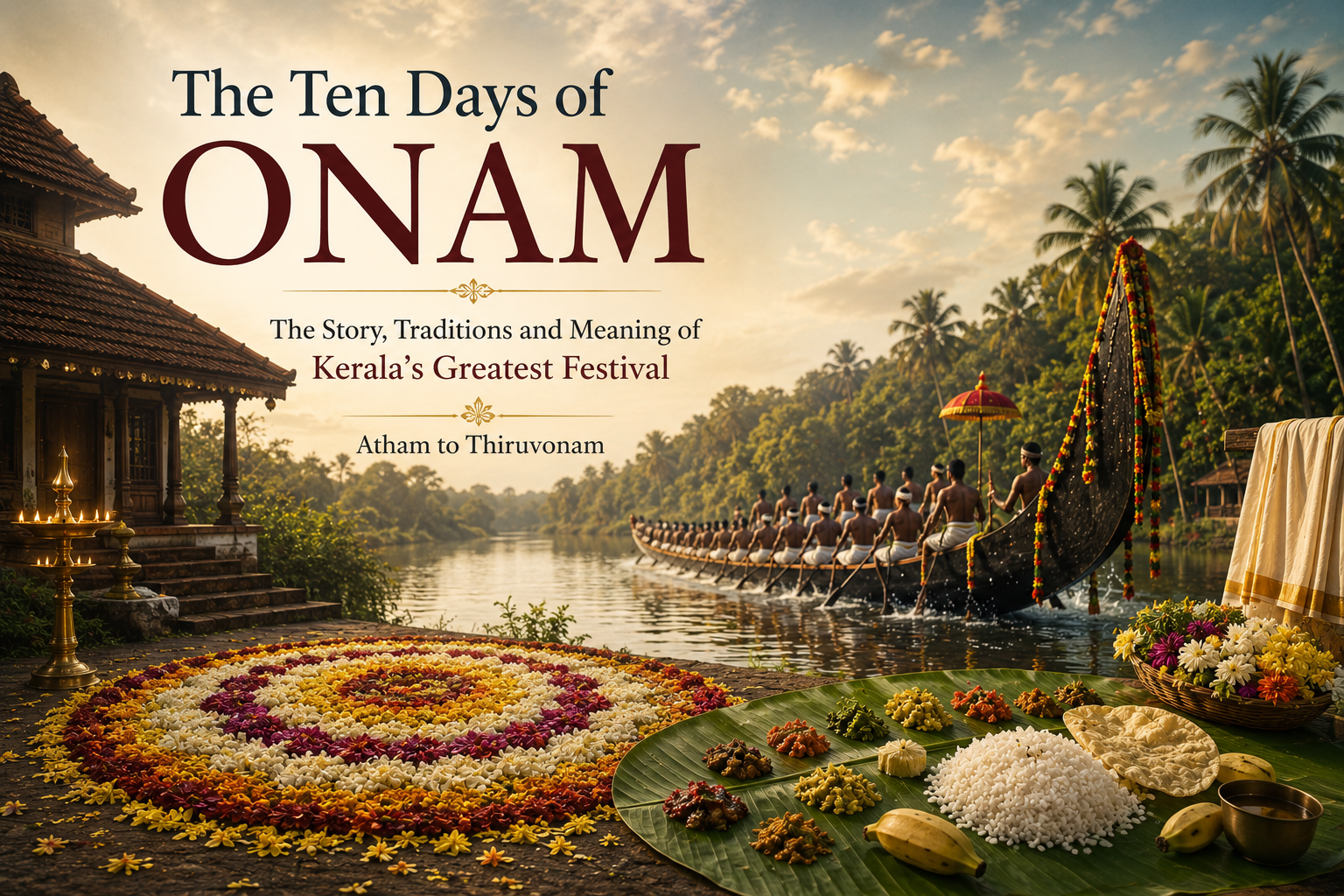
Every year, as the Malayalam month of Chingam arrives and Kerala emerges from the lushness of the monsoon, the rhythm of everyday life begins to change. Courtyards are cleaned, flowers appear in the markets, families start making plans to return home, and the first pookkalams begin to take shape outside houses. In kitchens, preparations for the Onasadya slowly gather momentum. Along the rivers, the great snake boats prepare for their races, while temples and public spaces begin to fill with the sounds, colours and rituals associated with the season.
Yet what we commonly call Onam is not really a single day.
The grand feast of Thiruvonam is only the culmination of a much longer festival. Traditionally, the ten-day celebration begins with Atham and builds gradually towards Thiruvonam, with each day acquiring its own customs, preparations and regional expressions. The pookalam grows a little larger, the household becomes a little busier, the markets become more festive, and families begin to gather. By the time Thiruvonam arrives, the celebration has already been unfolding for more than a week.
This is perhaps the best way to understand Onam. It is not merely a festival that happens on a particular day. It is a festival that builds towards something.
And at the heart of that journey lies one of Kerala’s most beloved stories: the return of Mahabali, remembered across Kerala as Maveli.
What Is Onam?
Onam is Kerala’s great annual festival, celebrated through a combination of religious observances, family traditions, agricultural associations, food, flowers, music, dance and community festivities. The festival is particularly associated with the story of Mahabali and the arrival of Bhagawan Vishnu in His Vamana avatara, but the lived traditions of Onam extend well beyond the telling of that story.
For Malayalis, Onam can mean many things at once. It can mean returning to one’s ancestral home, preparing a pookalam with family, wearing new clothes, eating an Onasadya on a banana leaf, watching a Vallamkali, visiting a temple or simply spending time with people who may live far away for much of the year.
This diversity is important because Onam is not practised in precisely the same manner throughout Kerala. Customs surrounding the pookalam, clay figures, temple celebrations, folk performances and food can vary between regions and communities. The ten-day sequence provides a shared cultural framework, but the way that framework is lived remains beautifully regional.
That is why any attempt to define Onam through a single ritual or a single origin story inevitably leaves something out.
There is the Puranic story of Vamana and Mahabali. There is the agricultural rhythm of Kerala. There are temple traditions. There are domestic customs. There are folk traditions and regional memories. And there is the modern experience of Malayalis around the world returning to the idea of home during Onam.
All of these layers have become part of the festival we know today.
The Ten Days of Onam
The traditional ten-day Onam celebration runs from Atham to Thiruvonam, and the gradual development of the pookalam provides one of the clearest visual expressions of this progression. What begins as a modest floral arrangement grows through the days until the courtyard is transformed into an elaborate celebration of colour.
But the flowers are only part of the story.
Each day changes something else as well. The household becomes more prepared. The markets become busier. Food begins to take centre stage. Public celebrations emerge. Families return. Temples become increasingly active. By the time Thiruvonam arrives, the entire landscape of the festival has changed.
Let us follow that journey.
Atham: The Beginning of Onam
The first day of the ten-day sequence is Atham.
This is when the pookalam traditionally begins to appear in the courtyard of the home. In many traditions, the first arrangement is relatively simple, using flowers such as thumba and other locally available varieties. As the days progress, more flowers and layers are added.
There is something deeply appropriate about beginning Onam this way.
The festival does not arrive fully formed.
It begins with a small act of preparation.
A courtyard is cleaned. Flowers are gathered. A pattern is created. The first circle is placed upon the earth.
Nobody expects the Atham pookalam to resemble the magnificent arrangements that will appear towards Thiruvonam. Its purpose is to begin the process.
And from this point onwards, every morning becomes part of the festival.
The pookalam is therefore more than decoration. It becomes a kind of visual calendar, marking the passage of the ten days through colour, shape and increasing complexity. The festival can be watched growing in front of the household.
In earlier domestic traditions, the use of locally available flowers also reflected Kerala’s intimate relationship with its landscape. The flowers of the season were not merely decorative materials purchased for an occasion. They were part of the world in which the festival itself existed.
Chithira: The Pookalam Grows
On Chithira, the second day, the pookalam begins to expand.
Additional layers are introduced, and in some traditions white flowers become part of the arrangement. The courtyard is increasingly transformed as the simple design of Atham develops into something more structured.
This is when the pookalam begins to reveal its extraordinary character.
Flowers are soft, temporary and delicate, yet they are arranged into geometry. Circles, symmetry and colour begin to emerge from something that would otherwise quickly wither away.
There is a quiet philosophy in that process. The festival is being built from things that are themselves temporary.
Every morning the flowers must be renewed.
Every layer will eventually fade.
Yet the act of making them is repeated.
Onam therefore does not require permanence in order to create meaning. It creates beauty precisely through participation and repetition.
Chodhi: When the Festival Enters the Home
By Chodhi, the third day, the atmosphere becomes increasingly festive. This stage is associated in some traditions with shopping for new clothes and jewellery for family members, while brighter and more varied flowers begin to enter the pookalam.
This is the point at which Onam begins to move beyond the courtyard.
The festival enters the marketplace.
Clothes are purchased. Flowers become more abundant. Homes are prepared. Families begin making arrangements for the days ahead.
The psychological distance between ordinary life and festival life starts to disappear.
Onam is no longer something that is coming.
It has arrived.
Vishakam: Preparing the Onasadya
By Vishakam, the fourth day, preparations increasingly turn towards food.
The Onasadya, the great vegetarian feast associated with Onam, requires considerable preparation. Rice, vegetables, coconut, spices, bananas and the many accompaniments that make up the meal have to be gathered and prepared.
But the Onasadya is more than a collection of dishes.
Its real significance lies in the act of eating together.
A banana leaf becomes the dining surface. Food is served in a traditional sequence. Several generations may sit together, sharing the same meal. The exact dishes and number of preparations vary between households and regions, but the underlying idea remains one of abundance, hospitality and community.
This is an important part of the larger rhythm of Onam.
The pookalam is growing.
The household is filling.
The preparations are expanding.
And the feast is beginning to take shape.
Anizham: Onam Reaches the River
On Anizham, the fifth day, the festival moves from the household towards Kerala’s waterways.
The day is strongly associated with Vallamkali, the famous snake-boat races, particularly along the Pamba River.
The change is dramatic.
Until this point, much of the festival has been experienced through flowers, food and domestic preparation. Now the rivers become part of the celebration.
Long snake boats glide across the water, their rowers moving in extraordinary synchrony. The rhythm of hundreds of oars striking the water becomes part of the soundscape of Onam.
The festival that began with a handful of flowers in a household courtyard has now expanded into a public spectacle involving entire communities.
This is one of the great strengths of Onam. It can be intimate enough to belong to a family and expansive enough to belong to an entire landscape.
Thrikketta: The Return Home
By Thrikketta, the sixth day, another dimension of Onam begins to emerge: homecoming.
For many Malayalis, Onam is inseparable from returning home. Families begin gathering, ancestral houses become centres of activity, and the festival becomes an occasion for generations to meet once again.
The significance of this can sometimes be overlooked because it does not produce the most spectacular photographs.
There may be no enormous pookalam or racing boat involved.
Instead, there is a house becoming full again.
Children return. Siblings arrive. Grandparents wait. The dining room becomes crowded. Conversations that have been postponed for months resume around the same table.
Onam does not merely bring people together in Kerala.
For many families, it brings people back to one another.
Moolam: From Household to Community
By Moolam, the seventh day, Onam begins to move increasingly into public and temple spaces.
Traditional performances such as Pulikali and Kaikottukali become part of the festive atmosphere in different parts of Kerala, while Onasadya begins to be served in some places. Temple celebrations also become increasingly important.
One particularly significant centre of Onam worship is Thrikkakara, associated with the Vamana tradition. The temple festival there runs through the ten-day period, combining ritual observances, pookkalam and sadya.
This reminds us that Onam has never belonged exclusively to the household.
It moves between the home and the temple, the village and the river, the marketplace and the public square.
Each setting reveals another aspect of the festival.
Pooradam: Mahabali and Vamana Enter the Courtyard
Pooradam, the eighth day, brings one of the most recognisable ritual elements associated with certain regional Onam traditions.
In many households, clay figures connected with Mahabali, Vamana and the Onam tradition are placed within the pookalam. Kerala Tourism describes pyramid-shaped clay figures known as Thrikkakarappan, while also noting regional variations. In parts of northern Kerala, related figures may be known as Mathevar, and the exact arrangement can differ between traditions.
This regional diversity deserves attention.
There is no single ritual involving an identical clay figure practised in precisely the same manner throughout Kerala. Some traditions use particular figures, others use different names or arrangements, and the timing of their installation can vary.
Yet the underlying idea is striking.
The mythic world is being brought into the household courtyard.
The pookalam is no longer merely an arrangement of flowers. It becomes a space in which the story of Onam is remembered physically.
Mahabali is no longer only a character in a story.
He has entered the home.
Uthradam: The Eve of Thiruvonam
Uthradam, the ninth day, is popularly known as First Onam and marks the point at which preparations reach their peak.
Markets become crowded. Flowers are gathered. Food is prepared. Homes are decorated. Families make their final arrangements for the principal day of the festival.
Traditionally, Uthradam is also associated with preparations for the arrival of Mahabali, including the gathering of new crops and delicacies. The pookalam reaches one of its most elaborate stages, and Kerala Tourism identifies Uthradam with the making of particularly large arrangements.
There is something wonderfully human about this stage of the festival.
After nine days of preparation, the celebration is still not complete.
The feast has not yet reached its fullest expression.
The final day has not yet arrived.
Everyone is waiting.
And that waiting is itself part of Onam.
The festival is not merely the moment of abundance. It is the anticipation that leads towards it.
Thiruvonam: When the Ten Days Come Together
By the time Thiruvonam, the tenth and principal day of Onam, arrives, the festival has already transformed the landscape around it. What began on Atham with a small arrangement of flowers has grown into elaborate pookkalams. Families have returned home, markets have filled with people preparing for the celebration, boats have carried rowers through Kerala’s rivers, temples and public spaces have become increasingly festive, and the kitchen has been preparing for the great Onasadya.
Thiruvonam is therefore not simply one more day in the calendar. It is the moment towards which the previous nine days have been moving.
Homes are cleaned and decorated, people wear new clothes, traditionally known as Onakodi, and families gather around the Onasadya. The pookalam reaches its fullest expression, its layers of flowers reflecting the journey that began with the modest design of Atham. The meal is served on banana leaves, conversations stretch across generations, and the ordinary rhythm of the household gives way to the slower, fuller rhythm of celebration.
For many Malayalis, this is also the emotional heart of Onam. Those who live away from Kerala try to return home. Families gather around the same table. Children who may have spent much of the year elsewhere find themselves once again in the familiar spaces of their childhood. The festival creates a brief suspension of distance, bringing people back into the same homes, courtyards and dining rooms.
Perhaps this is why Onam cannot be reduced to a single ritual. The pookalam, the sadya, the boat races, the temple celebrations and the ten-day calendar are all different expressions of something larger. They turn the festival into an experience that is shared by households and communities, but remembered personally by each generation.
And when Thiruvonam finally comes to an end, the flowers will begin to fade, the banana leaves will be cleared, the boats will return to their banks and the houses will slowly become quiet again.
But the festival will have done what it always does.
It will have brought people home.
That is perhaps the enduring beauty of Onam. It is not only a celebration that Kerala prepares for. It is a celebration that Kerala grows into, one day at a time, until the tenth day arrives and the entire landscape seems to pause for a moment.
The flowers have reached their fullest circle.
The feast has been served.
The family has gathered.
Thiruvonam has arrived.
And for one beautiful day, Kerala celebrates together.
Frequently Asked Questions About Onam
What is Onam?
Onam is Kerala’s major annual festival, traditionally celebrated over ten days from Atham to Thiruvonam. It combines Puranic traditions associated with Mahabali and Vamana with agricultural, household, temple and regional cultural practices.
Why is Onam celebrated?
Onam is traditionally associated with the annual return of King Mahabali, or Maveli, to visit his people. The festival is also closely connected with harvest, abundance, family gatherings, food, flowers and Kerala’s cultural traditions.
Who is Mahabali?
Mahabali is a powerful Asura king described in Puranic literature. He is renowned for his generosity and devotion. In the Vamana story, Bhagawan Vishnu appears before him as Vamana and asks for three paces of land. Mahabali ultimately offers his own head for the third step.
Who is Vamana?
Vamana is the dwarf Brahmana avatara of Bhagawan Vishnu. In the story of Mahabali, Vamana asks the king for three paces of land before revealing His cosmic form as Trivikrama.
Why does Mahabali return during Onam?
According to Kerala’s traditional Onam story, Mahabali was granted permission to return once each year and visit his people. His annual return is commemorated during Onam, particularly through the celebrations surrounding Thiruvonam.
What are the ten days of Onam?
The traditional ten-day sequence runs from Atham, Chithira, Chodhi, Vishakam, Anizham, Thrikketta, Moolam, Pooradam, Uthradam and Thiruvonam. Customs associated with individual days can vary by region and community.
What is a pookalam?
A pookalam is a traditional floral arrangement made during Onam, usually in the courtyard or entrance area of a home or other space. It traditionally begins on Atham and grows in size and complexity as Thiruvonam approaches.
What is Onasadya?
Onasadya is the traditional vegetarian feast associated with Onam. It is generally served on a banana leaf and includes rice along with a variety of vegetable, lentil, coconut-based, pickled, fried and sweet preparations. The exact menu varies by region and household.
What is Vallamkali?
Vallamkali refers to Kerala’s traditional boat races, particularly the spectacular races involving long snake boats. These races have become an important part of the cultural celebrations associated with Onam.
What is Thiruvonam?
Thiruvonam is the tenth and principal day of the traditional ten-day Onam celebration. It is marked by the fullest expression of the pookalam, family gatherings, new clothes, Onasadya and celebrations associated with the return of Mahabali.
Is Onam the same throughout Kerala?
No. While the ten-day framework and major themes are widely recognised, individual rituals and customs vary between regions, communities, households and temples. Traditions involving pookkalam, clay figures, folk performances, temple observances and food can differ considerably.
A final thought
Perhaps the greatest mistake we can make with a living festival is to reduce it to a single explanation.
Onam does not need to be placed into a contest between mythology and history, temple and folk tradition, harvest and Puranic story, or ancient memory and modern identity. Its richness lies precisely in the way these different layers have come together in Kerala and continue to be experienced by people in different ways.
The first flower of Atham does not tell the whole story.
Neither does the great feast of Thiruvonam.
To understand Onam, we have to watch the flowers appear one after another, listen to the boats moving through the rivers, enter the crowded kitchen, sit among the family, remember the story of Maveli, and finally understand why a festival that celebrates the return of a king has also become, for so many people, a celebration of returning home.
That is the story of Onam.



Leave a Reply