
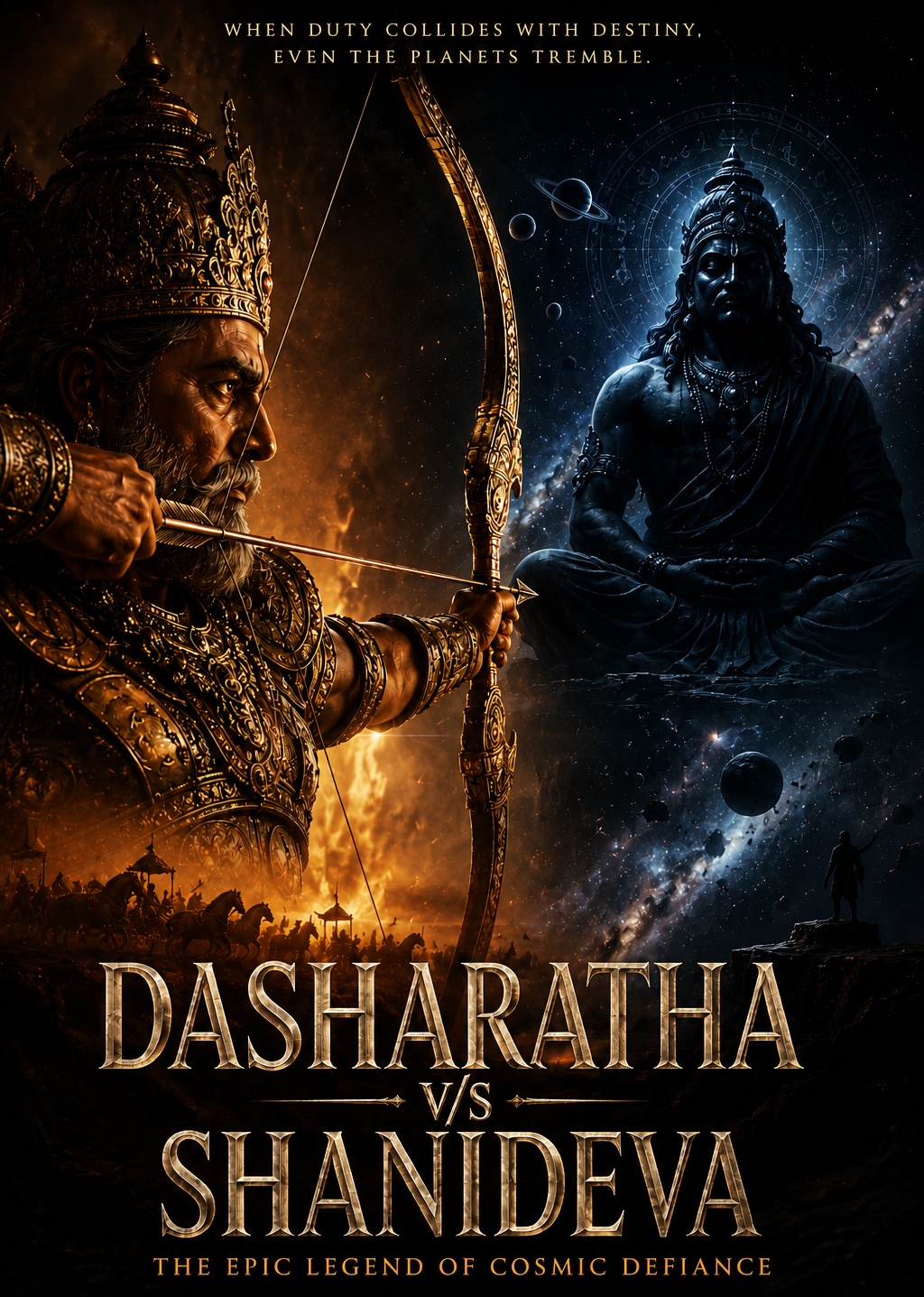
In the gilded courts of Ayodhyā, Emperor Daśaratha sat surrounded by pale-faced astrologers. The great sage Vasiṣṭha looked up from his parchment, his hands trembling.
“The slow-gaited one has reached the extremity of Kṛttikā,” Vasiṣṭha whispered, his voice sounding like dry leaves. “He positions himself to pierce through the cart-shaped constellation of Rohiṇī. It is the Śakaṭabheda—the piercing of the celestial wagon. There is no remedy for this in the books of Brahmā or Indra. When Shani enters that gate, a disastrous famine lasting twelve years will consume the earth. The rivers will turn to dust, and your subjects will eat the soil.”
Outside the palace walls, a low, rumbling panic was already vibrating through the rural folk and the citizens. The entire world was agitating.
Daśaratha looked at his empty hands, then at his line of ministers. “If the heavens have no remedy,” the king declared, rising from his throne, “then I will demand one from the stars myself.”
The emperor did not summon his armies. He stepped alone into his golden chariot—a magnificent vessel adorned with glittering jewels, sweeping white cāmaras, and bells that chimed like temple gongs. He yoked horses as white as swans, fitted his divine bow with the Saṃhārāstra—the ultimate missile of total dissolution—and drove his chariot straight upward, climbing through the clouds into the dark, silent stellar highway.
The Stand-Off in the Stellar Zone
The golden chariot refulged in the high cosmos like a second sun, cutting through the icy dark until it reached the edge of the constellation Kṛttikā.
There, blocking the path to Rohiṇī, sat Shani.
He was vast, terrifying, and awe-inspiring. His body was entirely pitch-black, his long matted hair bristling with ancient penance, his belly hollow and lean from eternal hunger. He was sitting in a rigid Yogic posture, his fierce refulgence casting blue lotus-colored rays across the void.
Daśaratha stood firm in his chariot, pulled his bowstring all the way back to his ear, and aimed the roaring Saṃhārāstra directly at the Planet’s chest. His eyebrows were knitted in absolute fury.
Shani turned his heavy, downcast eyes toward the mortal king. He looked at the divine weapon that could suppress both gods and demons. For a long, breathless moment, the entire cosmos held its breath.
Then, Shani laughed.
The sound was like heavy stones grinding together in a deep cave. “O great king,” Shani spoke, his tone dripping with an eerie amusement that hid a deep respect. “Your manliness is indeed terrifying to your foes. I have looked at Devas, Asuras, Siddhas, and serpents, and found them all weeping in terror before my gaze. Yet you climb into my realm and draw a bow upon Time itself. I am pleased with your raw bravery and the power of your absolute determination. Lower your bow, King of Raghu. Ask for a boon, and I shall grant whatever you desire.”
The Compact of Sauri
Daśaratha did not lower his weapon. His arms stayed steady as rock. “O Shani,” the king’s voice echoed across the stellar dust. “As long as the rivers run to the oceans, as long as the sun, moon, and earth endure, you must never pierce through Rohiṇī. You must never unleash that twelve-year famine upon my people. No other boon is desired by me.”
Shani smiled grimly, the black fire (Kālāgni) in his eyes softening. “A king who risks annihilation for his subjects deserves his empire. The boon is granted permanently. The cart of Rohiṇī shall remain unpierced by my stride.”
Realizing the immense grace shifting before him, Daśaratha lowered the Saṃhārāstra. The adrenaline left his body, replaced by a profound spiritual horripilation. He put his bow away, stepped down from his golden deck, and joined his palms in deep reverence. Meditating upon the goddess of speech, Sarasvatī, and Vināyaka, the remover of obstacles, the emperor began to sing a hymn of praise to the dark deity standing before him.
And thus, the hymn known as Dasharatha Shani Stotram came into being.
The Shield of the Stotra
As the verses of the King’s prayer vibrated through the stellar ether, Shani’s hair stood on end. The raw devotion within the king’s fierce words had completely transformed the cold, pitiless cosmocrat into a benevolent protector.
“O scion of Raghu,” Shani said, his voice now deep and protective. “You have asked me to stop being who I am—I am an evil planet by nature, born to cause the friction that purifies souls. I cannot stop my movement through the houses of Birth and Death. But because of this hymn you have sung, I will make a covenant with humanity.”
Shani raised his heavy, dark hand, sealing his final promise:
“Whoever—be it man, woman, Deva, or Asura—worships me on a Saturday with Śamī leaves, offering rice cooked with gingelly seeds, black gram, and jaggery, and recites this Daśaratha Stotra with joined palms, shall become untouchable to my wrath.
Even if I am transiting their House of Nativity, their House of Death, or grinding through their hardest Daśā periods, I will not cause them affliction. I will protect them not just from my own shadow, but from the adverse energies of all other planets. This hymn shall be their shield.”
His purpose achieved, Emperor Daśaratha bowed low to the great Planet. He returned to hisgolden chariot and descended back to Ayodhyā, greeted by the cheers of the heaven-dwellers who watched the dark clouds part to reveal a rain-washed, prosperous earth.
And to this day, when the world grows too loud and the heavy hand of destiny begins to grind, the wise do not panic. They wake early on a Saturday morning, light a lamp of sesame oil, and repeat the ancient map of words written in the sky—the day a mortal king taught the cosmos that even the unbending Shani yields to the shield of pure, protective love.



Leave a Reply