
For over a century, if a scholar wanted to study the definitive political timeline, maritime treaties, or administrative genius of the Chola Empire, they had to travel to a university library in the Netherlands.
The artifacts known as the Leiden Plates are among the most structurally complex, heavy, and historically significant copper-plate charters (sasanas) ever discovered in the Indian subcontinent. Totaling 24 individual sheets bound by heavy bronze rings and weighing approximately 30 kilograms, they preserve a flawless record of 11th-century geopolitics.
The Discovery and Colonial Provenance
The journey of these plates from the soil of Tamil Nadu to Western Europe is intrinsically tied to the colonial maritime trade of the 17th and 18th centuries.
The Excavation (1687–1700): Provenance investigations conducted by the Independent Colonial Collections Committee reveal that the plates were excavated in the late 17th century by the Dutch East India Company (VOC). They were unearthed during the construction of Fort Vijf Sinnen and the redevelopment of the “Chinese Pagoda” site in Nagapattinam—a critical port city captured by the Dutch.
The Colonial Transfer (1712): The plates were acquired by Florentius Camper, a Dutch pastor serving in Batavia (modern-day Jakarta, Indonesia), who had been stationed at the Dutch trading post in Nagapattinam. In 1712, his family transported the artifacts to the Netherlands.
The University Donation (1862): The descendants of Professor Hendrik Arent Hamaker officially donated the plates to Leiden University in 1862. Registered under the object numbers Or. 1687 and Or. 1688, they remained in the university library for 164 years as primary sources for South Asian studies.
Structural Breakdown and Content
The “Leiden Plates” are actually comprised of two completely distinct sets of charters issued by two different Chola monarchs, separated by nearly a century.
The Larger Leiden Plates (Or. 1687)
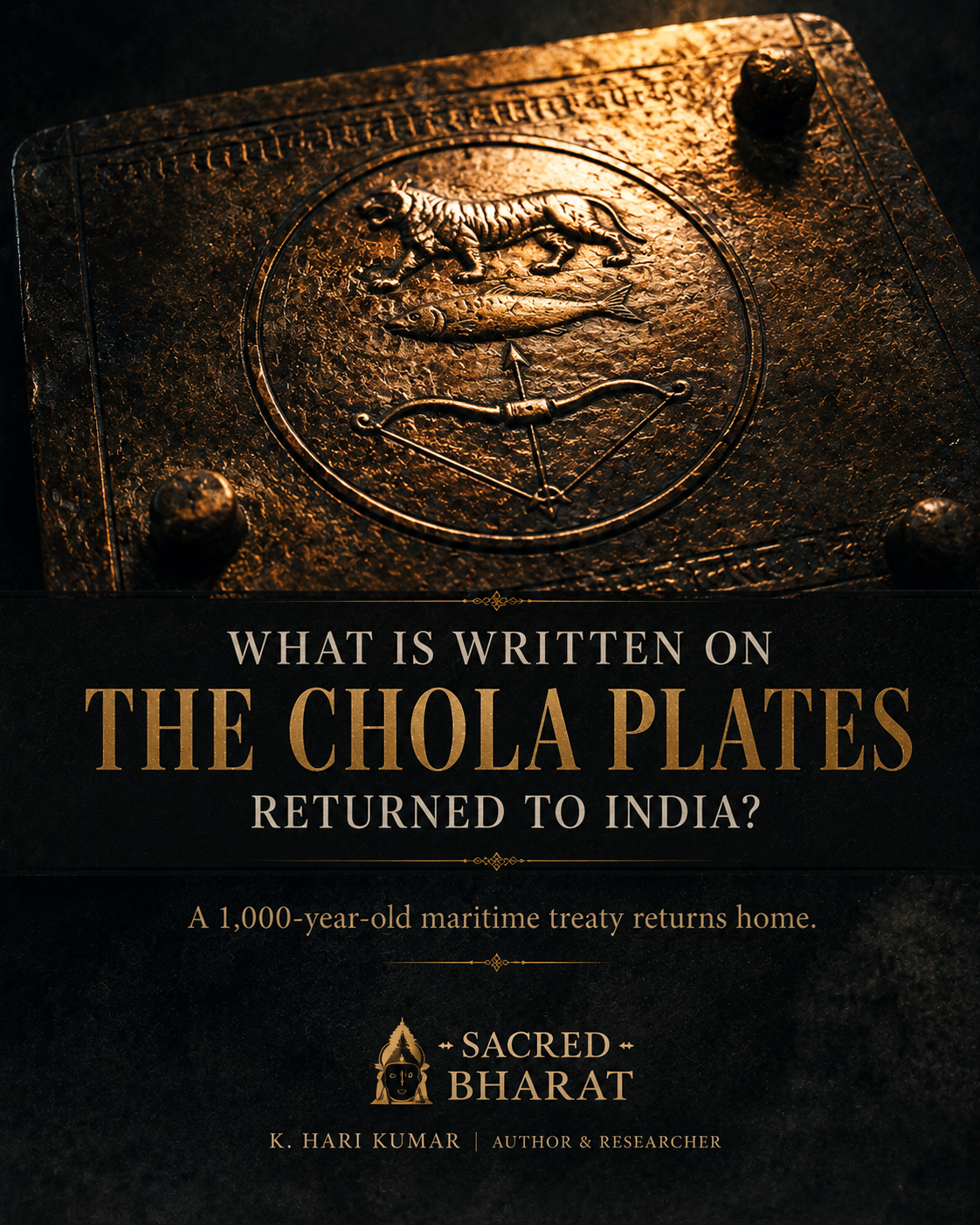
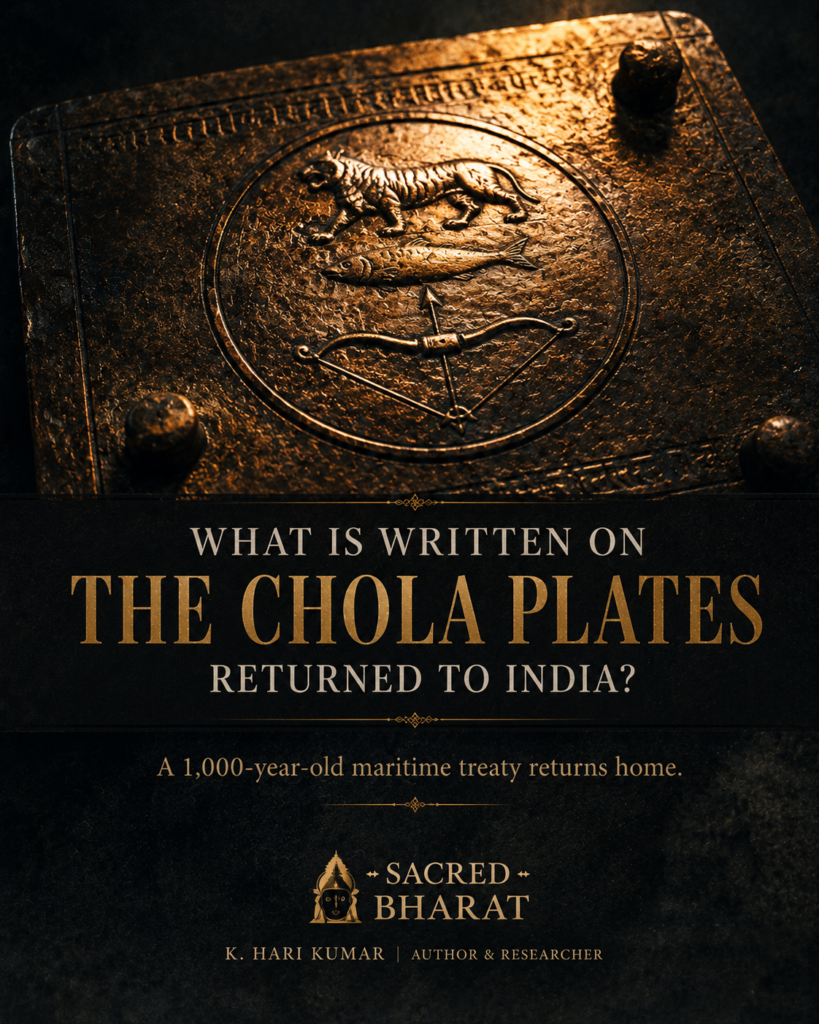
Issued during the early 11th century, this is the monumental core of the collection. It consists of 21 massive copper plates fastened together by a massive bronze ring. The ends of the ring are soldered together and secured under the Chola Royal Seal Emblem.
The Sanskrit Section (Plates 1–5): Written in the elegant Grantha script, this section serves as a grand genealogical and theological verification. It begins with praises to Lord Vishnu and traces the divine lineage of the Chola solar dynasty, validating the political legitimacy of the ruling house.
The Tamil Section (Plates 6–21): Written in Tamil, this section handles the explicit administrative, geographical, and legal reality of the charter.
The Smaller Leiden Plates (Or. 1688)
This smaller set consists of 3 copper plates held together by a separate bronze ring bearing the royal seal of King Kulōttunga Chola I (who reigned from 1070 to 1120 CE). It is written entirely in Tamil and acts as a secondary legal amendment ensuring the continuation of old rights.
What is Actually Written on the Plates?
The core text of the Larger Leiden Plates documents an extraordinary cross-border, inter-religious geopolitical event: the formalization of the Anaimangalam Grant.
The Oral Vow of Rajaraja I (1006 CE)
The plates record that in the 21st year of his reign, the legendary emperor Rajaraja Chola I (the builder of the Thanjavur Brihadisvara Temple) made a grand oral decree. He pledged the entire land tax and resource revenues of an entire village named Anaimangalam (near Nagapattinam) to support a Buddhist monastery.
This monastery was the Chulamanivarma Vihara, constructed in Nagapattinam by King Sri Chulamanivarman of the Sailendra Dynasty—the rulers of the maritime Srivijaya Empire (spanning modern-day Indonesia, Malaysia, and Sumatra).
The Copper Execution by Rajendra Chola I
Because Rajaraja I passed away before the verbal decree could be physically etched onto metal, his son, the great maritime conqueror Rajendra Chola I, executed his father’s final wish. He ordered the state scribes to engrave the oral command onto durable copper plates to preserve the legal right “for as long as the sun and moon endure.”
The Level of Administrative Precision
The Tamil text functions exactly like a modern, hyper-detailed property deed. It lists:
The exact boundaries of the village land down to the millimetre.
The specific irrigation systems, channels, and water rights assigned to the monastery.
Exemption from all state taxes (Irai-ili) for the Buddhist monks.
The names of local officials, witnesses, surveyors, and the royal engraver who executed the order.
The Deeper Symbolism of the Chola Royal Seal
To prevent anyone from altering or adding sheets to the legal text, the Chola blacksmiths cast a heavy bronze seal over the ring’s junction. The design is a masterpiece of imperial iconographic messaging:
The Seated Tiger: Positioned at the center, representing the Chola homeland and supreme authority.
The Twin Fish: Representing the Pandya Kingdom, completely subdued under Chola rule.
The Bow: Representing the Chera Kingdom, also conquered by the Cholas.
The Umbrella and Fly-Whisks (Chamaran): Placed at the very top, symbolizing universal sovereignty (Chakravartin status).
The Dynamic Message: The entire seal visually communicates a single message to anyone who looks at it: The conquests are complete, the internal rivalries are crushed, and this decree is final.
Current Status and The Homecoming (May 2026)
The repatriation of the Leiden Plates marks a triumph for India’s ongoing diplomatic push to reclaim cultural properties held overseas under colonial frameworks.
The Legal Breakthrough (2022–2023): Following the Netherlands’ finalization of a formal restitution policy for colonial-era artifacts in 2022, India formally staked its ownership claim through UNESCO’s Intergovernmental Committee (ICPRCP) in October 2023. The committee validated India as the rightful nation of origin.
The Official Restitution (May 16, 2026): During an official state summit in The Hague, the Executive Board of Leiden University officially repatriated the plates. The formal transfer took place in a ceremony attended by Prime Minister Narendra Modi and Dutch Prime Minister Rob Jetten.
The Present Status: The 30-kg copper plates are being officially transferred to the custody of the Archaeological Survey of India (ASI) in New Delhi, where they will undergo conservation and eventually be displayed to the public as foundational monuments of Tamil heritage and maritime diplomacy.
References / Citations:
Archaeological Survey of India (ASI), Epigraphia Indica, Volume XXII: The Larger and Smaller Leiden Plates.
UNESCO Intergovernmental Committee for Promoting the Return of Cultural Property (ICPRCP), 24th Session Report, October 2023.
K.A. Nilakanta Sastri, “The Cōḷas,” University of Madras, 1935 (Detailed historical context of the Anaimangalam grant).




Leave a Reply