
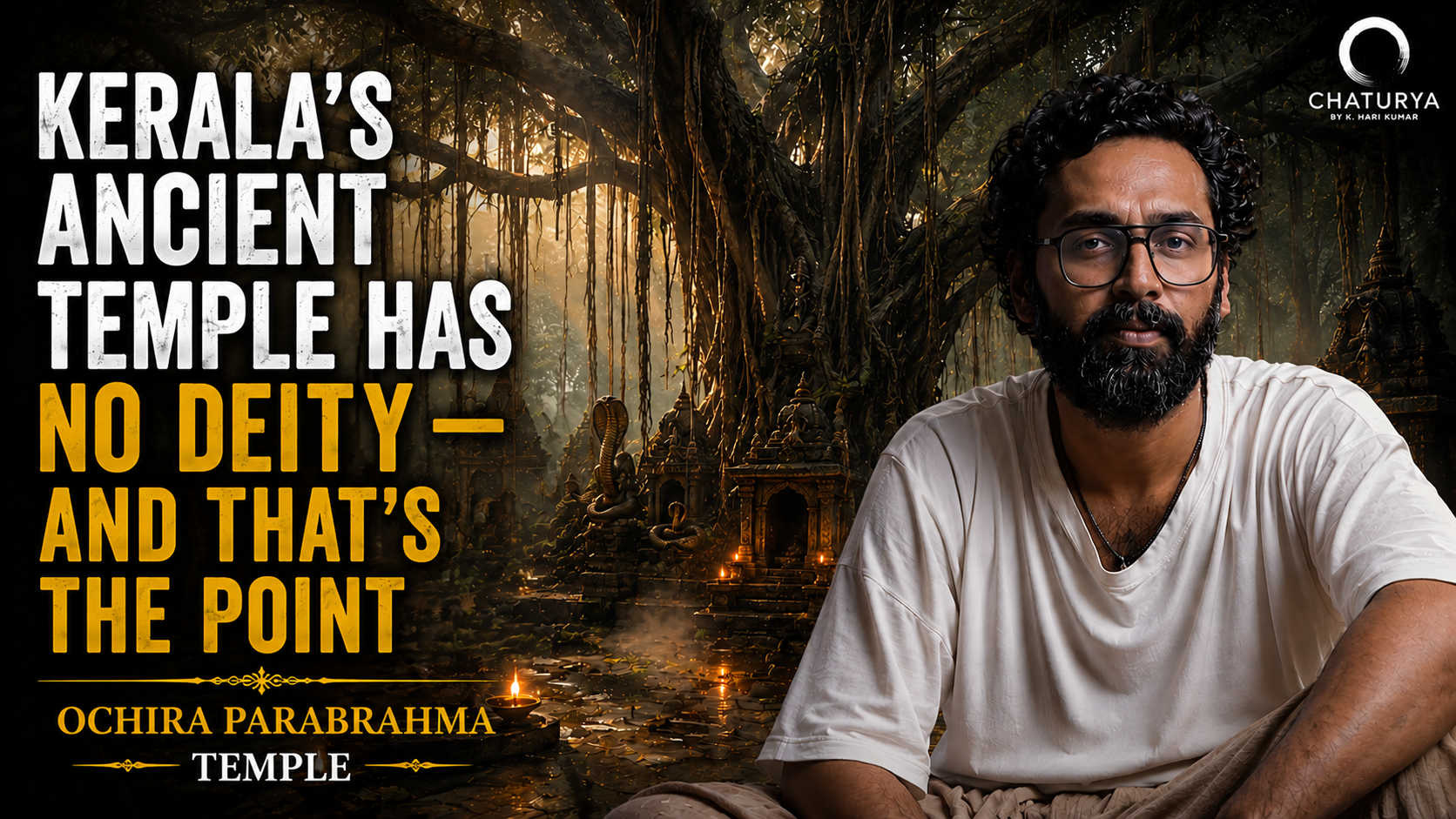
What if the most sacred temple in Kerala had no walls, no roof, and no idol? It is not a ruin. Not a shrine under restoration. It is a living, breathing place of worship where thousands of devotees gather every single day — and pray to the open sky. I am talking about the Ochira Parabrahmam Temple in Keralam. You can watch video below or read the rest of the article:
The Ochira Parabrahman Temple in Kollam district, Kerala, is one of the most unusual sacred spaces in all of India. While conventional South Indian temples place the divine within towering, architecturally precise gopurams, inner sanctums, and stone idols, Oochira does none of this. Here, a magnificent 50-foot gopuram opens not into a walled temple complex, but into 36 bare acres of earth, ancient banyan trees, and sky.
This is not absence. This is the highest theological statement possible: that Parabrahmam — the absolute, formless cosmic consciousness — cannot be confined by brick, mortar, or human imagination.
Where Is the Ochira Parabrahman Temple?
The Ochira Parabrahman Temple is located in Oachira, Kollam district, Kerala, approximately 65 km north of Thiruvananthapuram and 35 km south of Alappuzha on the NH 66 coastal highway. It sits at the heart of the historic Padanilam — a vast open ground that has served as a martial training field, pilgrimage hub, and community gathering space for centuries.
The Legend of Akavoor Chathan and the Namboothiri: A Story of Pure Faith
The spiritual origin of Oochira is preserved in the Aithihyamala, the celebrated Malayalam compilation of regional folklore and legend. And it begins, as the most powerful spiritual stories often do, with a subaltern — a servant whose faith puts his master to shame.
An orthodox Namboodiri Brahmin landlord had a devoted practice of worshipping the formless Parabrahmam every day. His servant, Akavoor Chathan, watched this daily ritual with growing curiosity. One day, he gathered the courage to ask his master a simple question:
“How does Parabrahmam actually look?”
Amused — and slightly contemptuous — the Namboothiri replied with a joke: “Parabrahmam takes the form of a Maadan Pothu.” A wild, divine bull.
An orthodox scholar would have dismissed this immediately. But Chathan was not an orthodox scholar. He was something rarer: a man of absolute, unfiltered faith. He took his master’s words as literal truth, directed his entire being toward the image of a Maadan Pothu, and for 41 consecutive days, he prayed with total surrender.
Moved by this unconditional devotion, the formless divine responded in form. A magnificent Maadan Pothu materialized — but it was visible only to Chathan.
The revelation of Chathan’s faith came during a journey. The Namboothiri looked back and was horrified to see their heavy travel bundles floating in midair — carried by something invisible. When the master touched Chathan, his spiritual sight opened, and he too could see the divine bull walking beside his servant, carrying their load with ease. The master’s arrogance had blinded him to what his servant’s simple faith had already made real.
A parallel oral tradition tells of Unnikkoran, a young illiterate man whose master similarly mocked him by pointing to a grazing bull in the distance. When they reached the dense banyan forests of Oochira, the divine bull became entangled in a thicket of hanging roots and vines. When Unnikkoran untangled them to free the animal, it dissolved into the earth.
The exact spot where that divine consciousness vanished into the soil is the sacred ground of Oochira.
To this day, the Ochirakkaala — the sacred bull — is the living symbol of the temple. Devotees do not offer prayers to stone idols; they feed and venerate the magnificent bulls that still roam the Padanilam.
What Does “Oochira” Mean? The Etymology Behind the Name
The origin of the name “Oochira” is a subject of ongoing linguistic debate, with several compelling theories.
The most spiritually resonant explanation traces the name to Omkarachira — combining Om, the primordial syllable representing Parabrahmam, with Chira, the Malayalam word for a reclaimed reservoir or water body. Others link it to Oymanchira (associated with a local chieftain named Oyman) or Uvachanchira, derived from Uvachan, a classical term for Lord Shiva.
However, historical cartography offers a more grounded explanation. In the early 19th century, British surveyors Ward and Conner conducted a comprehensive geographic survey of the Kingdom of Travancore. Their records documented a large reservoir at the center of a vast military training ground, known then as Onattuchira — built and maintained by the Kayamkulam Raja, also called the Odanattu Raja. Over decades of phonetic erosion in local dialect, Onattuchira eventually softened into Oachira.
The reservoir survives today as the Kallukettuchira, still visible near the temple grounds.
The Padanilam: A Military Training Ground Turned Sacred Space
To understand why the Ochira temple has no walls or roof, you must understand what the land beneath it actually is.
Padanilam literally translates to a military training ground and battlefield. This was not a place of quiet meditation — it was an arena of martial power, high stakes, and blood. Up until the early 20th century, the Padanilam sustained over 108 Kalaris — traditional martial art academies — spread across 52 local village subdivisions, making it the most concentrated heartland of Kalaripayattu in all of Kerala.
In the early 1800s, the visionary Prime Minister of the Travancore kingdom introduced land reforms, settled merchant families from Madras and Tirunelveli in the region, and gradually transformed the seasonal battlefield into a thriving pilgrimage hub. Yet even as commerce and pilgrimage replaced warfare, the temple grounds refused to be enclosed. The divine principle at Oochira — formless, boundless Parabrahmam — demanded space that reflected its nature.
If you walk into the Padanilam today, you pray facing the Aaltharas: stone-reinforced platforms built around ancient, sprawling banyan trees. The trees are the altar. The sky is the dome.
Even the local spirit geography reflects this all-encompassing theology. At the Yakshikkaav within the grounds, folklore recalls a volatile Yakshi — a female nature spirit — who once terrorized travelers. Instead of being exorcised or destroyed, she was integrated into the sacred geography by an ancient Mantravadi, her spiritual form absorbed into a sacred tree where she now stands as a protective guardian. At Oochira, nothing is excluded from the divine.
Ochirakkali: The Monsoon War Festival
If Oochira’s philosophical identity is defined by its radical openness, its most spectacular living expression is the Ochirakkali festival.
Celebrated on the first two days of the Malayalam month of Mithunam (mid-June), Ochirakkali transforms the rain-soaked Padanilam into a living museum of Kerala’s military heritage. The festival commemorates the historic Battle of Kayamkulam — the fierce conflict between the rising forces of Maharaja Marthanda Varma of Travancore and the independent Raja of Kayamkulam.
As the early monsoon rains flood the 36-acre field with knee-deep muddy water, men and boys from the East and West village subdivisions divide themselves into two massive mock armies. Led by their Kalari Aasans — veteran martial arts masters — they step into the thick mud armed not with theatrical props, but with real swords, shields, daggers, and heavy cane sticks.
To the thunderous rhythm of traditional drums, they launch into high-octane mock combat.
For 48 hours, the Padanilam wakes from centuries of sleep. This is not a performance for tourists. It is a fierce, full-contact tribute to ancestral memory — and one of the rare festivals in Kerala where caste and social divisions dissolve entirely inside the battlefield.
Other Festivals: Panthrandu Vilakku and the Spirit of Equality
The radical equality embedded in Oochira’s theology peaks again in November during the Panthrandu Vilakku — the Twelve Lamps festival.
For twelve days, thousands of pilgrims arrive at the Padanilam and build temporary huts of leaf and hay directly on the open sand. Wealthy landlords, day labourers, scholars, and merchants live side by side with minimal amenities, fasting and meditating beneath the open banyan canopy. The feudal hierarchy of the outside world is systematically dismantled. No one has a better room.
Throughout the year, the temple’s Annadana Mandhiram — its free food kitchen — feeds thousands of the poor, the sick, and the hungry every single day. At Oochira, serving the formless divine means directly serving human suffering.
Why Oochira Matters: A Theology of the Formless
Our ancestors built magnificent stone temples to help focus the restless human mind on the divine. Towering gopurams, inner sanctums lit by oil lamps, the fragrance of camphor and jasmine — all of it designed to pull the devotee inward, toward stillness.
But Oochira exists to remind us of something those stone walls cannot say.
Parabrahmam — the absolute cosmic consciousness — has no form, no boundary, and no location. When the Namboothiri’s mockery accidentally produced Chathan’s divine vision, it was not the bull that mattered. It was the faith. The formless responded to faith, not to architecture.
When you stand on the Padanilam at dawn, with your feet in the wet earth and the Kerala sky wide open above you, there are no walls to contain your prayer and nowhere for it to go except everywhere — which is, perhaps, exactly the point.
At Oochira, when you strip away the walls, the roof, and the human ego, the entire universe becomes the shrine of Parabrahmam.
How to Visit the Ochira Parabrahman Temple
Address: Oachira, Kollam District, Kerala — PIN 690526
Nearest railway station: Oachira Railway Station (on the Thiruvananthapuram–Ernakulam main line), approximately 1.5 km from the temple.
Best time to visit: June–July for the Ochirakkali festival; November for Panthrandu Vilakku. The temple is open year-round and can be visited on any day.
Dress code: Modest traditional or formal attire is expected within the Padanilam grounds.
Explore More on Chaturya
If this story of Oochira moved you, the full video — covering the complete military history of the Padanilam, the detailed Aithihyamala folklore, and the anatomy of Ochirakkali — is available on the Chaturya – The Fourth State YouTube channel.
Subscribe to Chaturya for weekly deep-dives into Hindu mythology, Puranic stories, South Indian temple folklore, and the hidden histories that mainstream history forgot.
May the formless divine be with you.

Leave a Reply