By K. Hari Kumar | Indian Mythology, Temple Traditions & Sacred Heritage
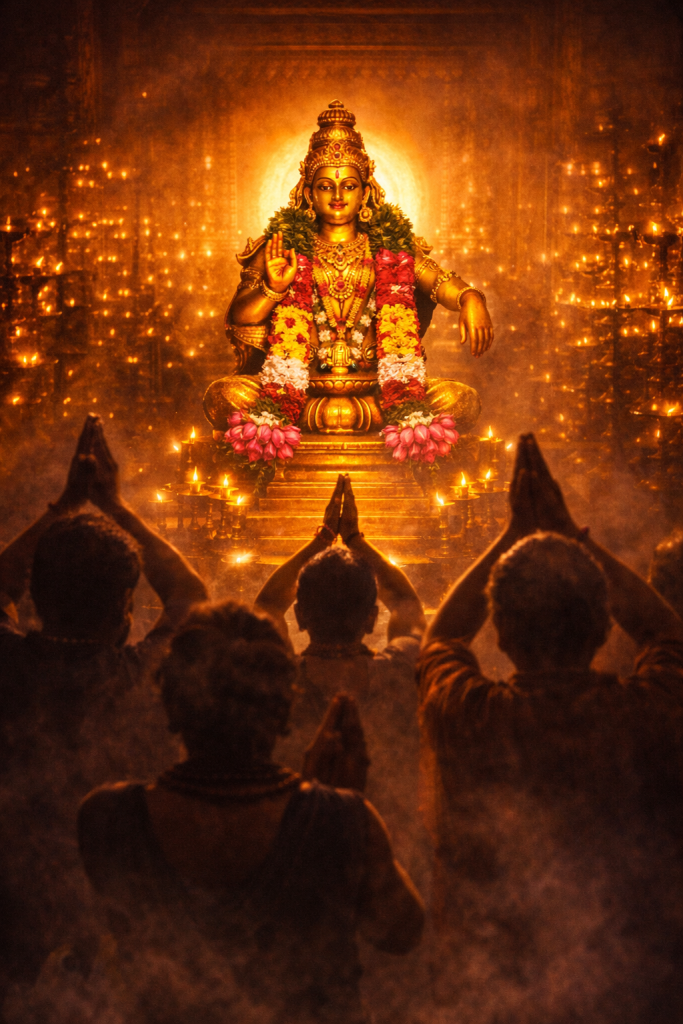
Eighteen steps stand between you and one of the most sacred darshans in the world.
But these are not ordinary steps. Each one is a battle. And before you even reach the first, you have already been fighting for forty-one days.
This is the Pathinettampadi — the sacred eighteen steps of Sabarimala. And the story behind them is one of the most profound pieces of spiritual architecture that ancient Bharat ever conceived.
The Steps That Cannot Be Rushed
Originally built from granite, the Pathinettampadi was later covered in Panchaloha — a sacred composition of five metals: gold, silver, copper, iron, and tin — in 1985, to preserve them from deterioration.
As per tradition, only those who have completed a 41-day penance and carry the sacred Irumudi Kettu on their head are permitted to set foot on these steps. The penance is total. No non-vegetarian food. No footwear. No indulgence. Forty-one days of stripping away everything that is not essential.
According to popular legend, Swami Ayyappa himself requested his earthly father, the King of Pandalam, to build a temple for him with eighteen steps. Every detail of this pilgrimage, in other words, was designed from the beginning — not by architects, but by the divine.
What Each Step Actually Means
The question every first-time pilgrim may ask is simple: why eighteen?
The answer is layered, ancient, and astonishingly precise. Each step corresponds to a stage of self-mastery drawn from Sankhya philosophy and bhakti tradition — a map of human bondage and the path to liberation.
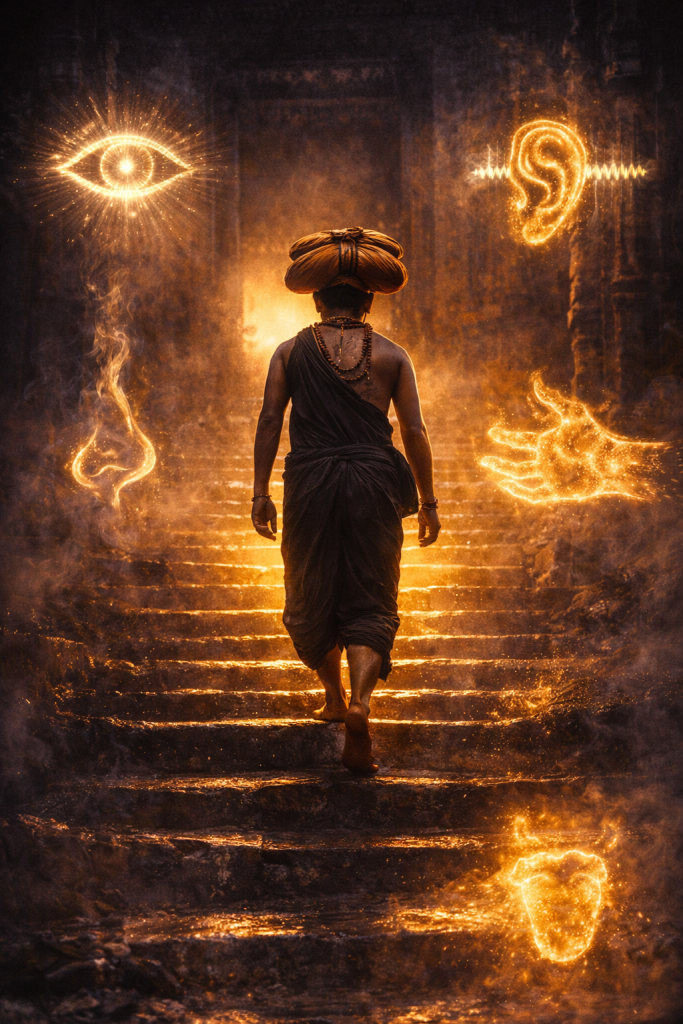
Steps 1 to 5 — The Five Senses (Panchendriyas)
The first five steps are called the Panchendriyas, symbolising the five human senses: sight, sound, smell, taste, and touch. These are the first gatekeepers of the mind. Every craving, every distraction, every pull of the world begins here — in the senses. By stepping over them, the devotee declares: I am not ruled by what I see, hear, or desire.
Steps 6 to 13 — The Eight Negative Emotions (Ashtaragas)
The next eight steps symbolise the Ashtaragas: Kama (desire), Krodha (anger), Lobha (greed), Moha (attachment), Madha (arrogance), Matsarya (unhealthy competition), Asooya (jealousy), and Dhumb (boastfulness).
Eight steps. Eight emotions that have destroyed friendships, families, kingdoms, and civilisations. The Mahabharata itself is a story of what happens when these eight run unchecked. At Sabarimala, the devotee climbs over every single one of them.
Steps 14 to 16 — The Three Gunas (Trigunas)
The next three steps represent the Trigunas — Sattva (goodness and purity), Rajas (passion and action), and Tamas (inertia and dullness). Every human being is a mixture of these three qualities. Even Sattva — the highest of the three — is still a quality of the created world, still a veil. To reach the divine, the devotee must transcend even goodness as a personal identity.
Steps 17 and 18 — Vidya and Avidya
The final two. The seventeenth step signifies Vidya — knowledge — and the eighteenth, Avidya — ignorance. It may seem strange that knowledge is an obstacle. But this is the deep wisdom of the tradition: even the pride of knowing, the attachment to one’s own understanding, must be surrendered at the threshold of the divine. Only when both knowledge and ignorance are left behind does the devotee stand — empty, open, ready — before Swami Ayyappa.
It is at this moment, having climbed all eighteen, that the devotee is believed to symbolically detach from all worldly ties — and becomes truly receptive to the divine presence. The words inscribed at the sanctum sanctorum say it all: Tatvamasi — Thou Art That.
The Rules of the Climb
The ascent is not merely symbolic. It is ceremonial in every detail.
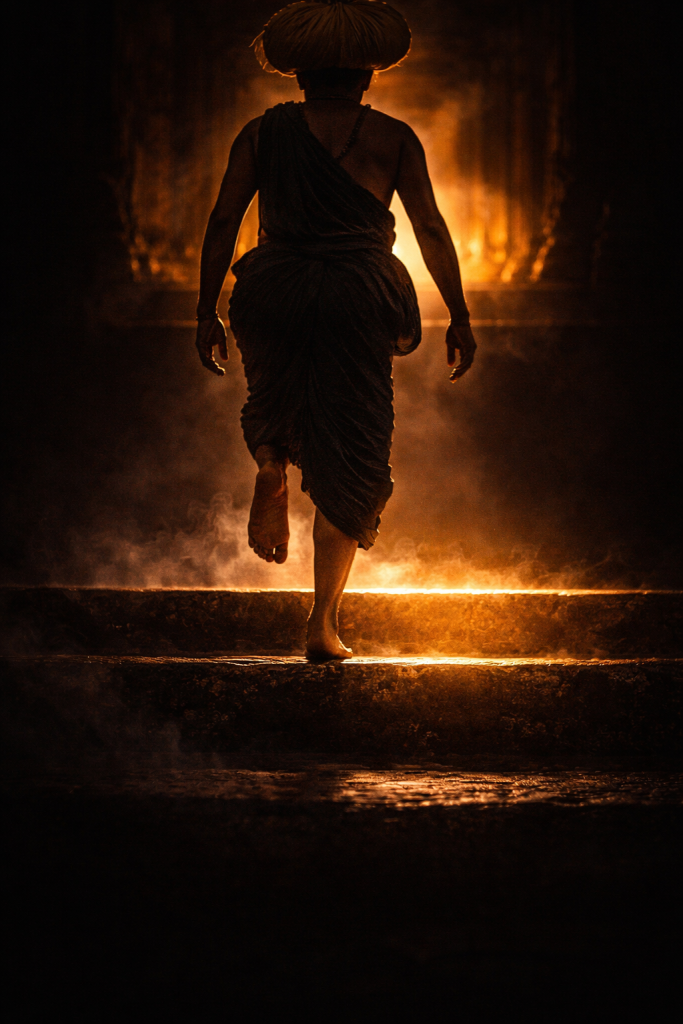
Pilgrims must begin the climb with their right foot on the first step. And when they descend, they do so facing backwards — their eyes never leaving the sanctum sanctorum. Even in leaving, they do not turn their back on the divine. Before both ascent and descent, a coconut is broken as an offering to the steps themselves.
The Irumudikettu — the sacred double bundle carried on the head throughout the pilgrimage — must remain in place for both the climb up and the climb down. It is the physical emblem of the vow, and removing it would mean the darshan is incomplete.
The Sacred Number 18
The number eighteen is not random. It runs through the spine of Sanatana Dharma like a golden thread.
The eighteen steps echo the eighteen Puranas authored by Veda Vyasa, the eighteen chapters of the Bhagavad Gita, and the eighteen days over which the Kurukshetra war was fought. There are also eighteen Shakti Peethas — the sacred seats of Goddess Shakti across the subcontinent.
Another interpretation holds that Ayyappa was a master of eighteen weapons, and that before merging into the idol at the sanctum sanctorum, he surrendered each weapon at one of the eighteen steps — an act of renunciation that turned a warrior into a god.
Some also believe the steps represent the eighteen hills that surround Sabarimala — as if the cosmos arranged the entire landscape of the Western Ghats to mirror the internal landscape of the human soul.
What It Means to Become a Guruswami
For the most devoted among Ayyappa’s followers, the pilgrimage to Sabarimala is not a once-in-a-lifetime event. It is a lifelong practice.
A pilgrim who climbs the Pathinettampadi eighteen times earns the highest title a Sabarimala devotee can receive — Guruswami. To mark this achievement, the Guruswami plants a young coconut sapling at Sannidhanam, the temple complex. A life planted like a seed. A tradition rooted like a tree.
A Staircase That the Ancient World Built for Us
There is something remarkable about the fact that this philosophy — the senses, the emotions, the gunas, knowledge, and ignorance — maps almost perfectly onto the frameworks of Sankhya, Vedanta, and the Bhagavad Gita. These are not unrelated traditions. They are the same river, flowing toward the same ocean.
The Pathinettampadi is, at its heart, an embodied philosophy. It takes the most abstract questions of human existence — what am I enslaved by? what must I release to be free? — and makes you walk through the answers, one step at a time, barefoot, with the weight of a sacred bundle on your head, and forty-one days of discipline already behind you.
No lecture hall. No book. Just eighteen steps and the truth of your own inner life beneath your feet.
That is the genius of ancient India. It did not just teach wisdom. It made you live it.
If this story stayed with you, there are thousands more waiting — from the forgotten folk deities of South India to the great epics and the temples that carry their memory. Author K. Hari Kumar has spent years bringing these stories to life.
📖 Explore K. Hari Kumar’s books on Indian mythology — available on Amazon and at leading bookstores.
📱 Follow @theharikumar on Instagram for daily stories from India’s ancient temples, mythology, and living traditions.
Swamiye Saranam Ayyappa.
Sources & References:
- Wikipedia — Pathinettampadi
- Official Sabarimala Temple — Pathinettam Padi
- Kerala Tourism — The Symbolic Significance of Pathinettampadi
- The Print — The Religious Significance of the 18 Steps at Sabarimala
- Grokipedia — Pathinettampadi
- Sabarimala.com — Holy Steps




Leave a Reply