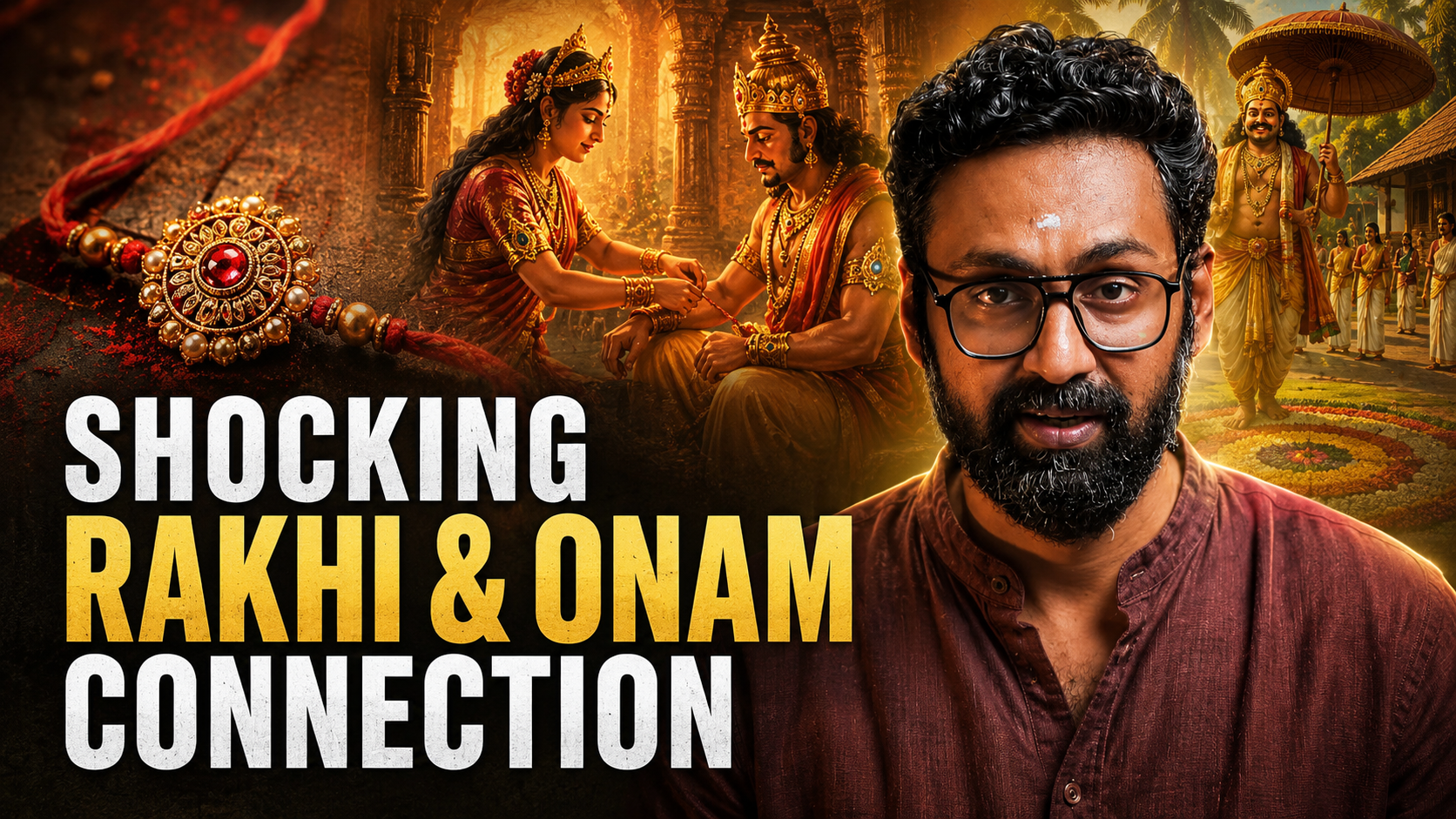
What if the story of Raksha Bandhan and the story of Onam are connected by the same legendary king? Every year, millions of people tie a rakhi on Shravana Purnima and, around the same season, Kerala prepares to welcome Maveli for Onam. At first glance, these seem like two entirely different traditions. One celebrates a sacred bond of protection, while the other remembers the annual return of a beloved king. Yet within a fascinating strand of Hindu and regional tradition, both stories lead us back to King Mahabali.
Watch the full episode on Chaturya – The Fourth State:
Raksha Bandhan Was Not Always About Brothers and Sisters
The modern Raksha Bandhan is usually understood as a celebration of the bond between brothers and sisters. A sister ties a rakhi around her brother’s wrist, and the thread represents love, protection and a promise of mutual affection. But the idea of raksha, or protection, and the sacred thread itself have much older ritual associations. The tradition of tying a protective thread, or rakshasutra, appears in Hindu ritual practices connected with protection, auspiciousness and sacred vows.
This older meaning gives the festival a fascinating depth. The rakhi is not merely an ornament worn on the wrist. It represents a bond and an obligation, a promise between two people. And one of the traditional stories associated with the mantra recited while tying the rakhi brings us to a king who lived far beyond the ordinary boundaries of the human world: Mahabali.
The King Beneath the Worlds
The story of Mahabali and Vamana is familiar to anyone who knows the traditions surrounding Onam. Mahabali was a powerful and generous king whose devotion to Bhagawan Vishnu and unwavering commitment to his word ultimately led to his encounter with Vamana, the dwarf incarnation of Vishnu. When Vamana asked for three paces of land, Mahabali granted the request. Vamana then assumed his cosmic form as Trivikrama and covered the worlds with two strides. With nowhere left for the third, Mahabali offered his own head.
Mahabali was sent to Sutala, but his story did not end there. According to the Puranic tradition, Bhagawan Vishnu granted him a boon and agreed to remain as the guardian of the entrance to Sutala. The image is extraordinary: the Lord of Vaikuntha standing at the doorway of the kingdom of the very king whose pride he had humbled.
But this created a problem in Vaikuntha. Devi Lakshmi, the goddess of fortune and Vishnu’s consort, found herself separated from her husband. According to a regional tradition associated with the Raksha Bandhan story, she descended to Sutala disguised as a woman in need of shelter. Mahabali welcomed her with the generosity for which he was renowned, and in time accepted her as his sister.
Then came Shravana Purnima, the same full moon on which Raksha Bandhan is traditionally observed.
Lakshmi tied a sacred thread around Mahabali’s wrist.
When Mahabali asked his new sister what she desired, she revealed her true identity and asked for Vishnu to return with her to Vaikuntha. Mahabali was now faced with two promises. Vishnu had promised to guard his kingdom, while Mahabali had accepted Lakshmi as his sister and was bound by the sacred bond he had just entered into.
He chose to honour his word.
Mahabali released Vishnu from his obligation, allowing him to return to Vaikuntha with Lakshmi.
The Rakhi Mantra Remembers Bali
This is where the connection becomes particularly intriguing.
The traditional mantra recited during the tying of a protective thread invokes King Bali:
Yena baddho Bali raja, Danavendro mahabalah;
Tena tvaam abhi-badhnaami, rakshe maa chala maa chala.
Its meaning is approximately: “With the same bond by which the mighty King Bali, lord of the Danavas, was bound, I bind you. O protective thread, do not waver.”
The significance is easy to miss. The story does not present Bali as someone who was physically forced to honour the thread. He honoured it because he had given his word. The raksha sutra therefore becomes more than a request for protection. It becomes a symbol of duty, honour and a promise that must be upheld.
And this brings us back to Kerala.
The Same Mahabali Returns During Onam
In Kerala’s tradition, the Mahabali who resides in Sutala is remembered as Maveli, the beloved king who returns to visit his people during Onam. The festival transforms the memory of Mahabali into one of the most emotionally powerful traditions in Kerala: the king returns once every year to see his kingdom and his people. You can read the detailed story of Onam here.
This is where the Onam and Raksha Bandhan connection becomes so fascinating. Raksha Bandhan remembers Mahabali through the sacred bond he accepted from Lakshmi in Sutala, while Onam remembers the same legendary king through his bond with the people of his kingdom. The stories emerge from different regional traditions and carry different meanings, but they converge around the same figure and, more importantly, around the same quality: Mahabali’s word was his bond.
The connection should therefore not be understood as suggesting that Onam and Raksha Bandhan are the same festival. They are not. Their customs, histories and regional expressions are distinct. What connects them is a fascinating Mahabali tradition in which the same king becomes a symbol of loyalty, generosity, protection and fidelity to one’s word.
A Bond That Goes Beyond Blood
The idea becomes even richer when we look at other stories associated with the sacred thread.
In the Mahabharata tradition, Draupadi binds Krishna’s injured finger with a piece of cloth, and Krishna accepts the gesture as a bond of affection and protection. Another popular tradition tells of Yama and Yamuna, in which Yamuna welcomes her brother and ties a sacred thread to him. These stories suggest that raksha was never simply about biological relationships. At its heart was the idea of a promise made between people who accepted responsibility for one another.
That is why the story of Mahabali fits so naturally into the symbolism of Raksha Bandhan. Bali’s greatness lies not merely in his power, but in his willingness to honour a promise even when doing so requires sacrifice.
And that same quality is central to the way Kerala remembers him during Onam.
One King. Two Festivals.
There is something beautiful about the fact that two festivals celebrated in very different parts of India can preserve different memories of the same legendary figure.
During Raksha Bandhan, the sacred thread recalls Mahabali and the power of a promise.
During Onam, the people of Kerala welcome Maveli, the king who is believed to return from Sutala to visit his kingdom.
One festival remembers a bond accepted by a king.
The other remembers the bond between a king and his people.
Both, in their own way, celebrate dharma expressed through relationships.
Perhaps that is the deeper connection between Raksha Bandhan and Onam. The thread is not merely something tied around the wrist, just as Onam is not merely a feast served on a banana leaf. Beneath both traditions is an older civilisational idea: that relationships become sacred when they are strengthened by responsibility, affection and the willingness to keep one’s word.
And so, when the rakhi is tied this Shravana Purnima, remember the king whose name is still preserved in its ancient mantra.
And when the flowers of Onam begin to fill the courtyard and Maveli comes home, remember that the same king lives in another story too.
One thread. Two festivals. One Mahabali.
A king whose greatest treasure was not his kingdom, but his word.




Leave a Reply