
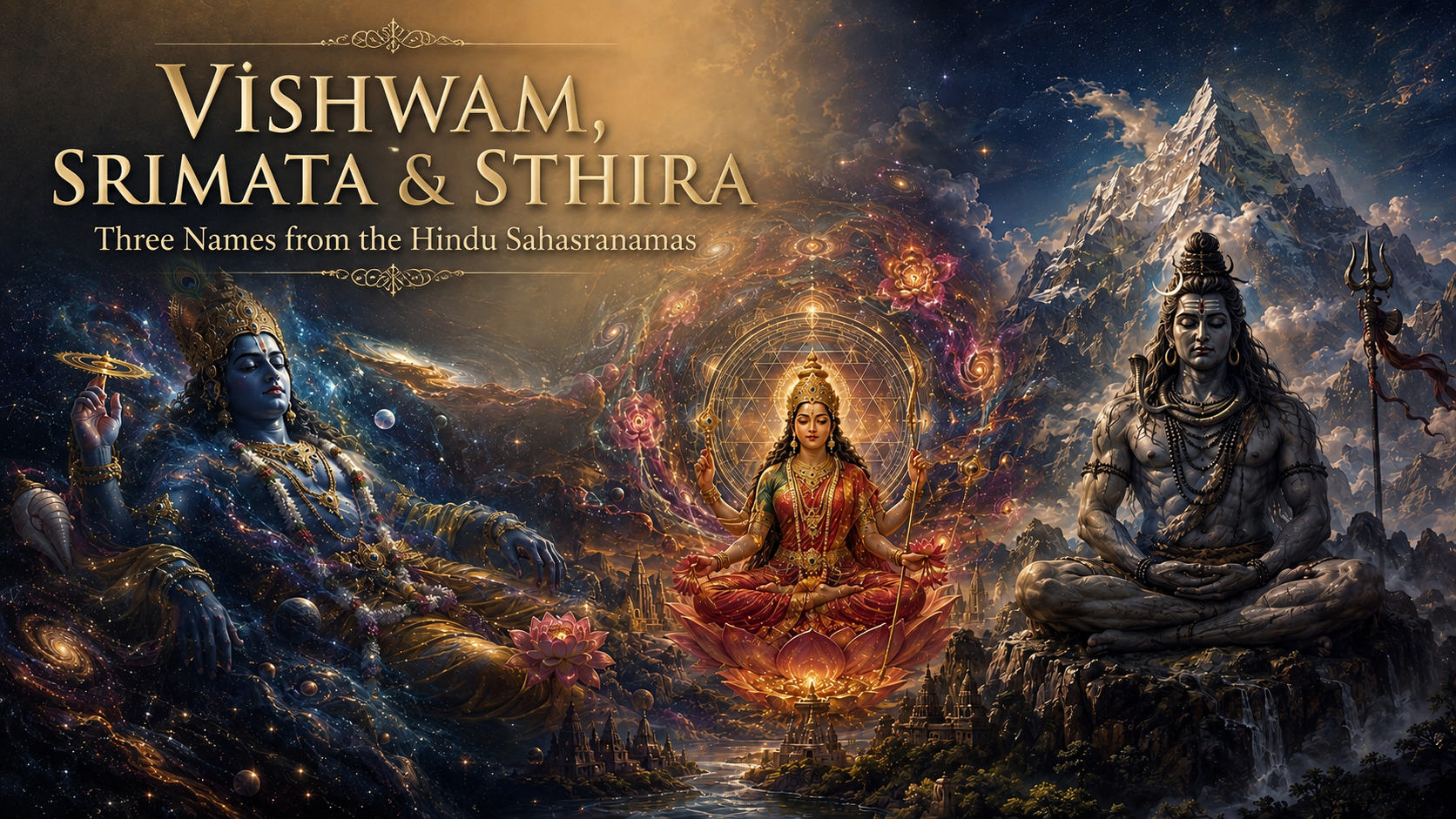
What if three names from three Hindu Sahasranamas (lit. thousand names) could offer us three completely different ways of imagining the Divine?
There is something fascinating about the importance given to names in the sacred traditions of India. A name is rarely just a label. In the world of Hindu philosophy and devotion, a divine name can contain an entire idea. It can describe the nature of a deity, reveal a cosmic function, express a relationship between the Divine and the devotee, or point towards something so vast that ordinary language struggles to contain it. This is perhaps why the tradition of the Sahasranama is so powerful. A thousand names do not merely give us a thousand descriptions of a deity; they give us a thousand ways of approaching the same mystery.
The Vishnu Sahasranama, Lalita Sahasranama and Shiva Sahasranama each present the Divine through a remarkable succession of names. Each name opens another door, inviting the devotee to pause, contemplate and see the deity from another perspective. But what happens when we look at the very first name of each of these three great traditions? What kind of vision of the Divine emerges when we place those names beside one another?
The answer is unexpectedly beautiful.
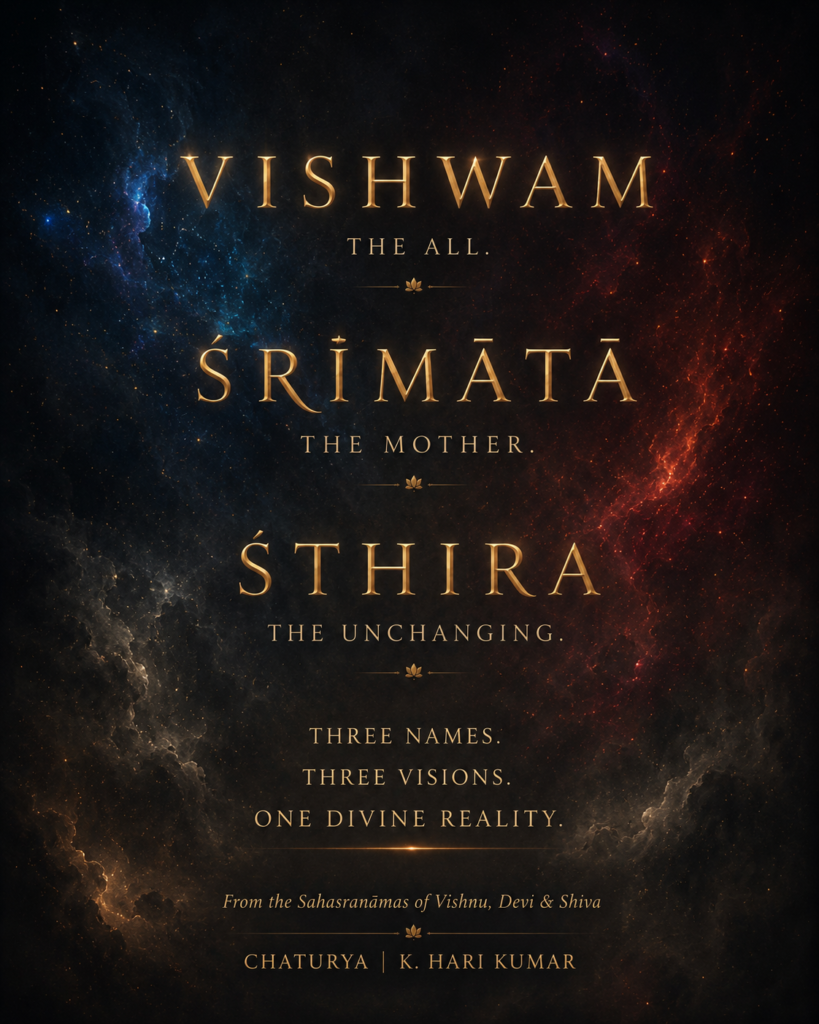
Vishwam – The All.
Srimata – The Mother.
Sthira – The Unchanging.
Three names. Three visions of the Divine. And together, they create a fascinating meditation on existence itself.
Vishwam: The Divine as the All
The Vishnu Sahasranama begins with a verse familiar to millions of devotees:
Vishwam Vishnur Vashatkaro…
Its first name is Vishwam.
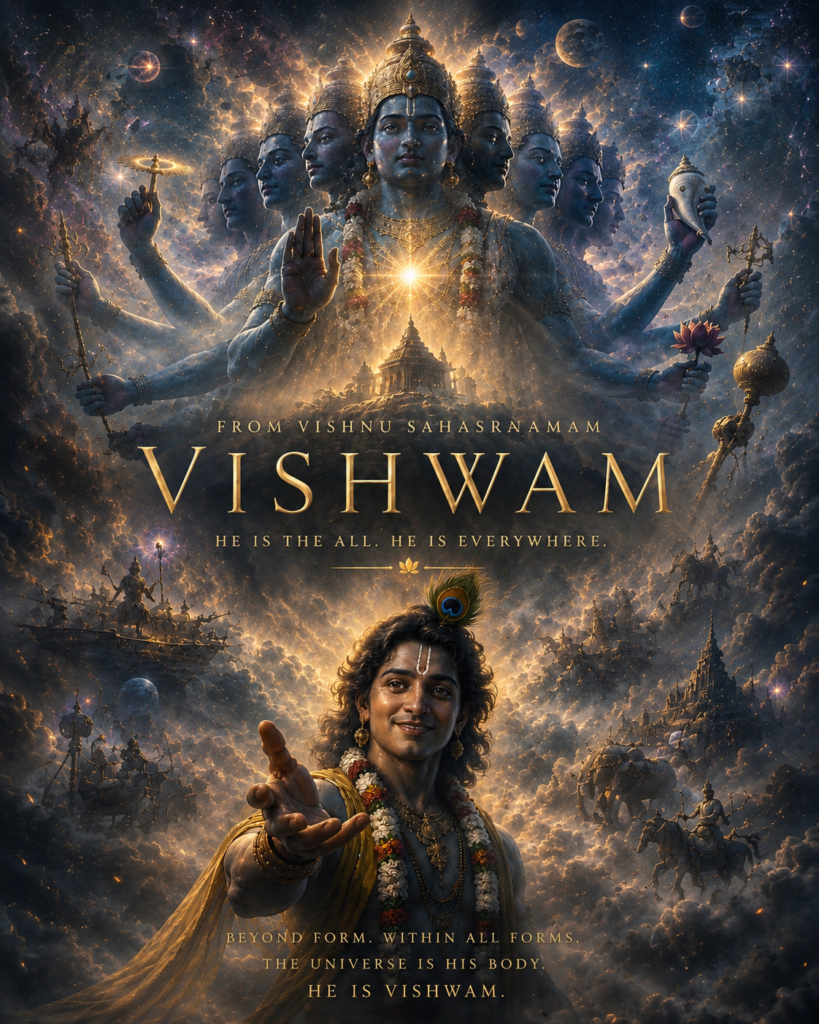
The word is commonly understood as the universe, the All, or the totality of existence. There is something almost audacious about beginning a thousand names of Vishnu with the universe itself. One might expect the first name to describe Vishnu as a ruler, protector, warrior or preserver. Instead, the hymn begins by turning our attention towards everything that exists.
Vishnu is not merely the One who rules the universe.
He is Vishwam.
The distinction is profound. If the universe were simply a creation existing separately from its creator, we could imagine Vishnu as a divine sovereign standing somewhere beyond it, governing the worlds from afar. But traditional interpretations of the name open another possibility. The Divine is understood not merely as being outside creation, but as pervading it. The universe becomes part of the very contemplation of Vishnu.
This gives us an extraordinary way of imagining the cosmic form of Mahavishnu.
We often picture a gigantic deity surrounded by stars and galaxies, with the cosmos spread behind him like an elaborate backdrop. But what if we looked at the image differently? What if the stars were not simply around him, but within him? What if the galaxies, worlds and countless forms of life were all expressions of the same vast reality?
Imagine standing before Mahavishnu and watching the universe unfold through his cosmic presence. Galaxies turn slowly in the darkness. Stars are born and disappear. Worlds emerge, flourish and eventually dissolve. Clouds of cosmic dust drift across distances so immense that the human mind can barely comprehend them. And yet, beneath all this movement, there is a strange sense of unity.
Nothing appears entirely separate.
The universe is not merely something Vishnu possesses.
It is Vishwam.
This is why the first name of the Vishnu Sahasranama lends itself so beautifully to a cosmic visual interpretation. The image should not merely be large; it should make us question the boundaries between the Divine and existence itself. Rama and Krishna can stand before us in a familiar human form, smiling gently, while behind him the cosmic form of Mahavishnu extends far beyond the limits of the visible world.
Stars burn. Galaxies move. Creation continues its endless dance.
And somehow, all of it belongs to the same presence.
Vishwam.
The All.
Srimata: The Divine as Mother
Then the imagery changes completely.
The Lalita Sahasranama begins with:
Srimata Srimaharajni Srimatsimhasaneshvari…
Its first name is Srimata.
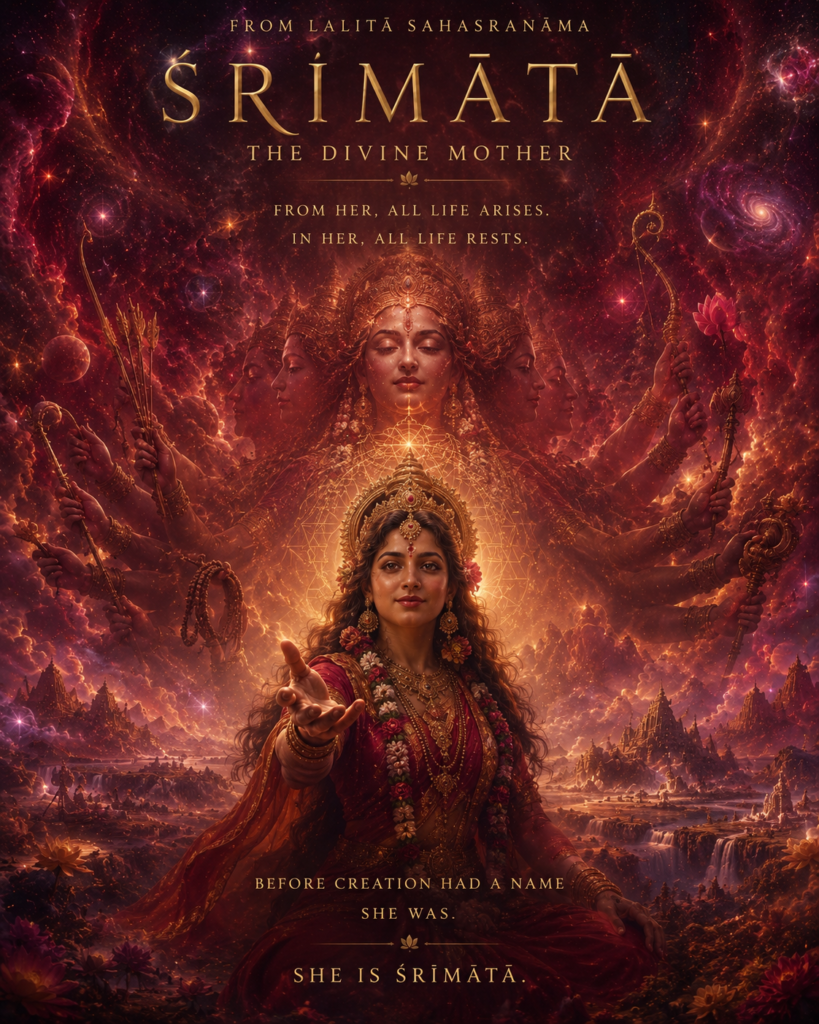
The name may be understood as the Divine Mother, the revered Mother, or the auspicious Mother. And there is something deeply significant about beginning the thousand names of Lalita with motherhood.
If Vishwam makes us look outward towards the totality of existence, Srimata changes the relationship between ourselves and that existence. The universe is no longer merely something we behold. It becomes something that has emerged from the Mother.
This is where the idea of motherhood becomes much more significant than an emotional metaphor.
A mother gives birth, but motherhood is also associated with nourishment, protection, intimacy and an enduring relationship between the source and that which emerges from it. To approach Lalita as Srimata is therefore to contemplate the Divine as the Mother of existence itself.
The Lalita Sahasranama soon expands this vision through a magnificent sequence of names. Among the early names is Chidagnikundasambhuta, the One who arises from the fire of consciousness. The hymn then moves through descriptions of her form, her qualities, her abode and her cosmic activity.
The Goddess is at once intimate and immeasurable.
She is beautiful, but she is also immensely powerful.
She is Mother, but she is also the cosmic force through which existence itself unfolds.
This gives the name Srimata a very different emotional quality from Vishwam.
Vishwam makes us feel the scale of existence.
Srimata makes that existence feel intimate.
Instead of imagining the cosmos as an enormous and perhaps indifferent expanse, we begin to imagine it as something that has emerged from a living, conscious source.
For this reason, a visual interpretation of Srimata should not simply place Lalita Tripurasundari against a background of stars. The cosmos itself should appear to emerge from her presence.
Galaxies could resemble flowers opening across an infinite celestial landscape. Stars could appear like seeds of light scattered through darkness. Nebulae might take the form of enormous petals, while the subtle geometry of the Sri Chakra emerges almost invisibly within the cosmic atmosphere.
Creation does not feel mechanical.
It feels alive.
The Divine Mother is not simply standing within the universe.
The universe is emerging around her.
And suddenly, the immeasurable cosmos feels less distant.
It feels held.
Sthira: The Divine as the Unchanging
Then comes Shiva.
The Shiva Sahasranama opens with:
Sthirah Sthanuh Prabhur Bhanuh…
The first name is Sthira.
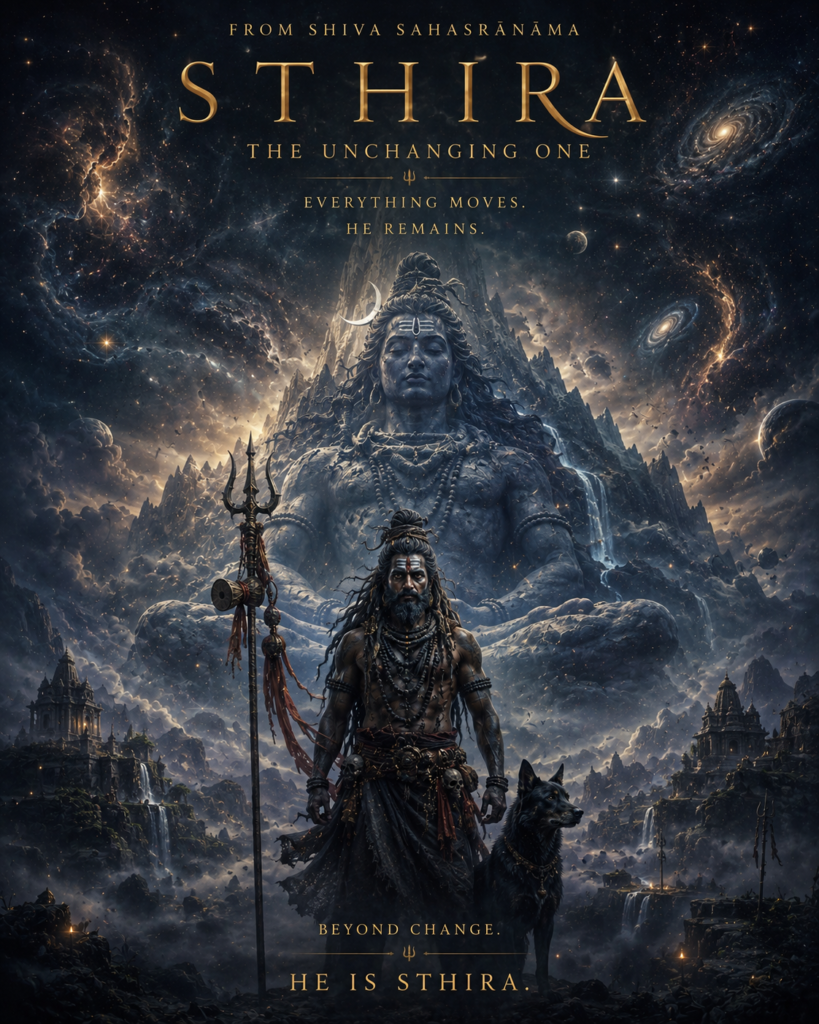
The word carries the sense of being steady, firm, stable or unmoving. The name that follows it, Sthanu, deepens the same imagery, evoking firmness and immovability.
And with this name, our vision of the Divine changes once again.
If Vishnu is the All, and Lalita is the Mother from whom that All emerges, Shiva becomes the One who remains steady while everything else changes.
Look around us.
Everything moves.
Mountains rise and erode. Rivers change their courses. Civilisations appear and disappear. Human bodies grow old. Thoughts arrive and vanish. Kingdoms that once seemed eternal become ruins beneath the earth. Even the stars themselves are born, burn for unimaginable periods of time and eventually disappear.
The universe is movement.
And yet the most enduring image of Shiva is one of profound stillness.
He sits upon Kailasa.
His eyes are closed.
His body is still.
The world continues around him, but he appears untouched by its restless movement.
There is a beautiful contradiction here. Shiva is surrounded by forces of destruction and transformation, yet the deity himself can appear utterly unmoving. He exists at the centre of a universe that never stops changing.
That is the idea I find most fascinating about Sthira.
Imagine Bhairava standing in the foreground, intense and powerful, while behind him an immense Shiva sits almost indistinguishable from Mount Kailasa itself. Around him, the universe continues its endless motion. Galaxies turn. Clouds drift. Stars appear and disappear. Cosmic rivers flow across the darkness.
Everything moves.
But Shiva remains.
Everything changes. He remains.
That is the visual world of Sthira.
Three Names. Three Ways of Seeing.
When these three names are placed beside one another, something extraordinary begins to emerge.
Vishwam.
The Divine is everything.
Srimata.
The Divine is the Mother from whom everything emerges.
Sthira.
The Divine is that which remains steady while everything else changes.
Of course, Hindu theology cannot be reduced to three simple definitions. The different sampradayas, philosophical schools, scriptures and commentarial traditions have developed enormously rich understandings of Vishnu, Devi and Shiva. These names should not be used to flatten that diversity into neat philosophical categories.
But as a meditation, the three names offer us three fascinating directions in which the human mind can turn.
We can look outward, towards the totality of existence.
We can look towards the source from which existence emerges.
Or we can look inward, towards that which remains steady beneath the constant movement of life.
Perhaps this is one of the great strengths of the Hindu Sahasranama tradition.
A thousand names do not necessarily mean a thousand different gods.
They can mean a thousand different ways of approaching the Divine.
One name may invite us to contemplate power. Another compassion. Another time. Another death. Another creation. Another silence. Another the universe itself.
The name becomes more than a description.
It becomes a way of seeing.
Why Divine Names Matter
In ordinary life, a name generally tells us who someone is. It identifies a person and distinguishes that person from someone else.
But a divine name can do something more.
Consider the difference between simply saying Vishnu and contemplating Vishwam.
The first identifies the deity.
The second asks us to contemplate existence itself as an expression of the Divine.
Likewise, Lalita becomes something profoundly intimate when we approach her as Srimata. She is not merely a goddess associated with a particular form, mythology or iconography. She is approached as Mother—the source from whom existence emerges and the presence in which it is sustained.
And then there is Shiva.
The name is familiar to almost anyone who has grown up around Hindu traditions. But when that familiar deity is encountered through Sthira, our attention is directed towards another quality altogether: stillness, stability and that which remains when everything else changes.
The name almost becomes an instruction.
Look at what changes. Look at what remains.
And then ask where you stand in relation to both.
When Theology Becomes Visual
There is another reason these three names lend themselves so beautifully to visual storytelling.
Indian sacred traditions have always understood the power of visual imagination. A temple can turn theology into architecture. A murti can transform an abstract philosophical principle into a form that can be approached and worshipped. A painting can preserve a story across generations. A ritual can turn an idea into something experienced through the body.
In the modern context, cinema can do something similar.
It can take an abstract idea and allow us to feel it.
That is what makes these three names particularly fascinating as subjects for visual interpretation.
For Vishwam, the universe itself becomes the body of the Divine.
For Srimata, creation appears to emerge from the presence of the Divine Mother.
For Sthira, an entire cosmos remains in motion around Shiva while he remains completely still.
These images are not intended to suggest that there is only one possible theological interpretation of these names. They are visual meditations—attempts to take a Sanskrit word, listen to the philosophical world contained within it, and then ask a simple question:
If this name were a world, what would that world look like?
Perhaps this is where Hindu philosophy and visual storytelling meet.
A word becomes an image.
An image becomes a feeling.
And sometimes, a feeling can take us closer to an idea that words alone cannot fully contain.
Three Names. One Mystery.
In the end, these three names lead us towards the same fundamental question:
What do we mean when we speak of the Divine?
Is the Divine the totality of existence?
Vishwam.
Is the Divine the Mother from whom that existence emerges?
Srimata.
Or is the Divine the eternal stillness beneath all movement and change?
Sthira.
Perhaps the answer depends upon where we are standing.
There are moments when life makes us look outward, when the sheer scale of existence leaves us humbled. There are moments when we need to feel that the universe is not merely an indifferent expanse, but something we can approach as Mother. And there are moments when everything around us seems to be changing too quickly, when what we need most is the reminder that beneath all movement there may be a deeper stillness.
Three names can therefore become three ways of approaching the same mystery.
The All.
The Mother.
The Unchanging.
And perhaps the beauty lies not in choosing between them, but in allowing each name to open another door.
Because in the world of Hindu sacred names, a word is rarely just a word.
Sometimes, a name is a universe waiting to be seen.
Read my article on Sriramdesh.
Frequently Asked Questions
What is the Vishnu Sahasranama?
The Vishnu Sahasranama is a traditional hymn consisting of a thousand (1008) names of Bhagawan Vishnu. It is one of the most widely recited devotional texts associated with Vishnu and offers numerous theological and devotional ways of contemplating the Divine.
What does Vishwam mean in the Vishnu Sahasranama?
Vishwam is the first name of the Vishnu Sahasranama. It is commonly understood as the universe, the All or the totality of existence. Traditional interpretations also connect the name with the idea of pervasion, making it a powerful expression of Vishnu’s relationship with the cosmos.
What is the Lalita Sahasranama?
The Lalita Sahasranama is a hymn containing a thousand names of Goddess Lalita Tripurasundari. It is one of the central devotional texts of the Sri Vidya tradition and explores the Goddess through her cosmic, philosophical and intimate aspects.
What does Srimata mean?
Srimata is the opening name of the Lalita Sahasranama. It is generally understood as the Divine Mother or the auspicious Mother. The name invites contemplation of Lalita as the Mother of existence and as the source from which creation emerges.
What is the Shiva Sahasranama?
The Shiva Sahasranama is a traditional collection of a thousand names of Bhagawan Shiva. Different textual traditions preserve versions of the Shiva Sahasranama, and the names explore Shiva’s many attributes, cosmic functions and philosophical dimensions.
What does Sthira mean in the Shiva Sahasranama?
Sthira is the opening name in the Shiva Sahasranama version discussed in this article. The Sanskrit word conveys the sense of being steady, firm, stable or unmoving. In a devotional meditation, it can therefore evoke Shiva as the still and unchanging presence amidst the constant movement of existence.
Are Vishwam, Srimata and Sthira names of three different Gods?
They are names associated respectively with Vishnu, Lalita and Shiva in the Sahasranama traditions discussed here. However, the purpose of this article is not to suggest that these three names provide exclusive or exhaustive definitions of the three deities. Rather, they offer three different ways of contemplating the Divine: as the All, as the Mother and as the Unchanging.
Why are there a thousand names of Hindu deities?
A Sahasranama presents numerous names through which devotees can contemplate different qualities, manifestations, relationships and philosophical dimensions of a deity. The names therefore function not simply as identifiers, but as objects of remembrance, meditation and devotion.
What is the significance of Sahasranama in Hindu tradition?
The Sahasranama tradition allows devotees to approach the Divine through repeated contemplation of sacred names. Each name can become a point of meditation, allowing a single word to open into a larger theological or devotional idea.
What is the connection between Hindu philosophy and divine names?
In many Hindu philosophical and devotional traditions, a divine name can carry much more than an identifying function. It can express an attribute of the Divine or point towards a larger metaphysical idea. This is why names such as Vishwam, Srimata and Sthira can become starting points for contemplating the nature of existence itself.




Leave a Reply