
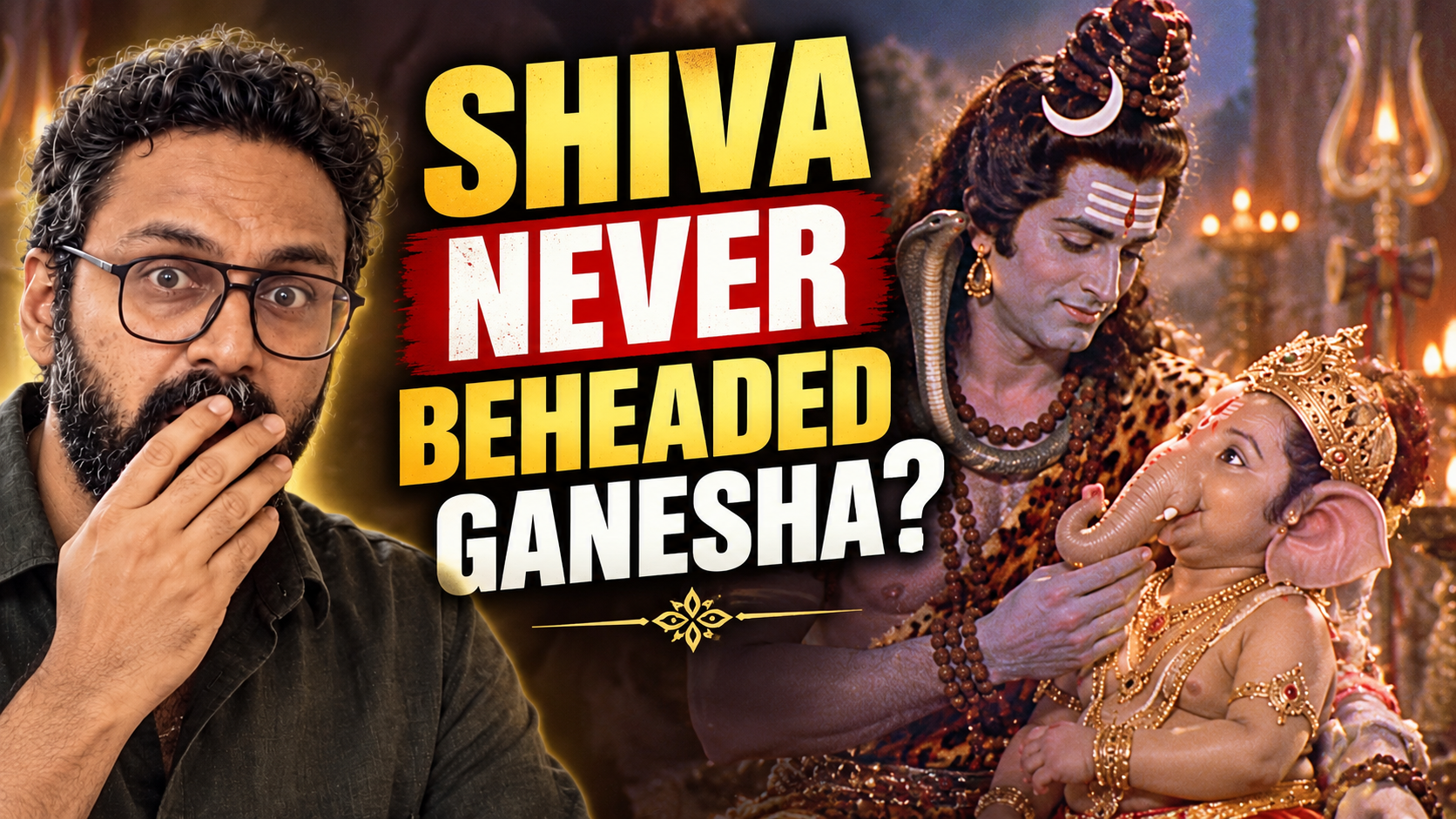
Every year, as Ganesh Chaturthi approaches, millions of homes prepare to welcome Ganesha. Clay idols are brought home, lamps are lit, modaks are offered, and the familiar image of the elephant-headed deity appears everywhere. Most of us know the story we were told as children. Parvati creates a young boy from the paste of her own body and asks him to guard the entrance while she bathes. Shiva arrives, the boy refuses to let him pass, and in a moment of terrible anger, Shiva severs his head. The boy is eventually restored with the head of an elephant and becomes Ganesha.
It is one of the most powerful stories in Hindu mythology. But it is not the only Ganesha birth story found in the Puranas.
Another account, preserved in the Brahma Vaivarta Purana, offers a radically different explanation for Ganesha’s birth and transformation. Here, there is no turmeric paste, no confrontation at Parvati’s doorway and no beheading by Shiva. Instead, the story begins with Parvati’s longing for a child, a year-long spiritual vow known as the Punyaka Vrata, the descent of the Supreme Divine, and the mysterious intervention of Shani Dev.
And suddenly, the familiar story of why Ganesha has an elephant head becomes something far more complex.
The Ganesha Story We Think We Know
The best-known account of Ganesha’s birth is associated with the Shiva Purana. In this version, Devi Parvati creates a young boy from the substances of her own body and gives him life. She appoints him as the guardian of her chamber and instructs him not to allow anyone to enter.
Then Shiva returns.
The boy does not recognise him and refuses him entry. What follows is a confrontation between Shiva and the child who is determined to obey his mother’s command. The conflict escalates, and Shiva ultimately severs the boy’s head.
Parvati’s grief and fury shake Kailasa. To restore the child, an elephant’s head is brought and placed upon his body. The boy rises again, transformed into the deity whom we know as Ganesha, the remover of obstacles and the one traditionally invoked before auspicious beginnings.
This story has become deeply embedded in the cultural memory surrounding Ganesh Chaturthi. But the Puranic tradition does not always tell the same story in the same way.
In the Brahma Vaivarta Purana, specifically its Ganapati Khanda, Ganesha’s birth follows an entirely different path.
And it begins with Parvati’s desire to become a mother.
Parvati and the Punyaka Vrata
The story begins on Kailasa.
Parvati desires a child, one who will possess extraordinary wisdom, strength and spiritual purity. Shiva, absorbed in his yogic detachment, advises her to undertake the Punyaka Vrata, a sacred vow undertaken to generate spiritual merit.
What makes this particularly fascinating is the object of her devotion.
The vrata is directed towards Bhagawan Vishnu, described in this tradition through his eternal form as Krishna.
Parvati therefore undertakes an extraordinary spiritual discipline. For twelve continuous months, she observes the vow with austerity, meditation, charity and unwavering devotion.
It is important to pause here.
The Divine Mother herself is shown undertaking tapasya for the blessing of a child. The image reverses the ordinary relationship between devotee and deity. Parvati is herself divine, yet she performs a vrata, demonstrating the extraordinary place that tapasya and devotion occupy within Hindu sacred imagination.
When the vow is completed, Bhagawan appears before her and grants her an astonishing boon.
He does not merely promise to give her a son.
He declares that he himself will descend as her son.
When the Supreme Divine Becomes a Child
Parvati returns to her chamber, and a radiant child is born.
The child is not presented simply as an ordinary divine being. In the theological framework of this account, he is connected with the Supreme Reality itself, described as Svayam Bhagavan, the eternal Divine beyond the limitations of ordinary linear time.
This is where the story introduces one of its greatest theological mysteries.
If the child is connected with Krishna, how can Ganesha be associated with a birth that takes place long before Krishna’s earthly birth in Dvapara Yuga?
The answer lies in the distinction between Krishna as the historical child of Devaki and Vasudeva and Krishna as the primordial Supreme Reality described in certain Puranic theological traditions.
The Krishna who is born in the prison of Mathura belongs to a particular earthly manifestation. The Supreme Divine described as Svayam Bhagavan exists beyond the limitations of historical chronology.
In this account, therefore, the connection between Krishna and Ganesha is not presented as a simple case of the Krishna of Mathura physically becoming Ganesha. It belongs to a larger theological conception of the eternal Divine manifesting in different forms.
And this is precisely where the story takes its darkest turn.
Shani Dev Refuses to Look at the Baby
News of the divine birth spreads across Kailasa.
Devas, sages, Gandharvas and the Navagrahas gather to see Parvati’s newborn child. One by one, they approach the infant, offer their blessings and marvel at his radiance.
But one figure refuses to look.
Shani Dev stands apart from the celebration with his eyes lowered towards the ground.
Parvati notices.
Why would Shani, one of the great planetary deities, refuse to bless her newborn son?
Shani then reveals the reason.
His wife, Dhamini, had once approached him while he was absorbed in deep meditation. Because he remained completely withdrawn in contemplation, he failed to notice her. Hurt and angry, she pronounced a terrible curse: whoever Shani looked upon directly would be destroyed.
This became the reason for Shani’s lowered gaze and his feared krura-drishti, his destructive or harsh gaze.
Shani therefore refuses to look at the infant not because he is indifferent to him, but because he is afraid that his gaze itself could cause harm.
Parvati, naturally, is not convinced.
She asks him to look at her child.
And Shani eventually does.
The Gaze That Severed Ganesha’s Head
The moment is almost unbearable in its simplicity.
Shani does not stare at the child. He merely turns his gaze towards him.
But that is enough.
According to this account, the curse of Dhamini and an older karmic decree converge at precisely this moment. The infant’s head is severed from his body.
Yet even here, the story introduces another extraordinary detail.
The child’s head does not simply fall to the ground.
Because the child is presented as an expansion of the Supreme Reality, the severed head ascends and returns to the eternal divine realm, merging back into the transcendent form of Bhagawan.
On Kailasa, however, Parvati sees only the headless body of her child.
Her grief becomes fury.
She blames Shani and curses him, and the divine drama now requires another intervention.
Kashyapa’s Curse and the Wheel of Karma
Behind the tragedy lies an older story.
According to the account presented in this tradition, Shiva had once struck Surya, the Sun God, with his trishula. Surya’s father, Sage Kashyapa, was overcome by grief and pronounced a solemn decree upon Shiva: just as Shiva had caused suffering to his son, Shiva’s own son would one day suffer the severing of his head.
The story therefore places Ganesha’s tragedy within a much larger framework of karma and cosmic law.
Shani is not presented simply as a villain.
He is the instrument through which an older karmic decree unfolds.
This is an important distinction. In Hindu mythology, Shani Dev is often feared because he is associated with hardship, discipline, consequences and the unfolding of karma. But hardship is not necessarily equivalent to evil.
Sometimes the force that brings suffering is also the force that brings transformation.
That idea becomes central to the restoration of Ganesha.
Vishnu’s Search for the Elephant
Bhagawan Vishnu mounts Garuda and travels across the earthly realms in search of the being whose head can restore the child.
Eventually, near the banks of the sacred Pushpabhadra River, he encounters a mother elephant resting beside her calf. The elephant’s head is turned towards the North, a direction associated in the story with sacred significance.
Vishnu uses the Sudarshana Chakra to sever the elephant’s head.
The story does not end with the death of the animal.
The mother elephant grieves, and Vishnu responds with compassion, restoring the elephant and granting a boon according to the tradition.
The elephant’s head is then carried back to Kailasa.
There, Vishnu and Shiva place it upon the body of the child.
Through divine mantras, prana and sacred power, the body comes alive again.
The child opens his eyes.
Parvati sees him.
But he is no longer the same child.
He now has the head of an elephant.
And this time, the transformation is permanent.
Why Does Ganesha Have an Elephant Head?
This is where the spiritual meaning of Ganesha’s head becomes especially powerful.
The elephant is not chosen merely because it is an impressive animal. In Hindu symbolism, the elephant carries associations of strength, intelligence, memory, patience and expansive awareness.
The human body joined with an elephant head therefore becomes a visual representation of transformation.
The old head has been removed.
The new head represents a new consciousness.
In the symbolic interpretation of the story, the severing of the head can represent the cutting away of ahamkara, the limited ego that insists upon “I” and “mine”. The transformation does not destroy the individual. Instead, it replaces a restricted identity with a broader intelligence.
This gives the Ganesha elephant head symbolism an extraordinary spiritual dimension.
The large ears remind us to listen before speaking. The elephant’s intelligence evokes buddhi, higher discrimination and wisdom. The trunk represents adaptability and the ability to navigate both delicate and powerful tasks. The single tusk has traditionally inspired interpretations concerning resolve, sacrifice and the transcendence of duality.
Ganesha’s form is therefore not simply an explanation of how a mythological character looks.
It is a philosophy expressed through the human body.
Why Ganesha Is Worshipped Before Every Beginning
After the child is restored, another extraordinary decree follows.
Ganesha is established as the deity who must be invoked before sacred rites and auspicious beginnings.
This is why devotees traditionally begin a puja, vrata, ceremony, journey or new undertaking by remembering Ganesha.
And there is a beautiful irony here.
The child whose head was once severed becomes the deity who must be remembered before every beginning.
The event that appeared to be his destruction becomes the moment of his consecration.
His tragedy becomes his inauguration.
This is perhaps one of the deepest ideas hidden inside the Ganesha birth story.
Sometimes what appears to be an ending is actually the beginning of a completely different form of existence.
What Is the Spiritual Meaning of Ganesha’s Head?
The elephant head can therefore be read as a symbol of awakened intelligence.
The human mind, when dominated by ego, sees the world through limitation. It constantly separates self from other, success from failure and gain from loss. Ganesha’s transformed form suggests another possibility: wisdom begins when consciousness becomes larger than the ego that confines it.
The head is where identity resides, both physically and symbolically. To lose the old head is therefore to lose an old way of seeing.
To receive the elephant head is to receive a new way of understanding.
This is why Ganesha is associated with buddhi, wisdom, discernment and the removal of obstacles. The greatest obstacle is often not somewhere outside us. It is the limitation within our own way of thinking.
The story therefore asks a question that remains relevant far beyond mythology:
What would happen if the part of us that constantly says “I” could be replaced by a consciousness capable of seeing something much larger?
That is one possible spiritual reading of Ganesha’s elephant head.
Why Are There Different Ganesha Birth Stories?
At this point, another question naturally arises.
If one Purana says Parvati created Ganesha from the substances of her body, while another gives us the story of the Punyaka Vrata, Krishna, Shani and the elephant head, which story is correct?
The answer found within the Puranic worldview is not necessarily that one story must destroy the other.
The concept of Kalpa-Bheda offers another way of understanding these apparently different accounts.
Hindu cosmology describes time as vast, cyclical and divided into enormous cosmic periods known as kalpas. Different events may therefore be described as taking place in different cosmic cycles.
Within this framework, the traditions can preserve different manifestations of Ganesha without requiring us to reduce the entire mythology to a single historical timeline.
The Shiva Purana preserves the famous account of Parvati creating Ganesha and Shiva severing his head. The Brahma Vaivarta Purana preserves the extraordinary Punyaka Vrata account involving Shani and the elephant head. Other Puranic traditions contain still other accounts of Ganesha’s manifestation.
Rather than viewing these stories only through the modern expectation of a single linear biography, the Puranic imagination allows the Divine to manifest repeatedly across immense cycles of cosmic time.
The question is therefore not simply, “Which story happened?”
It is also:
What truth is each story trying to reveal?
The Deeper Meaning of the Ganesha Birth Story
Perhaps that is the reason Ganesha’s story has survived for so long.
The outer story changes. The inner symbolism remains remarkably consistent.
Ganesha represents the transformation of limitation into wisdom. His elephant head represents an expanded consciousness. His association with beginnings reminds us that wisdom must precede action. His relationship with Shiva and Parvati places him within the deepest symbolism of divine family and cosmic consciousness.
And Shani’s presence adds another dimension.
Shani represents karma, discipline and the consequences that cannot simply be wished away. Even the Divine drama unfolds within a universe governed by laws and relationships. Yet the story does not end with karma.
It ends with grace.
The child loses his head, but he receives a new one. The tragedy cannot be undone, but it can be transformed into something greater.
That may be the most profound lesson of all.
We often imagine that removing an obstacle means restoring things exactly as they were before. Ganesha’s story suggests something different.
Sometimes the obstacle is removed by transforming us into someone capable of walking a different path.
The boy who began the story with a human head ends it with an elephant’s head.
He does not return to what he was.
He becomes Ganesha.
And perhaps that is why, every year during Ganesh Chaturthi, when we welcome the elephant-headed deity into our homes, we are celebrating more than the birth of a god.
We are celebrating the possibility of transformation itself.
The possibility that loss can become wisdom.
That karma can become a turning point.
That the ego can be severed.
And that what appears to be the end of one identity may be the beginning of another.
So the next time you see Ganesha during Ganesh Chaturthi, look beyond the familiar elephant head.
Ask what it represents.
Ask what the old head had to be surrendered.
And ask what, within you, still needs to be transformed before you can begin again.
Perhaps that is why Ganesha stands at the threshold of every sacred beginning.
Before we ask for the road to become easier, we must first become wiser travellers.


Leave a Reply