
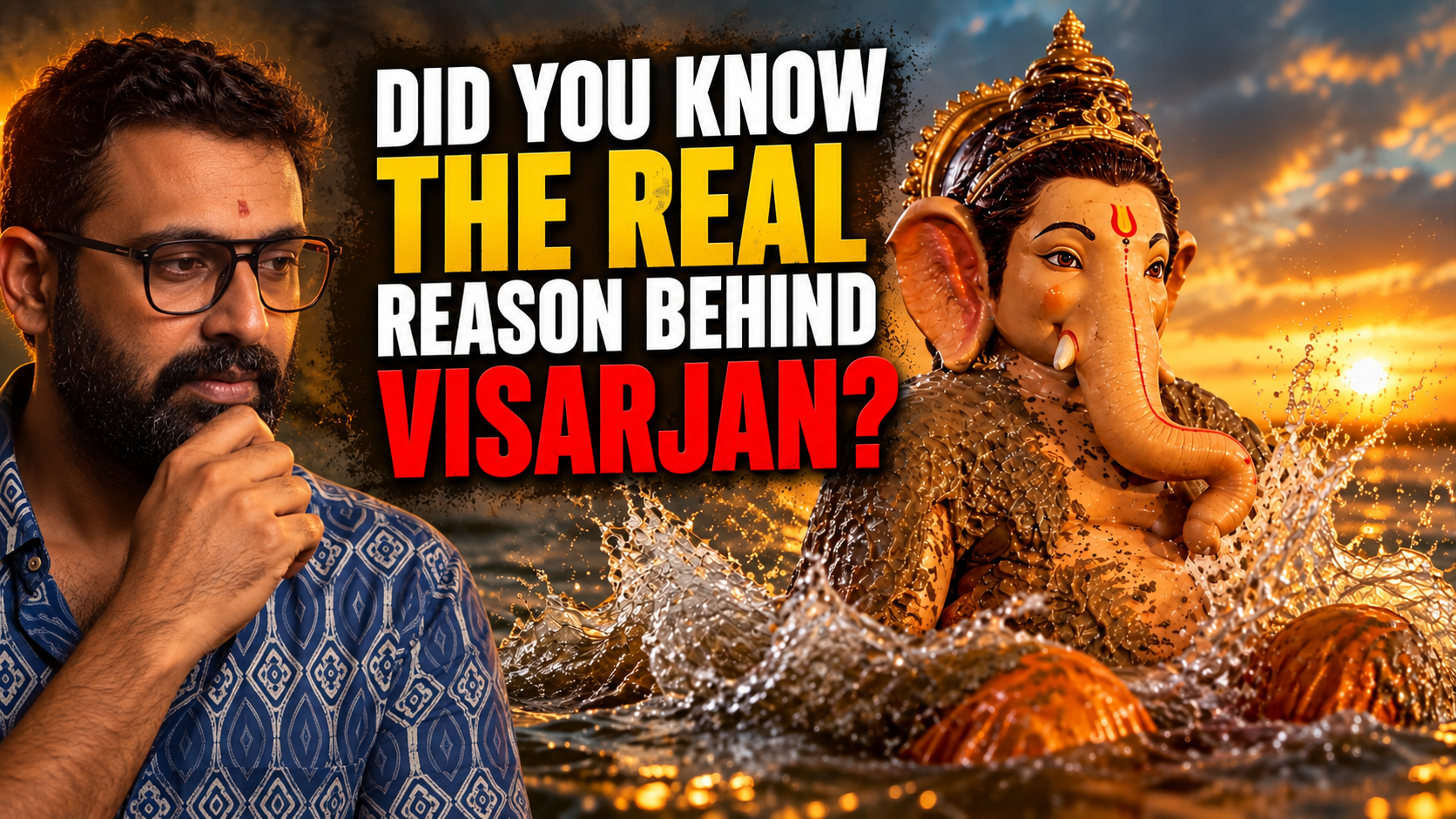
Across India this week, millions of households will do something that looks, on the surface, like a contradiction. For ten days they will welcome an idol of Ganesha into their homes as an honoured guest, only to carry it to a river, lake or the sea at the end of the festival and let it dissolve into the water.
The ritual, known as Ganapati Visarjan, ends Ganesh Chaturthi each year with a scene that is at once celebratory and mournful. Drums play, crowds sing, and then devotees release the same murti they spent days worshipping, calling out “Ganapati Bappa Morya, pudhchya varshi lavkar ya”, a request for Ganesha to come back next year.
For outsiders, and even for some who grew up with the tradition, the obvious question is why. Why build something with such devotion only to let it go?
A guest, not a prisoner
The answer begins with what the clay idol is understood to be in the first place.
The temporary murti used during the festival is called a Parthiva Murti, an earthen form, from parthiva, relating to Prithvi, the earth. During the festival, Bhagawan Ganesha is ritually invoked into that clay figure through a ceremony called pranapratishtha. From that point on, the murti is treated the way a family might treat a respected guest: welcomed, fed, decorated, sung to.
But nothing in the ritual suggests that Ganesha is now confined to the clay. The form is a meeting point between the worshipper and the divine, not a container for it. So when the festival ends and the murti is immersed, it is not treated as an act of destruction. The figure dissolves. What it represented does not.
The story behind the clay
One traditional account ties the practice to the writing of the Mahabharata.
As the story goes, Ganesha agreed to serve as scribe for Sage Vyasa, and wrote with such intensity that his body grew hot. Vyasa applied wet river clay to cool him down. By the time the epic was finished, the clay had hardened over him, and Vyasa took Ganesha to a sacred river to bathe and wash it away.
Whether it is read as scripture, folklore or metaphor, the pattern is the same one enacted every year at Visarjan: an earthen form is created, the divine animates it, and the earth eventually returns to water. The clay, in this telling, was never meant to be permanent, and neither was the shape it held.
Why water
The practical explanation for the immersion is straightforward: a clay idol is built from earth, and water is what returns it to nature.
But practitioners describe a second, symbolic layer to it. The murti stands for form. Water stands for dissolution, for return. Put together, the festival becomes a complete cycle: earth is shaped into a beloved form, the divine is invited into it, a relationship is built with it, and then it is allowed to dissolve.
It is a yearly, ritualised confrontation with something people generally try to avoid thinking about: that everything which takes form eventually changes form.
Creation, preservation, dissolution
This is where Ganapati Visarjan connects to a much older framework in Hindu philosophy: Srishti, Sthiti and Laya, or creation, preservation and dissolution.
The Ganesha murti moves through exactly this rhythm within the space of ten days. It is made. It is worshipped. It is released. The scale is domestic, but the idea behind it is cosmic.
Dissolution, in this worldview, is not the opposite of existence, and not simply a loss. It is treated as one part of a continuous cycle: things arise, they remain for a time, they return, and something new eventually follows. Visarjan compresses that principle into a ritual small enough to fit inside a single household, and legible enough for a child to understand: the murti is born, the murti is loved, the murti is let go.
Form and formlessness
Underlying all of this is a distinction Hindu philosophy draws between two ways of approaching the divine.
When devotees worship Ganesha as a murti, with a face, a form and a name, they are engaging with what is called Saguna Brahman, the Absolute understood through attributes and relationship. It is one way of relating to something that, in its other aspect, is said to have no form at all.

Leave a Reply