
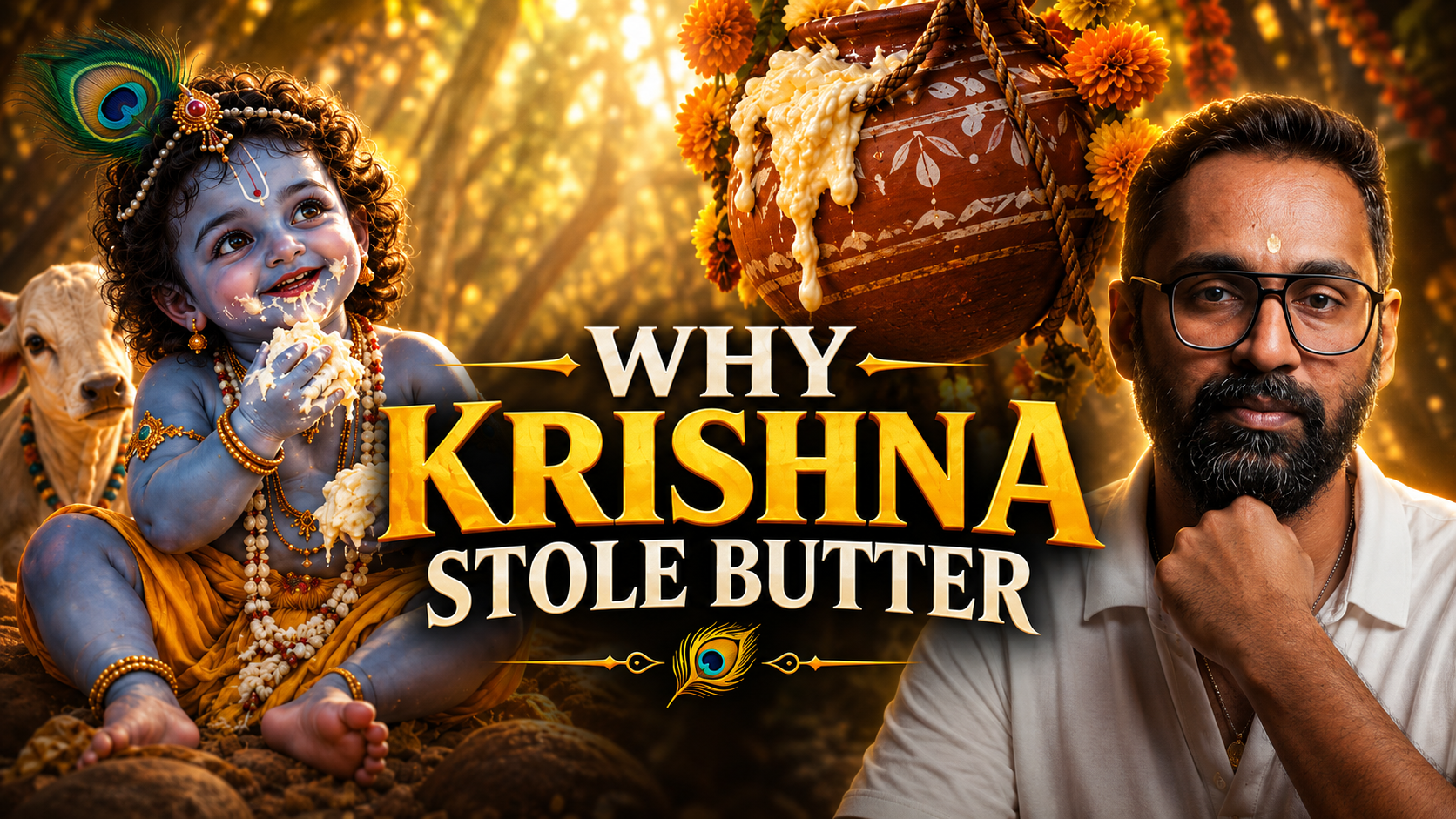
Every Janmashtami, the same image returns. A mischievous child with butter smeared across his face, a broken earthen pot, frightened gopis complaining to Yashoda, and a little Krishna pretending that he has done nothing wrong. We call him Makhan Chor, the butter thief, and tell the story as one of the most charming episodes of Krishna’s childhood.
But why does Krishna steal butter?
There is something much deeper hidden inside this apparently simple story. The butter Krishna steals is not merely food. The pot he breaks is not merely a household vessel. And the rope with which Yashoda eventually binds him reveals one of the most beautiful paradoxes in Hindu devotional tradition: the Infinite can be bound, but only by love.
The story of Makhan Chor is therefore not simply about a naughty child. It is about devotion, the purified heart, surrender and the extraordinary intimacy that bhakti allows between the devotee and the Divine.
The Significance of Butter in Krishna’s Childhood
To understand why Krishna steals butter, we first have to understand what butter meant in the world of Gokul.
Today, butter is something we can simply pick up from a shop. In a pastoral community such as the one remembered in Krishna’s childhood stories, however, butter represented time, labour and prosperity. Milk had to be collected, curd had to be prepared and then patiently churned before butter could emerge. It was something precious enough to be carefully stored in a matki, an earthen pot, and often kept out of reach.
This makes the stories of Krishna entering the homes of the gopis more interesting. He does not merely stumble upon butter. He seeks it out. He finds the pots suspended from the ceiling, gathers his companions, climbs on their shoulders and reaches what the householders had deliberately placed beyond his reach.
Sometimes he eats the butter himself. Sometimes he shares it with his friends. Sometimes he feeds it to the monkeys. And sometimes he leaves behind nothing except an empty pot, a few white footprints and the unmistakable evidence of Krishna’s presence.
The gopis then go to Yashoda and complain about her son.
Yet there is a curious tenderness hidden inside these complaints. The same gopis who protest about Krishna’s mischief continue churning fresh butter. The pots are filled again. The leela begins again.
Why?
Because Makhan Chor is not really a name of condemnation. It is a name of affection.
The gopis are not simply losing their butter. They are receiving something in return: the presence of Krishna in their homes, the joy of being noticed by him and the intimacy of participating in his leela.
The Divine has entered their homes not as a distant cosmic ruler, but as a child.
And that changes everything.
Krishna the Makhan Chor: Was It Really Theft?
The traditional image of Krishna stealing butter is one of the most beloved scenes in Krishna’s childhood. He is small enough to appear innocent, mischievous enough to be impossible to control and divine enough to transform an ordinary household into the setting for a sacred story.
But there is a beautiful way to read this theft.
Krishna is not taking something that the gopis do not value. He is taking something that they have prepared with care.
The butter has required labour. It has been churned patiently. It has been protected and stored. The gopis have invested their time and affection into it. And Krishna comes precisely for that.
In this sense, the butter is already an offering before it reaches Krishna’s hands.
The gopis may complain with their words, but their actions tell another story. They churn more butter. They hang another pot. They wait for the next visit.
This is why the story can be understood as an exchange of love rather than an act of deprivation. Krishna takes what devotion has already prepared.
And this becomes even clearer when we look at what butter represents.
What Is the Spiritual Meaning of Butter?
There is a reason the tradition gives us such a specific image: milk becoming curd and curd being churned until butter emerges.
Milk is fluid and undifferentiated. Through a process of setting and churning, something hidden within it is brought forth. The butter was always present in the milk, but it had to be separated and revealed through a process of transformation.
This becomes a powerful metaphor for the spiritual life.
The human mind can be like milk: fluid, restless and easily scattered. Through discipline, remembrance, devotion and spiritual practice, that restless mind is gradually churned. What eventually emerges is something more refined, something that was hidden within us all along.
The spiritual meaning of butter can therefore be understood as the image of a purified heart, the nirmala hridaya.
And notice what Krishna chooses to steal.
He does not steal the milk.
He does not steal the curd.
He steals the butter.
The story therefore invites an inward question: what happens when Krishna enters our own hearts?
Perhaps what he takes is everything that has already been purified by devotion. Perhaps the butter represents the part of ourselves that remains after the distractions, attachments and ego have been churned away.
The gopis hide the butter high above the ground, inside a pot. Krishna reaches it anyway. He breaks the vessel and brings what is hidden into the open.
The symbolism is striking. We may try to conceal our deepest devotion, reserve it for ourselves or place it beyond reach. But Krishna, the Divine who comes searching for the devotee, finds it.
This is the deeper mystery of Makhan Chor.
He is not merely the thief of butter.
He is the one who steals the heart.
Damodara: When the Infinite Allowed Himself to Be Bound
There is another episode from Krishna’s childhood that deepens this symbolism.
One day, after Krishna’s mischief has gone too far, Yashoda decides that enough is enough. She takes a rope and attempts to tie him to a wooden mortar, the ukhala.
But something strange happens.
The rope is too short.
She brings another rope and joins it to the first. Still too short. More rope is added, and once again there remains the same tiny gap.
Yashoda keeps trying until, finally, Krishna allows himself to be bound.
This is how he comes to be remembered as Damodara, the one whose belly was bound with a rope.
The paradox is extraordinary.
This is the same Krishna whom the tradition presents as Bhagawan, the Divine whose cosmic nature cannot be contained by space or time. Yet he allows his mother to tie him to a wooden mortar.
Why?
Because bhakti creates a relationship unlike any other.
The Infinite does not become smaller. Rather, the Infinite chooses to become accessible.
The rope does not conquer Krishna. Love does.
That is why the Damodara episode belongs so naturally beside the story of Makhan Chor. In one story, Krishna steals butter from the gopis. In the other, Yashoda tries to restrain him. Both reveal the same idea: the Divine willingly enters the intimate world of those who love him.
The child who cannot be contained by the universe allows himself to be contained by a mother’s affection.
From Makhan Chor to Dahi Handi
Every Janmashtami, this ancient image comes alive again on the streets of India.
In Maharashtra, Dahi Handi recreates the memory of Krishna reaching for the pots of curd and butter suspended above the ground. A pot is hung high, and teams of Govindas form human pyramids, one person supporting another until someone at the top finally reaches the handi and breaks it.
To a casual observer, it looks like a spectacular game.
But look again at the image.
Krishna rarely reaches the butter pot entirely by himself in these childhood stories. His friends help him. They lift him. They create the height he needs to reach what has been placed beyond his grasp.
That gives Dahi Handi another layer of meaning.
Some things can only be reached when people hold one another up.
The human pyramid becomes a physical expression of community. One person becomes the foundation for another. Everyone’s balance matters. Everyone’s strength contributes to the final act.
And then the pot breaks.
The curd and butter spill down into the crowd, transforming something that was hidden and protected into something shared.
This is why Dahi Handi and Krishna Janmashtami belong so naturally together. The festival is not merely recreating Krishna’s mischief. It is recreating the communal joy of reaching the Divine together.
The Butter Pot Across India
The memory of Krishna’s butter theft is not limited to Maharashtra.
In Karnataka, especially around Udupi, Janmashtami traditions include Mosaru Kudike and Vittal Pindi, where the breaking of pots becomes part of the public celebration surrounding Krishna’s birth. In Kerala, Janmashtami is widely known as Ashtami Rohini, and traditions such as Uriyadi preserve the imagery of reaching for a suspended pot. Uriyadi is also associated with Krishna Jayanthi celebrations in parts of Tamil Nadu.
Across Gujarat and other parts of India, variations of the pot-breaking tradition similarly keep alive the memory of Krishna’s childhood leela.
The names and forms change from region to region, but the central image remains remarkably familiar: a pot placed beyond ordinary reach, a community coming together to reach it, and the joyful breaking of the vessel.
And then, in Guruvayur, Kerala, the story takes a beautiful turn.
At the Guruvayur Temple, Krishna is worshipped as Guruvayurappan, and among the many devotional traditions associated with the child Krishna is the offering of butter, known as Venna Nivedyam.
The symbolism is almost poetic.
The butter that Krishna once stole in Gokul is now placed into his hands as an offering.
What was once taken in childhood mischief is now consciously given in devotion.
From the stolen butter of Gokul, to the broken handi of Maharashtra, to the pots of Udupi and the offerings made to Unnikrishna in Guruvayur, the same image travels across India in different forms.
The butter has come full circle.
Why Does Krishna Steal Butter?
So, why does Krishna steal butter?
The simplest answer is that he is a child, and this is his leela. Krishna’s childhood is deliberately filled with play, laughter and mischief. The Divine appears not only as the majestic deity of temples and scriptures, but as a child who runs through Gokul with butter on his hands and a smile on his face.
But beneath that play lies a deeper spiritual meaning.
Krishna steals the butter because the butter has been churned with love. In the devotional reading of the story, he takes the essence that has emerged from the churning, just as he seeks the essence of the devotee’s heart.
He breaks the pot because the vessel can represent what contains and conceals us. He reaches what has been placed beyond ordinary reach because devotion is not always a rational transaction. And he allows Yashoda to bind him because love, rather than force or knowledge alone, creates the deepest relationship with the Divine.
Perhaps that is why the story has survived so powerfully.
We do not remember Krishna merely because he was a mischievous child.
We remember him because his mischief becomes a language of love.
Every broken handi on Janmashtami carries that memory. Every child dressed as Krishna with a little pot of butter recalls it. Every devotee who offers butter to Unnikrishna participates in its reversal.
And perhaps the question we should ask is no longer, “Why did Krishna steal butter?”
Perhaps it is this:
What is the butter inside us that Krishna is waiting to steal?
The answer may be the part of our heart that has been purified by remembrance, devotion and love.
That is the secret of Makhan Chor.
The thief did not come to take something away.
He came to take what the heart had already prepared for him.
And perhaps, after all these centuries, that is still what Krishna comes looking for.
A heart he can call his own.
You can read the previous part of this Krishna series article here:
https://theharikumar.com/krishna-janmashtami-the-story-of-krishnas-birth-and-the-night-the-divine-entered-the-world/





Leave a Reply