
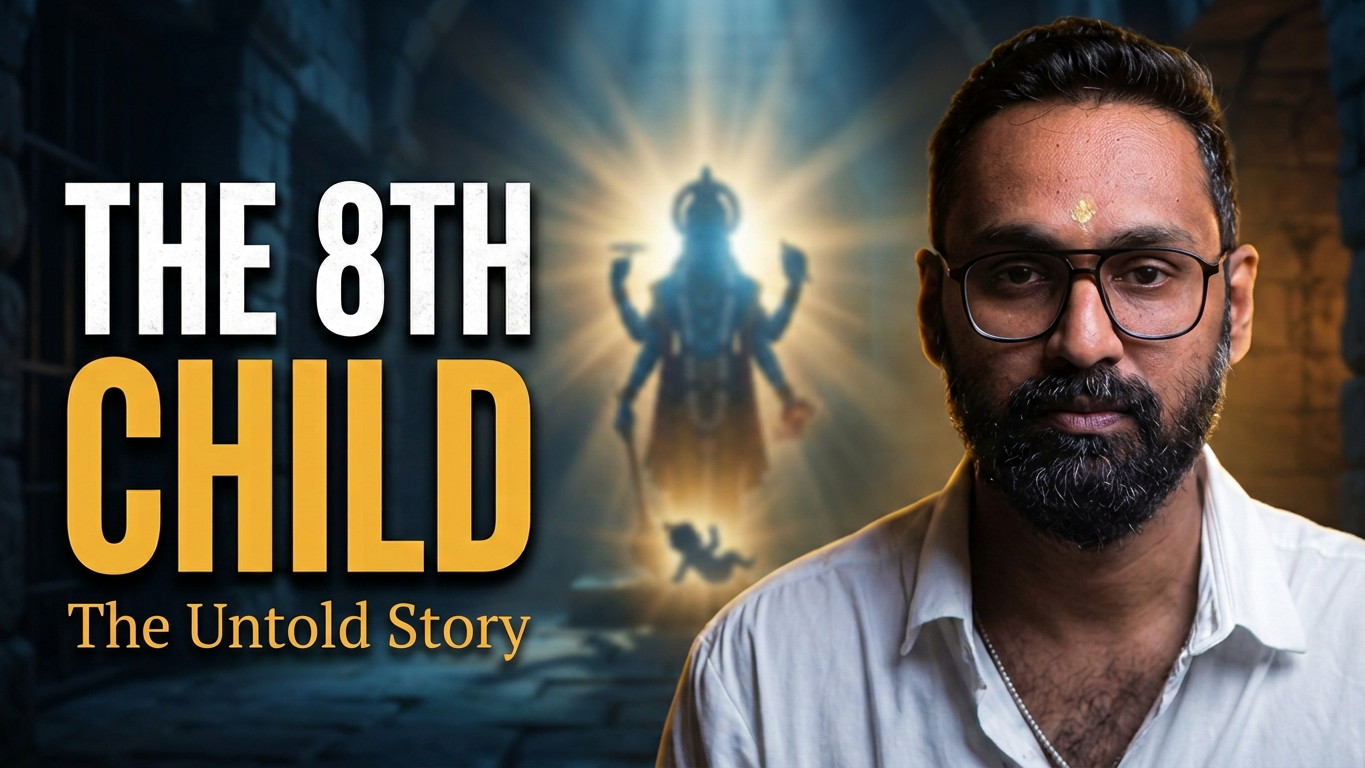
What if the Krishna birth story does not actually begin in a prison in Mathura? What if it begins much earlier, with the Earth herself crying out for help? Long before Devaki and Vasudeva entered the prison, before Kamsa heard the terrible prophecy of his death, and before the world waited for the miraculous midnight birth of Krishna, the Earth had become burdened by the forces of adharma. In the Bhagavata Purana, this distress is given a remarkable form. Bhumi Devi, the Goddess Earth, appears before Brahma as a sorrowful cow, her eyes filled with tears, asking the gods for relief. Her cry sets into motion the chain of events that will eventually lead to one of the most celebrated moments in Hindu tradition: the birth of Bhagawan Shri Krishna.
When the Earth Cried for Help
The image of Bhumi Devi appearing as a cow is one of the most evocative moments in the Krishna Janmashtami story. The Earth is not presented merely as an inert piece of land, but as a living and conscious presence capable of suffering. She has become unbearably burdened because powerful rulers have abandoned dharma, and according to the Bhagavata Purana, many of these rulers are Daityas who have taken birth among human kings.
The choice of the cow is equally significant within the traditional imagination. The cow represents nourishment, generosity and sustenance. She gives without demanding anything in return. When Bhumi Devi appears in this form, the symbolism becomes powerful: the very being that sustains life is now overwhelmed by the burden placed upon her.
Brahma sees her suffering, but the solution does not lie within his own power. Accompanied by Shiva and the other devas, he turns towards Vaikuntha, where they seek the intervention of Bhagawan Vishnu. The answer they receive will change the course of the world.
Vishnu has already seen the suffering of the Earth.
And He has decided to descend.
Why Krishna Was Born
The concept of an avatar is central to understanding the birth of Krishna. The Divine does not remain distant when dharma declines. Bhagawan Vishnu takes form and enters the world in order to restore balance.
But there is something remarkable about the answer given to the crisis.
The Earth is suffering. Powerful rulers have turned away from dharma. The gods seek the intervention of the Supreme Being. And the solution is not another army or a celestial weapon.
It is a birth.
Bhagawan Vishnu declares that He will descend into the Yadu dynasty as the son of Vasudeva and Devaki. The cosmic plan now has to enter the human world, and the family chosen for this extraordinary descent will soon find itself at the centre of one of the most dramatic episodes in Hindu mythology.
That brings us to Mathura.
Devaki, Vasudeva and the Prophecy of Kamsa
Devaki, the daughter of King Devaka, was to be married to Vasudeva, a respected nobleman of the Yadu dynasty. The wedding was a joyous occasion, and among those present was Devaki’s cousin, Kamsa, the powerful ruler of Mathura. In an act that reflected their close relationship at the time, Kamsa himself drove the newlyweds’ chariot.
Then came the voice from the heavens.
The akashavani declared that Devaki’s eighth child would become the cause of Kamsa’s death.
Everything changed in that instant.
Kamsa drew his sword and prepared to kill Devaki, but Vasudeva intervened. He promised that every child born to Devaki would be handed over to Kamsa. The promise saved Devaki’s life, but it condemned the couple to imprisonment.
The contrast could hardly be greater. Somewhere beyond the visible world, Vishnu’s decision to descend had already been made. In a dark prison in Mathura, Kamsa was now desperately attempting to prevent that divine plan from becoming reality.
He believed he was fighting a prophecy.
He did not understand that he was already part of the plan.
Six Children and One Terrible Fear
When Devaki’s first child was born, Vasudeva kept his promise and brought the newborn before Kamsa. At first, Kamsa decided that the child did not need to die because the prophecy had specifically referred to the eighth child. But fear is rarely satisfied once it takes control of the mind. Kamsa eventually killed the baby.
The pattern continued.
Devaki gave birth again and again, and Kamsa killed each child. Six sons were lost because a king was terrified of what the future might bring.
Yet the prophecy was moving closer to fulfilment with every passing moment.
The seventh pregnancy would be different.
According to the Bhagavata Purana, Vishnu instructed Yogamaya to transfer the child from Devaki’s womb to that of Rohini, another wife of Vasudeva who was living away from Mathura. To those watching from outside, it appeared that Devaki had suffered a miscarriage. In reality, the child had been moved beyond Kamsa’s reach.
This child would become Balarama, also known as Sankarshana, whose name is connected with the act of being drawn away.
Kamsa believed the seventh child was gone.
But the divine plan had simply taken another step forward.
The Garbha Stuti: Prayers to the Divine in the Womb
When Devaki became pregnant for the eighth time, something extraordinary began to happen. Her radiance became so remarkable that Kamsa understood that the being he feared was now within her.
The devas also knew.
They came to the prison, not to rescue Devaki and Vasudeva, but to offer prayers to the Divine who was still within the womb. These prayers are known as the Garbha Stuti, the hymns offered to Bhagawan while He remained within Devaki.
There is something deeply moving about this scene. The world outside the prison is ruled by fear. Kamsa is surrounded by power, yet he is powerless before what is about to happen. Meanwhile, the devas are waiting in reverence for the arrival of the Divine.
The prison has become a place of darkness.
But it is also the place where the light is about to appear.
Midnight: The Birth of Krishna
Then comes the moment at the heart of Krishna Janmashtami.
It is midnight in Mathura.
Devaki gives birth, but Vasudeva does not see an ordinary newborn child. Before him stands Bhagawan Vishnu Himself, manifested with four arms, the Srivatsa mark upon His chest, the Kaustubha jewel around His neck and the Shankha, Chakra, Gada and Padma in His hands.
Devaki and Vasudeva recognise the Divine immediately.
Yet they also understand the danger. Outside the prison is Kamsa, the king who has already killed six newborn children. They therefore pray that Bhagawan conceal His divine form.
The four arms disappear.
The celestial ornaments vanish.
The Supreme Being becomes a helpless infant.
This is one of the most beautiful paradoxes in the Krishna birth story. The Divine, who is beyond the limits of creation, chooses to enter the world in its most vulnerable form. The being whom the devas worship becomes a child who must be carried to safety by His father.
And then another miracle takes place.
The chains binding Vasudeva fall away. The prison doors open. The guards fall into a deep sleep. Vasudeva lifts the newborn Krishna into his arms and begins his journey out of Mathura.
The divine plan has entered the human world.
Why Was Krishna Born at Midnight?
The midnight birth is central to the way Janmashtami is celebrated. Krishna’s appearance is associated with the eighth tithi, Ashtami, of the dark fortnight of Bhadrapada, and devotees traditionally remain awake, pray, sing devotional songs and wait for the arrival of midnight.
At the textual level, midnight is simply the moment at which Bhagawan Vishnu manifests as Krishna. But over centuries, the symbolism of that moment has become inseparable from the festival itself.
The prison is dark.
The night is dark.
Mathura is living under the shadow of Kamsa.
And it is precisely within that darkness that the Divine appears.
This is why the significance of Janmashtami extends beyond the celebration of a divine birth. The story presents a powerful spiritual image: when adharma appears overwhelming and darkness seems to have reached its deepest point, divine intervention can arrive from the most unexpected place.
Krishna is not born into a palace surrounded by comfort.
He is born in a prison.
He is not immediately celebrated by a kingdom.
He has to be carried secretly through the night.
And yet, that child will eventually transform the world around him.
When the Divine Became a Child
The Krishna Janmashtami story begins with the Earth crying out and ends, for this episode, with a father carrying his newborn son away from a prison in the darkness of Mathura. Between those two moments lies a remarkable sequence of divine intervention: the devas turning towards Vishnu, the prophecy of Kamsa, the deaths of six children, the mysterious transfer of Balarama, the Garbha Stuti and finally the birth of Krishna.
The answer to the Earth’s suffering was not a weapon.
It was a child.
And perhaps that is what makes the story so enduring. Bhagawan did not enter the world as a distant cosmic force beyond human experience. He entered it as a newborn who needed to be protected, carried and taken across the Yamuna to safety.
But Vasudeva’s journey was not yet the end of the story.
As he carried Krishna towards Gokula, another child was being born.
A baby girl.
And when Kamsa tried to seize her, he discovered that she was no ordinary child.
Who was she, and why was she born on the same night as Krishna?
That is where the next chapter of the Krishna Janmashtami story begins.
And if you want to know why Krishna steals butter and its spiritual meaning then check out this article on my blog:
https://theharikumar.com/why-krishna-steals-butter-the-spiritual-meaning-behind-makhan-chor-and-dahi-handi/
Frequently Asked Questions About Krishna Janmashtami
What is the story of Krishna’s birth?
The Krishna birth story begins with Bhumi Devi seeking relief from the burden of adharma. Bhagawan Vishnu then decides to descend as Krishna, the son of Vasudeva and Devaki. After Kamsa learns through an akashavani that Devaki’s eighth child will cause his death, Devaki and Vasudeva are imprisoned. After six children are killed and the seventh is transferred to Rohini, Krishna is born at midnight as the eighth child.
Where was Krishna born?
According to the traditional account in the Bhagavata Purana, Krishna was born in Mathura, in the prison where Devaki and Vasudeva were being held by Kamsa.
Why is Krishna’s birth celebrated at midnight?
Krishna’s manifestation is traditionally placed at midnight on Ashtami of the dark fortnight of Bhadrapada. Janmashtami celebrations therefore traditionally culminate around midnight, when devotees gather for prayers, devotional singing and the celebration of Krishna’s birth.
Who were Krishna’s parents?
Krishna was born to Devaki and Vasudeva of the Yadu dynasty. Although Devaki was his biological mother, Krishna was subsequently carried to Gokula by Vasudeva and raised there by Nanda and Yashoda.
Who was Kamsa?
Kamsa was the powerful ruler of Mathura and a relative of Devaki. After hearing the prophecy that Devaki’s eighth child would cause his death, he imprisoned Devaki and Vasudeva and killed their newborn children.
What is the Garbha Stuti?
The Garbha Stuti refers to the prayers offered by the devas to Bhagawan while He was within Devaki’s womb. These prayers form an important part of the traditional Krishna birth narrative preserved in the Bhagavata Purana.
Who was the seventh child of Devaki?
According to the Bhagavata Purana, the seventh child of Devaki was transferred to the womb of Rohini through the agency of Yogamaya. This child became Balarama, also known as Sankarshana.
Why is Krishna Janmashtami important?
Krishna Janmashtami commemorates the birth or divine manifestation of Bhagawan Shri Krishna. For devotees, the festival celebrates the descent of the Divine to restore dharma and represents hope, devotion and the triumph of divine purpose even during times of darkness.





Leave a Reply