
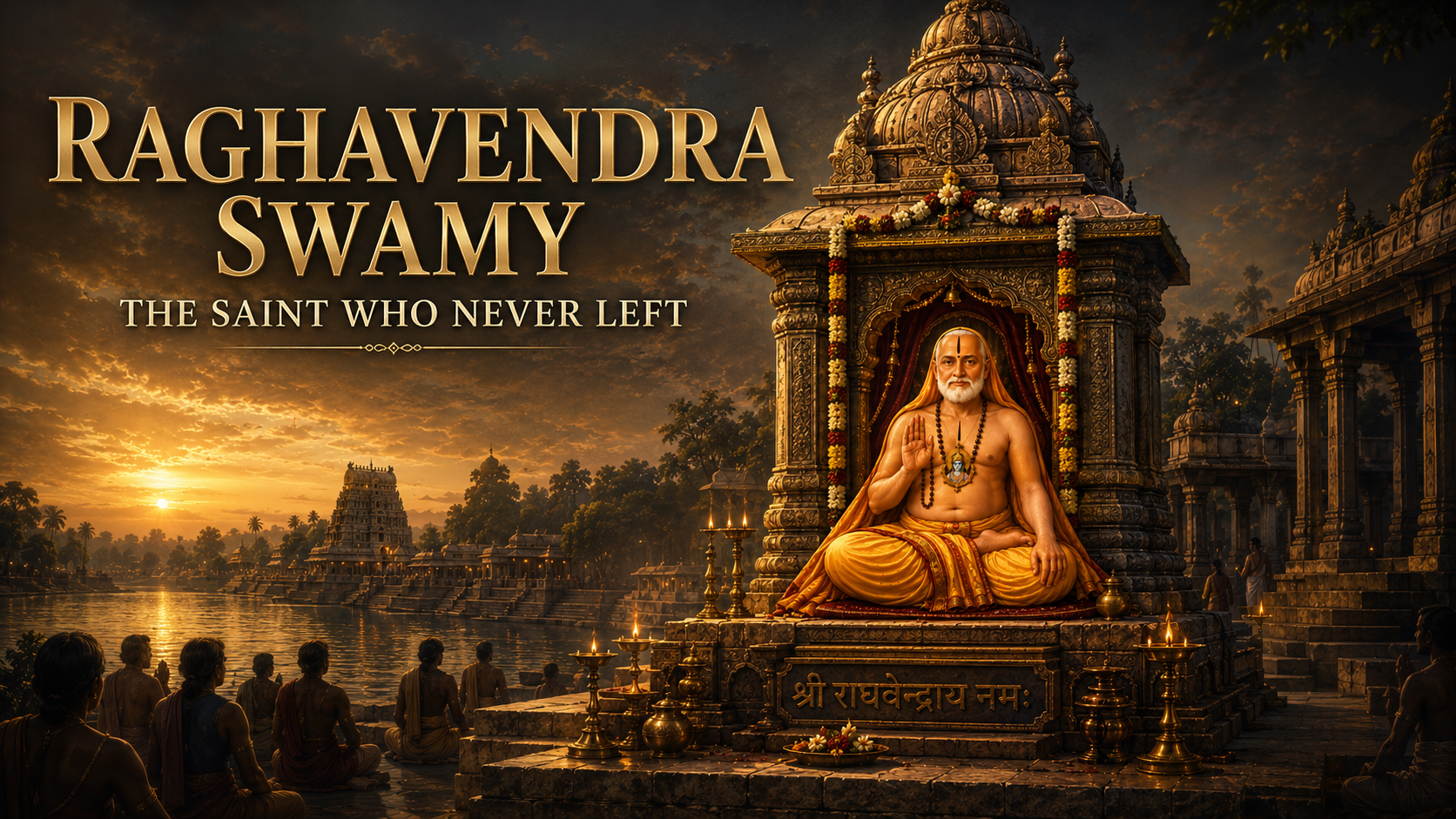
Raghavendra Swamy, His Brindavana and the True Meaning of Aradhane
What if a saint entered samadhi more than three centuries ago, yet millions of devotees continue to believe that he is still present? Every year, thousands gather at Mantralayam on the banks of the Tungabhadra River to honour Sri Raghavendra Swamy, one of the most revered Gurus of the Dvaita tradition. In 2026, the tradition enters its 355th year of Aradhane, observed from August 29 to 31. But the most fascinating part of the celebration is not simply that devotees remember Raghavendra Swamy. It is that they do not believe he is someone to be remembered in the ordinary sense. They believe he remains present within his Brindavana, continuing to bless those who seek him.
Watch the full video on Chaturya by K. Hari Kumar Youtube channel:
The Man Before Raghavendra Swamy
Before he became Rayaru, the name of this revered Guru was Venkatanatha. Born in 1595 at Bhuvanagiri in present-day Tamil Nadu, he was raised in a deeply learned Brahmin household after the early death of his father, Thimmanna Bhatta. From a young age, Venkatanatha displayed an extraordinary intellectual curiosity. His questions about scripture were not those of a child simply memorising what his teachers told him. Tradition remembers him as someone who wanted to understand what lay beneath the words.
Yet the life of the future Raghavendra Swamy was far removed from the splendour with which his name is associated today. He married Saraswathi and had a son, Lakshminarayana, but the family lived in severe poverty. There were occasions when Ekadashi fasting was not simply an act of religious discipline but a consequence of having little food. Even when thieves once entered his house, they reportedly found nothing worth stealing. This was the life of a scholar who had knowledge, devotion and talent, but very little material wealth.
It is from this background that the transformation of Venkatanatha into Raghavendra Teertha becomes remarkable.
From Venkatanatha to Rayaru
Venkatanatha’s Guru, Sudheendra Teertha, was seeking a successor, and tradition holds that Moola Rama appeared to him in a dream and indicated that Venkatanatha was the chosen disciple. Venkatanatha, however, hesitated. He had a wife and a young son, and the decision to renounce worldly life was not something he could make lightly.
According to the tradition, it was Vidya Lakshmi who appeared to Venkatanatha in a dream and reminded him that his duty extended beyond his immediate family to Bhagawan Hari, Vayu and dharma itself. In 1621, at the court of King Raghunatha Nayak of Tanjavur, Venkatanatha accepted sannyasa. His Guru gave him the name by which generations would know him: Raghavendra Teertha.
The name itself carries significance. Raghavendra brings together Raghava, referring to Prabhu Sri Rama, and Indra, signifying one who is exalted or foremost. To his devotees, therefore, Raghavendra was not merely a scholar who became a monk. He became Rayaru, a Guru whose life was dedicated to Bhagawan Vishnu, dharma and the preservation of the Madhva tradition.
The Guru Who Became Rayaru
As the head of the Matha, Raghavendra Teertha spent decades teaching, debating and writing. He travelled through important centres of learning, including Tanjavur and Udupi, and became closely associated with the philosophical tradition of Madhvacharya. During periods of famine, he is remembered for feeding thousands, while his scholarship earned him respect among rulers and intellectuals.
But the story of Raghavendra Swamy eventually moves away from royal courts and scholarly centres and towards a much quieter destination: Manchale.
Today, we know it as Mantralayam.
The story of how Raghavendra came to Manchale is inseparable from Venkanna, a man who, according to tradition, began life as an illiterate shepherd. Rayaru had once instructed him to remember his Guru during times of difficulty. When Venkanna was later placed in a frightening situation before the Nawab of the region, he silently invoked Raghavendra Swamy. Tradition holds that he was miraculously able to read a written message announcing a military victory.
The relationship between Venkanna and Rayaru would eventually lead the Guru towards Manchale, the place that would become inseparable from his name.
Why Mantralayam Became Sacred
For devotees, Mantralayam is not simply the location of a famous temple. It is the sacred space where Raghavendra Swamy chose to enter Brindavana.
The site itself carries an older sacred memory. Tradition associates Manchale with Prahlada and his performance of a great yagna, while another tradition holds that Prabhu Sri Rama rested upon a black rock at the site during his exile. Raghavendra’s own spiritual lineage is also understood through the idea of successive incarnations, beginning with Shankukarna and passing through Prahlada and Sri Vyasaraja before culminating in Raghavendra Swamy.
Whether one approaches these accounts as matters of faith, sacred tradition or devotional memory, they explain why Mantralayam occupies such a powerful place in the spiritual imagination of his followers.
It was here that Rayaru chose to remain.
The Brindavana and the Promise of Seven Hundred Years
In 1671, on Shravana Krishna Paksha Dwitiya, Raghavendra Swamy delivered his final discourse on the works of Madhvacharya and entered samadhi. According to the tradition preserved at Mantralayam, he seated himself in padmasana, entered deep meditation and recited the pranava, Om. As his japamala became still, his disciples began sealing the Brindavana around him.
A copper box containing 1,200 Shaligramas was placed above his head before the final stone slabs were put into position.
But the story does not end there.
Raghavendra Swamy had declared that he would remain spiritually active in his Brindavana for seven hundred years. For his devotees, this is not merely an extraordinary statement from the past. It is the foundation of the living faith surrounding Raghavendra Swamy Brindavana today.
One of the most beloved stories associated with this moment concerns his disciple Appanacharya. Separated from his Guru by the flooded Tungabhadra, Appanacharya hurried towards Manchale, composing verses of grief that would become the Sri Raghavendra Stotra. By the time he arrived, the Brindavana had already been sealed. Tradition holds that when his voice faltered at the final line, a voice emerged from within the sealed Brindavana and completed the verse.
For devotees, this was not the ending of Raghavendra Swamy’s life.
It was the beginning of his continuing presence.
So, What Does Aradhane Actually Mean?
This is where the meaning of Raghavendra Swamy Aradhane becomes particularly important.
The Sanskrit word Aradhana refers to worship, honouring and propitiation. It is therefore easy to think of Aradhane as a death anniversary, a day on which devotees remember a saint who has passed away.
But that is not how the tradition of Raghavendra Swamy understands it.
Aradhane is observed across three days: Purva Aradhane, Madhya Aradhane and Uttara Aradhane. The central day corresponds to the day on which Rayaru entered samadhi, but the atmosphere is not one of mourning. Devotees gather to worship him because they believe his spiritual presence continues.
That distinction changes everything.
A death anniversary looks backwards.
Aradhane looks at a presence that continues.
This is why the Brindavana at Mantralayam remains the centre of devotion. The devotee does not simply stand before a monument to a Guru who once lived. The devotee comes seeking the blessings of a Guru who, according to the tradition, is still spiritually active.
The Mantra of Raghavendra Swamy
One of the most beloved mantras associated with Rayaru is:
Pujyaya Raghavendraya Satya Dharma Rathaya cha
Bhajatam Kalpavrukshaya Namatam Kamadhenave.
The prayer salutes Raghavendra Swamy as one devoted to Satya and Dharma, and compares him to the wish-fulfilling Kalpavruksha for those who worship him and Kamadhenu for those who bow before him.
There is something deeply revealing in those words. The devotee does not simply ask for worldly blessings. The Guru is remembered through Satya, truth, and Dharma, righteousness. His spiritual power is inseparable from the values he represents.
Perhaps that is why the story of Raghavendra Swamy has survived for more than three centuries.
The Saint Who Never Left
Today, Mantralayam stands as one of the most important pilgrimage centres associated with Guru Raghavendra Swamy. The Tungabhadra continues to flow beside the sacred town, devotees continue to arrive at the Brindavana, and the three days of Aradhane transform the region into a vast gathering of faith.
The most extraordinary part of this tradition is not simply the age of the Brindavana. It is the belief behind it.
Raghavendra Swamy is not remembered as someone whose story ended in 1671.
He is remembered as a Guru who chose to remain.
That is the deeper meaning of Aradhane. It is not simply an annual remembrance of the past. It is an act of faith in an unbroken spiritual presence, one that devotees believe continues to connect the Guru with those who seek his grace.
Perhaps that is why the question surrounding Rayaru has remained so powerful for generations: are we remembering a saint who lived centuries ago, or are we standing before a Guru who is still watching?
For millions of devotees, the answer is already known.
Rayaru never left.
Frequently Asked Questions
Who was Raghavendra Swamy?
Raghavendra Swamy, also known as Raghavendra Teertha or Rayaru, was a revered 17th-century Guru, saint and philosopher associated with the Dvaita tradition of Madhvacharya. He lived from 1595 to 1671 and became the head of his Matha before entering samadhi at Mantralayam.
Where is Raghavendra Swamy Brindavana located?
The Raghavendra Swamy Brindavana is located at Mantralayam in present-day Andhra Pradesh, on the banks of the Tungabhadra River. The town is one of the major pilgrimage centres associated with the Guru.
What is Raghavendra Swamy Aradhane?
Raghavendra Swamy Aradhane is the annual three-day observance commemorating and worshipping the Guru’s entry into samadhi. It consists of Purva Aradhane, Madhya Aradhane and Uttara Aradhane. Devotees understand it not simply as a death anniversary, but as an observance of his continuing spiritual presence.
When is Raghavendra Swamy Aradhane celebrated?
The Aradhane is observed according to the traditional lunar calendar on Shravana Krishna Paksha Dwitiya and the surrounding days. In 2026, the 355th Aradhane is being observed from August 29 to August 31.
Why is Mantralayam important to Raghavendra Swamy devotees?
Mantralayam is sacred because it is the place where Raghavendra Swamy entered samadhi and where his Brindavana is located. For devotees, the Brindavana remains a living centre of his spiritual presence.
What is the Raghavendra Swamy mantra?
A widely recited prayer is: Pujyaya Raghavendraya Satya Dharma Rathaya cha, Bhajatam Kalpavrukshaya Namatam Kamadhenave. It praises Raghavendra Swamy as one devoted to truth and dharma and invokes his grace upon devotees.
What does Rayaru mean?
Rayaru is an affectionate and reverential name by which Raghavendra Swamy is popularly known, particularly among his devotees in South India.





Leave a Reply