
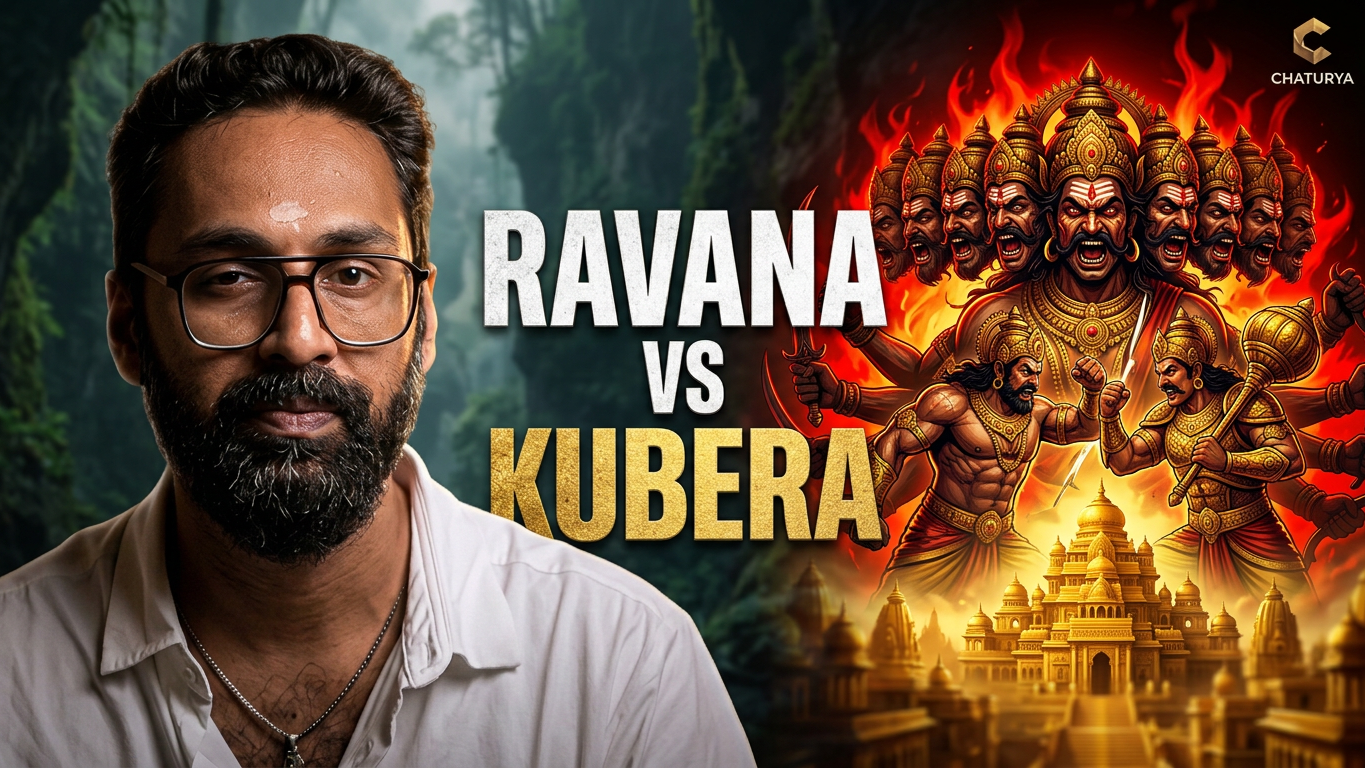
As excitement builds around the Ramayana trailer and audiences once again immerse themselves in the world of Prabhu Shri Rama, Sita, Hanuman, Ravana and the golden city of Lanka, one fascinating chapter of the epic continues to remain in the shadows. Long before the Vanara Sena crossed the ocean. Long before the construction of Rama Setu. Long before the famous battle that would culminate in Ravana’s downfall, Lanka had already witnessed another war. Not exactly a battle but a passive takeover.
It was not a battle against Shri Rama.
It was a war between two half-brothers.
The Forgotten War Before the Ramayana: How Ravana Seized Lanka
This forgotten chapter from the Ramayana tells the story of Kubera and Lanka. How a kingdom built on virtue was taken by ambition, and how Ravana’s very first conquest planted the seeds of his eventual destruction. Whether you are revisiting the Ramayana during Ramayanamasam, preparing for Dussehra, or simply discovering these lesser-known episodes after watching the Ramayana trailer, this ancient story offers a remarkable glimpse into Lanka before Ravana became its king.
The Golden Lanka Before Ravana
Kubera’s Exile and the Rise of Alakapuri
Kubera’s departure from Lanka was not the end of his story. It was the beginning of a very different one. Having relinquished the golden city rather than plunge it into needless bloodshed, he turned his back on the kingdom that had once been entrusted to him and journeyed north towards the snow-clad Himalayas. There, in the shadow of Mount Kailasa, the sacred abode of Bhagawan Shiva, Kubera established a new city known as Alakapuri.
Unlike Lanka, whose splendour rested upon its golden palaces and earthly riches, Alakapuri came to symbolise something far more enduring. It became the seat of Kubera’s divine office as the guardian of wealth, a place where prosperity remained inseparable from dharma and where material abundance was understood as a responsibility rather than a possession.
There is a quiet irony in Kubera’s journey. Although he lost the most magnificent kingdom in the world, he never lost the divine trust that had made him worthy of ruling it in the first place. His authority did not depend upon the walls of Lanka or the ownership of the Pushpaka Vimana. It flowed from his character, his humility, and his unwavering adherence to cosmic order. The Puranic tradition reminds us that kingdoms may be seized through force, treasures may pass from one hand to another, and even the grandest cities may change their rulers. But spiritual stature cannot be stolen. It must be earned.
Ravana, meanwhile, stood at the height of his triumph. Lanka became the dazzling capital of a rapidly expanding empire, its wealth unmatched and its ruler feared across the three worlds. Yet beneath that outward splendour lay an uncomfortable truth. The empire rested upon an act of betrayal committed against an elder brother who had shown no aggression towards him.
The very foundation of Ravana’s reign had been laid not through righteous inheritance or divine appointment, but through envy and force. It was a flaw invisible to those dazzled by Lanka’s golden walls, yet one that would continue to widen with every decision Ravana made thereafter. By the time Prabhu Shri Rama arrived at Lanka’s shores decades later, the seeds of Ravana’s downfall had already been sown on the day he first claimed his brother’s throne.
The First Step Towards Ravana’s Downfall
Every year, as Dussehra approaches, effigies of Ravana rise across towns and cities before being consumed by fire, reminding us of the triumph of dharma over adharma. A few weeks later, Diwali celebrates the joyous return of Shri Rama to Ayodhya after his victory in Lanka. For most of us, these festivals mark the conclusion of Ravana’s story. Yet the Ramayana quietly suggests that his downfall did not begin on the battlefield outside Lanka’s walls, nor with the abduction of Mata Sita. The path towards his destruction had been set in motion many years earlier, on the day he chose ambition over righteousness and turned against his own brother.
The capture of Lanka was, without question, Ravana’s first great triumph. He acquired the most magnificent city in the world, claimed the celestial Pushpaka Vimana, and established himself as a ruler whose power soon inspired fear across the three worlds. By every worldly measure, he had succeeded. Yet the Puranic tradition repeatedly reminds us that victories achieved through adharma carry within them the seeds of their own undoing.
In seizing a kingdom that had never been denied to him through injustice, Ravana crossed a boundary from which there would be no return. The same pride that compelled him to covet Kubera’s throne would later lead him to challenge devas, sages, and ultimately Shri Rama himself. Each decision flowed naturally from the one before it, as though the first act of betrayal had quietly shaped every choice that followed.
Perhaps that is why the story of Kubera and Lanka deserves to be remembered alongside the better-known episodes of the Ramayana. It reminds us that great epics are rarely shaped by a single moment. They are built upon countless smaller choices, each carrying its own moral weight.
Long before Rama’s arrows pierced the skies above Lanka, Ravana had already begun dismantling the foundations of his own empire. The golden city that he had coveted for its splendour would eventually become the very place where his pride met its inevitable end, proving that while kingdoms may be won through power, they can only endure when rooted in dharma.
A Forgotten Lesson from the Ramayana
Perhaps this is why the Ramayana has endured for thousands of years. It is not merely the story of a great war or the triumph of good over evil. It is a deep exploration of the choices that shape destiny, often long before the decisive battle is fought. Ravana’s confrontation with Prabhu Shri Rama did not arise in isolation. Its origins can be traced back to a far quieter moment, when envy first took root in his heart and transformed admiration into ambition. The seizure of Lanka was not simply the beginning of his reign; it was the beginning of a path from which there would be no turning back.
The story of Kubera and Lanka also reminds us that wealth, power, and kingdoms are never permanent. They may be won through conquest or inherited through lineage, but they endure only when upheld by dharma. Kubera lost his golden city, yet retained the honour that had earned him the trust of the gods. Ravana gained everything he had once desired, but in doing so lost the very principles that might have preserved his empire. By the time the Vanara Sena crossed the ocean and the final battle of the Ramayana unfolded, the fate of Lanka had already been sealed many years earlier.
Perhaps that is the forgotten lesson hidden within this ancient account. Great civilizations are rarely destroyed in a single day, nor do great heroes or villains emerge through a single decision. Their destinies are shaped by countless choices, each one quietly building upon the last. Ravana’s greatest conquest became the first crack in the foundation of his empire, while Kubera’s greatest loss ultimately elevated him to a place that no earthly throne could ever equal.
As millions revisit these timeless stories through the Ramayana, during Ramayanamasam, or with the renewed excitement surrounding the upcoming Ramayana film, this forgotten chapter invites us to look beyond the epic’s famous climax. Before there was a war between Rama and Ravana, there was a conflict between two brothers—one who believed that power was meant to be protected by dharma, and another who believed it could simply be taken.
If you enjoyed this lesser-known chapter from the Ramayana, you may also enjoy exploring Kubera’s remarkable previous birth and the extraordinary journey that eventually led him to become the divine guardian of wealth. Read the full story here.





Leave a Reply