
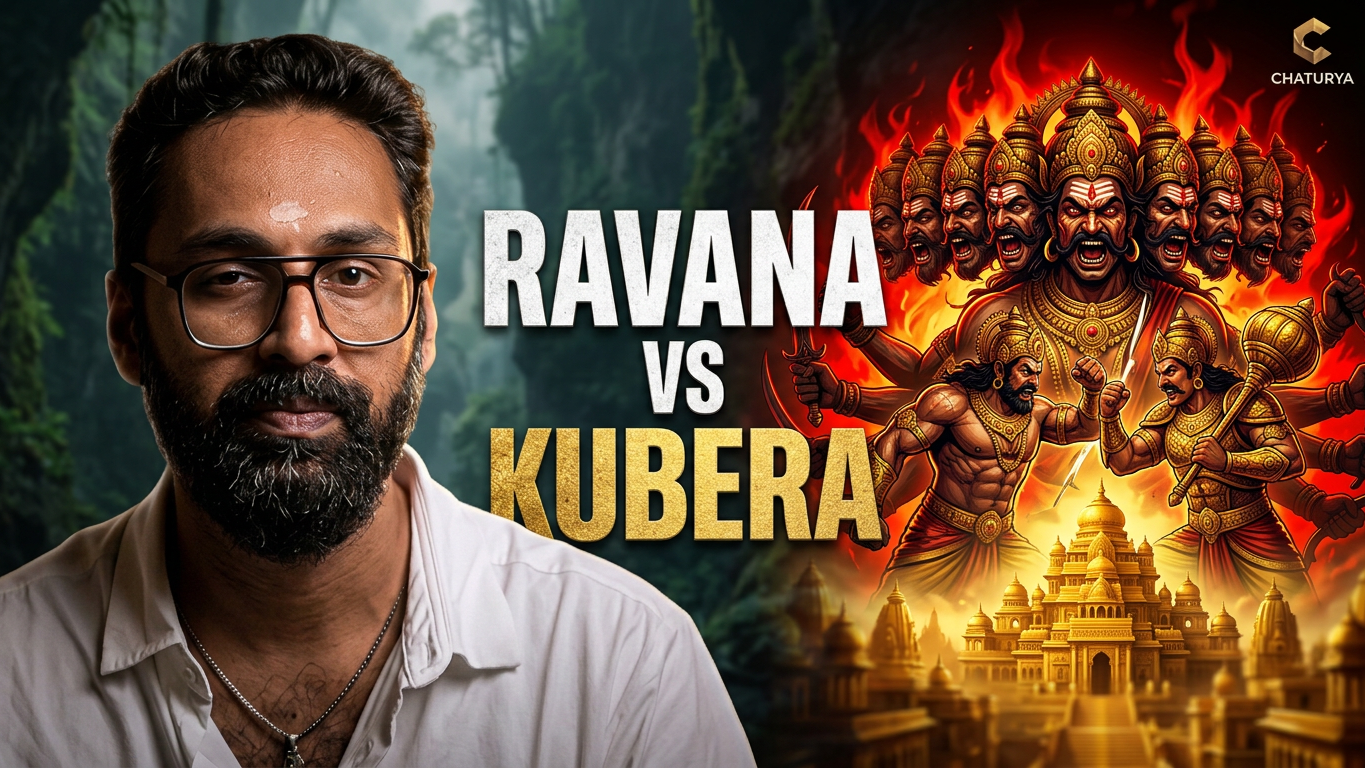
Kubera vs Ravana: The First Battle for Lanka

Illustration of Ravana confronting Kubera before the First Battle of Lanka, showing the golden city of Lanka and the Pushpaka Vimana in a forgotten story from the Ramayana.

As excitement builds around the Ramayana trailer and audiences once again immerse themselves in the world of Prabhu Shri Rama, Sita, Hanuman, Ravana and the golden city of Lanka, one fascinating chapter of the epic continues to remain in the shadows. Long before the Vanara Sena crossed the ocean. Long before the construction of Rama Setu. Long before the famous battle that would culminate in Ravana’s downfall, Lanka had already witnessed another war. Not exactly a battle but a passive takeover.

It was not a battle against Shri Rama.

It was a war between two half-brothers.

Watch the entire video on Chaturya – The Fourth State Channel:

The Forgotten War Before the Ramayana: How Ravana Seized Lanka

This forgotten chapter from the Ramayana tells the story of Kubera and Lanka. How a kingdom built on virtue was taken by ambition, and how Ravana’s very first conquest planted the seeds of his eventual destruction. Whether you are revisiting the Ramayana during Ramayanamasam, preparing for Dussehra, or simply discovering these lesser-known episodes after watching the Ramayana trailer, this ancient story offers a remarkable glimpse into Lanka before Ravana became its king.

The Golden Lanka Before Ravana

When we think of Lanka today, we almost instinctively picture the kingdom of Ravana. A glittering fortress rising from the sea, its towering palaces clad in gold, its fortifications thought to be impregnable, and its name forever entwined with the final chapters of the Ramayana. It is the Lanka that has inspired countless retellings of the epic, from temple murals and classical poetry to modern adaptations and the much-anticipated Ramayana trailer.

Yet, hidden beneath the grandeur of Ravana’s empire lies a far older history, one that is often overlooked. According to the Uttara Kanda of the Ramayana, Lanka did not begin as the stronghold of a conqueror. Before it became synonymous with Ravana, it was a city born of divine craftsmanship, entrusted to a ruler whose greatest strength was not military power but unwavering devotion.

The ancient texts tell us that Kubera, the Yaksharaja and elder son of Rishi Vishrava, arrived to make the island his home. Unlike many kings celebrated in mythology, Kubera did not inherit his greatness through conquest. His rise was the fruit of years of austerity, discipline, and sincere devotion to Brahma. Moved by his penance, Brahma appointed him as the Lokapala, the divine guardian of the northern direction, and entrusted him with the stewardship of the world’s treasures. Along with this sacred responsibility came another extraordinary gift: the celestial Pushpaka Vimana, a wondrous aerial chariot that responded not to reins or horses but to the will of its master.

Under Kubera’s rule, Lanka entered what may well be described as its first golden age. The city itself had been fashioned by the divine architect Vishwakarma, whose creations were said to mirror the harmony and perfection of the heavens. Its golden palaces reflected the light of the rising sun, its avenues echoed with the laughter of Yakshas rather than the march of Rakshasa armies, and its prosperity flowed not from fear or conquest but from righteous governance. Wealth was abundant, yet it remained inseparable from dharma. The splendour of Lanka was not merely measured by the gold that adorned its walls, but by the virtue of the king who ruled within them.

This was the original story of Kubera and Lanka, a kingdom that stood as a reward for humility rather than ambition, for spiritual merit rather than military might. Ironically, it was this very splendour that would one day capture the imagination of Kubera’s younger half-brother. For Ravana, Lanka was not a sacred trust to be protected. It was a prize waiting to be claimed. And with that single desire, the destiny of the golden city began to change forever.

Two Brothers. Two Different Paths

The peace that defined Kubera’s Lanka would not endure for long. The seeds of its downfall were not sown by a foreign king or an invading army, but within Kubera’s own family.

Rishi Vishrava, the great sage and father of Kubera, later married Kaikesi, a Rakshasi princess descended from a powerful lineage. Their union brought forth four children who would each leave an indelible mark upon the pages of the Ramayana—Ravana, Kumbhakarna, Vibhishana, and Shurpanakha of Janasthana. Though Kubera and Ravana shared the same father and grew up under the guidance of the same learned sage, they inherited vastly different temperaments. Kubera had come to embody restraint, humility, and the quiet responsibilities that accompanied divine wealth. Ravana, brilliant and immensely capable in his own right, possessed an intellect matched only by an ambition that refused to recognise limits.

The Uttara Kanda recounts a defining moment in Ravana’s youth. One day, Kubera arrived at his father’s hermitage aboard the celestial Pushpaka Vimana, the wondrous aerial chariot gifted to him by Brahma. To those gathered there, it was a magnificent sight. The radiant vimana seemed to glide effortlessly through the sky, reflecting the splendour of its master. But where others saw the reward of a life dedicated to tapas and dharma, Ravana saw something else entirely. He saw a brother whose status eclipsed his own, whose kingdom surpassed anything he possessed, and whose honour had been earned through virtues Ravana had little interest in cultivating. In that quiet moment, admiration gave way to envy, and envy slowly hardened into resolve.

Determined never to stand in his brother’s shadow, Ravana withdrew into the forests with his brothers and undertook one of the most severe penances described in the Puranic tradition. His austerities were extraordinary, displaying a discipline few could equal. Yet the intention behind them differed fundamentally from Kubera’s.

Kubera had sought spiritual fulfilment and the opportunity to serve the cosmic order. Ravana sought supremacy. His tapas was directed not towards inner transformation, but towards becoming unconquerable. Pleased by the intensity of his penance, Brahma granted Ravana formidable boons, making him nearly invincible against devas, gandharvas, yakshas, and many other celestial beings. It was a turning point not only in Ravana’s life but in the destiny of Lanka itself. Armed with newfound power and driven by unrestrained ambition, he no longer looked upon Kubera as an elder brother worthy of reverence. He looked upon him as the final obstacle standing between himself and the golden kingdom he believed should have been his all along.

The First Battle of Lanka

Empowered by Brahma’s boons and convinced that no force in the three worlds could challenge him, Ravana’s ambitions soon outgrew the forests where he had performed his penance. His gaze turned towards Lanka, the magnificent island kingdom that continued to flourish under Kubera’s just rule. To Kubera, Lanka had always been a sacred trust, a kingdom bestowed upon him through tapas and sustained through dharma.

Ravana, however, saw something very different. He saw a throne occupied by another. He saw immeasurable wealth, the celestial Pushpaka Vimana, and a glory that he believed should rightfully be his. The admiration he had once felt for his elder half-brother had long since hardened into a relentless determination to possess everything Kubera had earned.

The Ramayana preserves more than one tradition regarding what happened next. In one account, Rishi Vishrava, fully aware of the extraordinary boons Ravana had received from Brahma, recognised that resisting him would only lead to needless destruction. Rather than allowing Lanka to become the site of a catastrophic conflict, the sage advised Kubera to relinquish the city and withdraw peacefully.

Other traditional retellings describe Ravana advancing upon Lanka with a formidable army of Rakshasas, where the gentle Yakshas, unaccustomed to warfare on such a scale, found themselves unable to withstand his assault. Though the details differ, both traditions arrive at the same destination. The first great war fought for Lanka ended not with celebration, but with exile.

Kubera departed from the golden city that had once been entrusted to him by Brahma, carrying little more than his dignity and his unwavering commitment to dharma. Ravana entered Lanka not as its rightful guardian, but as its conqueror. Along with the throne, he seized the city’s immense riches and claimed the celestial Pushpaka Vimana, transforming what had once symbolised divine grace into a trophy of conquest. It was the first great victory of Ravana’s life, but it also marked the moment when the destiny of Lanka began to change.

A kingdom that had flourished because of virtue was now ruled through power. Its golden walls still shimmered beneath the tropical sun, but the spirit that had once defined the city had quietly slipped away. Long before Prabhu Shri Rama’s army stood before the gates of Lanka, the island had already suffered its first and perhaps most profound fall.

Kubera’s Exile and the Rise of Alakapuri

Kubera’s departure from Lanka was not the end of his story. It was the beginning of a very different one. Having relinquished the golden city rather than plunge it into needless bloodshed, he turned his back on the kingdom that had once been entrusted to him and journeyed north towards the snow-clad Himalayas. There, in the shadow of Mount Kailasa, the sacred abode of Bhagawan Shiva, Kubera established a new city known as Alakapuri.

Unlike Lanka, whose splendour rested upon its golden palaces and earthly riches, Alakapuri came to symbolise something far more enduring. It became the seat of Kubera’s divine office as the guardian of wealth, a place where prosperity remained inseparable from dharma and where material abundance was understood as a responsibility rather than a possession.

There is a quiet irony in Kubera’s journey. Although he lost the most magnificent kingdom in the world, he never lost the divine trust that had made him worthy of ruling it in the first place. His authority did not depend upon the walls of Lanka or the ownership of the Pushpaka Vimana. It flowed from his character, his humility, and his unwavering adherence to cosmic order. The Puranic tradition reminds us that kingdoms may be seized through force, treasures may pass from one hand to another, and even the grandest cities may change their rulers. But spiritual stature cannot be stolen. It must be earned.

Ravana, meanwhile, stood at the height of his triumph. Lanka became the dazzling capital of a rapidly expanding empire, its wealth unmatched and its ruler feared across the three worlds. Yet beneath that outward splendour lay an uncomfortable truth. The empire rested upon an act of betrayal committed against an elder brother who had shown no aggression towards him.

The very foundation of Ravana’s reign had been laid not through righteous inheritance or divine appointment, but through envy and force. It was a flaw invisible to those dazzled by Lanka’s golden walls, yet one that would continue to widen with every decision Ravana made thereafter. By the time Prabhu Shri Rama arrived at Lanka’s shores decades later, the seeds of Ravana’s downfall had already been sown on the day he first claimed his brother’s throne.

The First Step Towards Ravana’s Downfall

Every year, as Dussehra approaches, effigies of Ravana rise across towns and cities before being consumed by fire, reminding us of the triumph of dharma over adharma. A few weeks later, Diwali celebrates the joyous return of Shri Rama to Ayodhya after his victory in Lanka. For most of us, these festivals mark the conclusion of Ravana’s story. Yet the Ramayana quietly suggests that his downfall did not begin on the battlefield outside Lanka’s walls, nor with the abduction of Mata Sita. The path towards his destruction had been set in motion many years earlier, on the day he chose ambition over righteousness and turned against his own brother.

The capture of Lanka was, without question, Ravana’s first great triumph. He acquired the most magnificent city in the world, claimed the celestial Pushpaka Vimana, and established himself as a ruler whose power soon inspired fear across the three worlds. By every worldly measure, he had succeeded. Yet the Puranic tradition repeatedly reminds us that victories achieved through adharma carry within them the seeds of their own undoing.

In seizing a kingdom that had never been denied to him through injustice, Ravana crossed a boundary from which there would be no return. The same pride that compelled him to covet Kubera’s throne would later lead him to challenge devas, sages, and ultimately Shri Rama himself. Each decision flowed naturally from the one before it, as though the first act of betrayal had quietly shaped every choice that followed.

Perhaps that is why the story of Kubera and Lanka deserves to be remembered alongside the better-known episodes of the Ramayana. It reminds us that great epics are rarely shaped by a single moment. They are built upon countless smaller choices, each carrying its own moral weight.

Long before Rama’s arrows pierced the skies above Lanka, Ravana had already begun dismantling the foundations of his own empire. The golden city that he had coveted for its splendour would eventually become the very place where his pride met its inevitable end, proving that while kingdoms may be won through power, they can only endure when rooted in dharma.

A Forgotten Lesson from the Ramayana

Perhaps this is why the Ramayana has endured for thousands of years. It is not merely the story of a great war or the triumph of good over evil. It is a deep exploration of the choices that shape destiny, often long before the decisive battle is fought. Ravana’s confrontation with Prabhu Shri Rama did not arise in isolation. Its origins can be traced back to a far quieter moment, when envy first took root in his heart and transformed admiration into ambition. The seizure of Lanka was not simply the beginning of his reign; it was the beginning of a path from which there would be no turning back.

The story of Kubera and Lanka also reminds us that wealth, power, and kingdoms are never permanent. They may be won through conquest or inherited through lineage, but they endure only when upheld by dharma. Kubera lost his golden city, yet retained the honour that had earned him the trust of the gods. Ravana gained everything he had once desired, but in doing so lost the very principles that might have preserved his empire. By the time the Vanara Sena crossed the ocean and the final battle of the Ramayana unfolded, the fate of Lanka had already been sealed many years earlier.

Perhaps that is the forgotten lesson hidden within this ancient account. Great civilizations are rarely destroyed in a single day, nor do great heroes or villains emerge through a single decision. Their destinies are shaped by countless choices, each one quietly building upon the last. Ravana’s greatest conquest became the first crack in the foundation of his empire, while Kubera’s greatest loss ultimately elevated him to a place that no earthly throne could ever equal.

As millions revisit these timeless stories through the Ramayana, during Ramayanamasam, or with the renewed excitement surrounding the upcoming Ramayana film, this forgotten chapter invites us to look beyond the epic’s famous climax. Before there was a war between Rama and Ravana, there was a conflict between two brothers—one who believed that power was meant to be protected by dharma, and another who believed it could simply be taken.

If you enjoyed this lesser-known chapter from the Ramayana, you may also enjoy exploring Kubera’s remarkable previous birth and the extraordinary journey that eventually led him to become the divine guardian of wealth. Read the full story here.


Categories: ,

Leave a Reply

Your email address will not be published. Required fields are marked *