
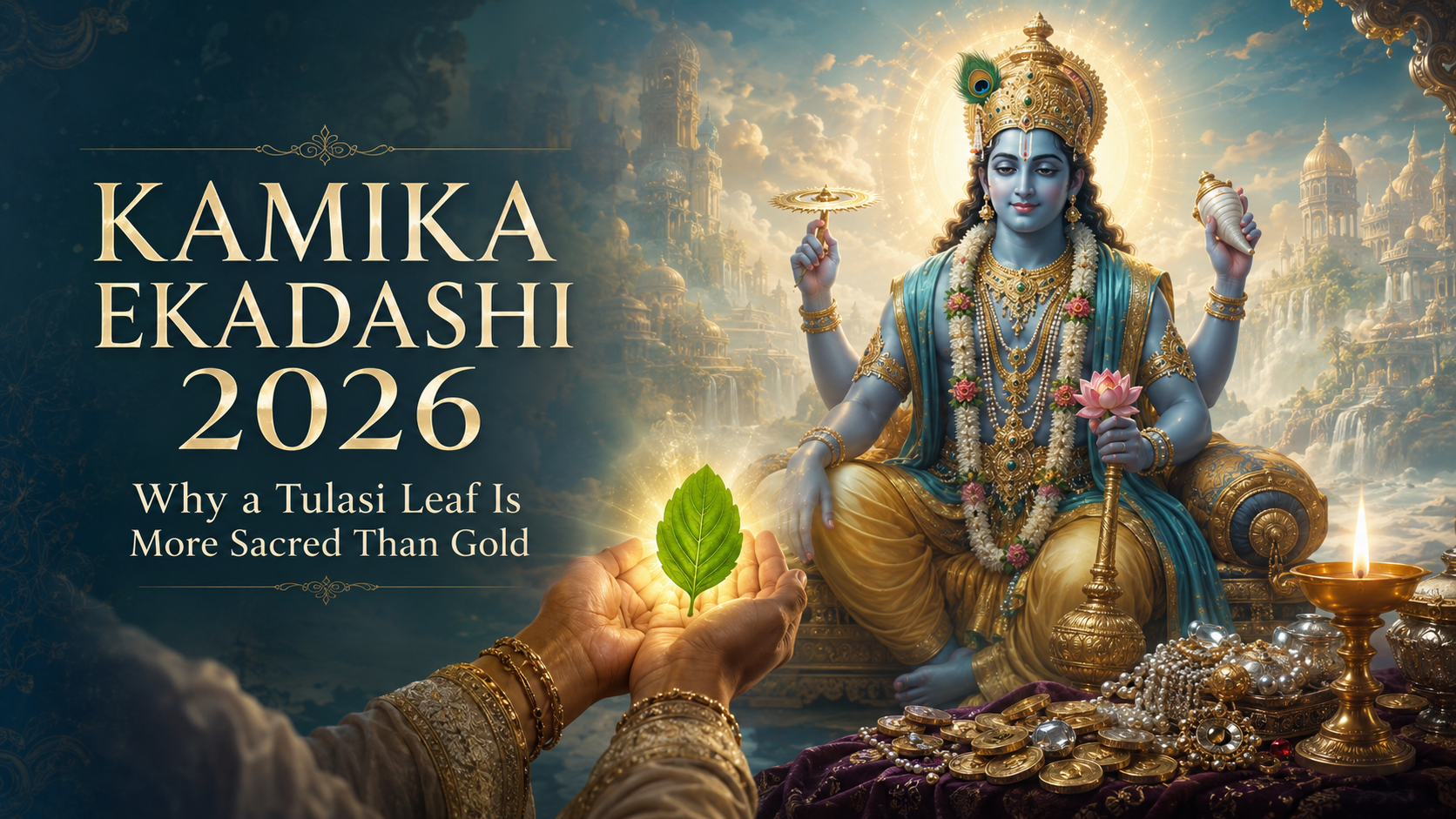
Kamika Ekadashi 2026 is observed during the Krishna Paksha, or dark fortnight, of the sacred month of Shravana. Dedicated to Bhagawan Vishnu, this Ekadashi is associated with fasting, prayer, remembrance of Vishnu, worship with Tulasi, lighting of a deepa and, according to tradition, remaining awake in devotion during the night. Yet the traditional Kamika Ekadashi Vrat Katha carries a deeper message. It tells us that spiritual merit is not determined by how much wealth a devotee possesses or how elaborate an offering may be. Sometimes, something as simple as a single Tulasi leaf, when offered with sincere devotion, can become more precious than gold, silver, pearls and other costly offerings.
This idea lies at the heart of Kamika Ekadashi. The vrata brings together some of the most familiar elements of Vaishnava devotion, including Vishnu worship, Tulasi, fasting and remembrance of the divine, but places bhakti above material grandeur. To understand why Kamika Ekadashi is considered so sacred, we have to return to its traditional Vrat Katha and the conversation through which its significance is revealed.
📌 A quick clarification about Shravan (Sawan) dates:
In 2026, the dates of Shravan differ depending on the regional lunar calendar traditionally followed. Under the Purnimanta calendar, commonly followed in North India, Shravan runs from 30 July to 28 August 2026. Under the Amanta calendar, followed across much of South and Western India, including Karnataka, Shravan runs from 13 August to 11 September 2026. So, if the dates you follow are different from those mentioned in the video, neither is necessarily incorrect. It reflects the different calendrical traditions followed across India. 🙏
What Is Kamika Ekadashi?
Kamika Ekadashi is the Ekadashi observed during the Krishna Paksha of the month of Shravana. Like other Ekadashi observances, it is primarily associated with the worship of Bhagawan Vishnu. The traditional Kamika Ekadashi Vrat Katha describes the spiritual merit of observing this day with devotion and explains the different practices associated with the vrata.
The significance of Kamika Ekadashi is revealed through a sacred dialogue between Shri Krishna and Arjuna. Arjuna asks Krishna about the Ekadashi that occurs during the dark fortnight of Shravana and wishes to understand its importance. Krishna explains that this sacred teaching had earlier been narrated by Pitamaha Bhishma to Devarshi Narada. Narada had approached Bhishma seeking knowledge about this Ekadashi for the spiritual welfare of all beings. Bhishma then revealed its name as Kamika Ekadashi and described its glory.
According to the traditional Vrat Katha, even listening to the glory of Kamika Ekadashi with devotion is considered an act of punya, or spiritual merit. At the centre of the observance, however, is Bhagawan Vishnu.
Why Is Kamika Ekadashi Considered So Sacred?
On Kamika Ekadashi, devotees worship Bhagawan Vishnu, the preserver of the cosmos, who is traditionally represented bearing the Shankha, Chakra, Gada and Padma. The Kamika Ekadashi Vrat Katha makes an extraordinary comparison while describing the importance of this worship. It states that spiritual merit associated with sacred pilgrimages and elaborate yajnas may also be attained through sincere worship of Bhagawan Vishnu on Kamika Ekadashi.
This teaching is important because it makes devotion accessible. Not everyone can travel to distant pilgrimage centres. Not everyone possesses the resources required to conduct elaborate rituals or make large donations. A person’s financial condition, physical circumstances or place of residence may prevent such acts. Bhakti, however, is available to everyone. Fasting according to one’s capacity, prayer, self-restraint, remembering Vishnu and maintaining purity of thought can themselves become offerings.
This simplicity is one of the reasons why the significance of Kamika Ekadashi extends beyond the ritual act of fasting. The vrata asks the devotee to turn inward and consider the quality of the offering rather than its monetary value. It is here that one of the most important elements of Kamika Ekadashi enters the story: Tulasi.
Why Is Tulasi Important on Kamika Ekadashi?
Tulasi Devi occupies a special place in the Kamika Ekadashi tradition. According to the Vrat Katha, Bhishma tells Narada that Bhagawan Vishnu is more pleased by a Tulasi leaf offered with sincere devotion than by great quantities of gold, silver, pearls or precious stones. The comparison contains one of the most beautiful teachings associated with Kamika Ekadashi. The most precious offering is not necessarily the most expensive one. Its true value comes from the bhakti with which it is offered.
Tulasi has a deeply sacred association with Bhagawan Vishnu in living Hindu tradition. During Kamika Ekadashi, this relationship becomes particularly significant. The Vrat Katha praises seeing Tulasi, touching her with reverence, watering her roots and offering her leaves to Bhagawan Vishnu. These are simple acts, but the tradition gives them profound spiritual meaning.
The devotee is compared to a lotus leaf that remains untouched by the water surrounding it. The image expresses an important spiritual ideal. Human beings have to live within the world, fulfil responsibilities, experience relationships and face the joys and difficulties of ordinary life. Spiritual practice does not necessarily demand an escape from that world. Instead, it teaches a person how to live within it without becoming completely bound by attachment.
The importance of Tulasi on Kamika Ekadashi can therefore be understood at more than one level. Tulasi is an offering to Vishnu, but she also becomes a reminder of devotion itself. A small green leaf, available to an ordinary devotee, can carry a significance that material wealth cannot purchase. In this way, Kamika Ekadashi quietly challenges the idea that spiritual worth can be measured through the grandeur of an offering.
What Does the Kamika Ekadashi Vrat Katha Say?
The traditional Kamika Ekadashi story is framed through a chain of sacred conversations. Shri Krishna narrates its significance to Arjuna, while explaining that the teaching had earlier been given by Bhishma to Narada. Through this dialogue, the Vrat Katha describes Kamika Ekadashi as a sacred observance dedicated to Vishnu and praises the punya associated with observing it sincerely.
The Katha repeatedly returns to the importance of devotion. Sacred pilgrimages, yajnas and material offerings possess their own place within tradition, but Kamika Ekadashi presents another path that is available even to a person without great wealth. Worship of Vishnu, remembrance of his names, fasting, Tulasi and a simple lamp become spiritually meaningful when they arise from sincere devotion.
This is perhaps why the Kamika Ekadashi Vrat Katha continues to remain relevant. Beneath its descriptions of punya and religious observance lies a very human question: What can a person offer to the divine when they possess very little? The answer offered by the tradition is simple. Devotion itself can become the offering.
How Is Kamika Ekadashi Observed?
The method of observing Kamika Ekadashi can differ according to family tradition, sampradaya, health and individual capacity. Traditionally, devotees undertake the Ekadashi vrata and dedicate the day to Bhagawan Vishnu through fasting, prayer, remembrance of his sacred names and worship with Tulasi.
Fasting is one of the practices most commonly associated with Ekadashi, but the wider meaning of the vrata also includes self-restraint and remembrance. A vrata is not merely about abstaining from food. The mind, speech and actions of the devotee are also directed towards spiritual discipline. For this reason, prayer and remembrance of Vishnu form an important part of Kamika Ekadashi worship.
Another practice mentioned in the tradition is ratri jagaran, or remaining awake during the night in devotion and prayer. The night becomes an opportunity for remembrance rather than ordinary activity. Devotees may spend this period in prayer, worship or recitation of the names of Bhagawan Vishnu according to their tradition and capacity.
There is also another remarkably simple offering associated with Kamika Ekadashi: the deepa.
Why Is a Deepa Offered on Kamika Ekadashi?
The Kamika Ekadashi Vrat Katha praises the offering of a deepa before Bhagawan Vishnu during the night. A lamp filled with ghee or sesame oil is described in the tradition as generating immense spiritual merit.
The symbolism of the lamp is especially beautiful. On the surface, the devotee is simply lighting a flame before the deity. At another level, the external flame can be understood as a reflection of an internal act. Light is brought into those parts of ourselves that remain governed by ignorance, fear and attachment.
A deepa is also an accessible offering. Like Tulasi, it does not require great wealth. This again brings us back to the central theme of Kamika Ekadashi. The vrata repeatedly directs attention away from the size or cost of an offering and towards the consciousness of the person making it.
What Is the Spiritual Significance of Kamika Ekadashi?
The deeper significance of Kamika Ekadashi lies in its simplicity. Spiritual progress is not presented as something reserved only for those capable of performing grand ceremonies, travelling to distant sacred places or making expensive offerings. The tradition presents a far more intimate path.
A Tulasi leaf. A lamp. A fast. A night spent remembering Vishnu. Above all, sincere devotion.
According to the traditional Kamika Ekadashi Vrat Katha, observing the vrata with bhakti helps in the purification of karmic burdens and leads the devotee towards the grace of Bhagawan Vishnu. Even listening to or reciting the sacred story is regarded as an act of punya.
These ideas also explain why Kamika Ekadashi holds significance during the sacred month of Shravana. The observance creates a moment in which everyday life can be interrupted by remembrance. Hunger during the fast becomes a reminder. Tulasi becomes a reminder. The flame of the lamp becomes a reminder. The night itself becomes a period of remembrance.
The ritual objects may be simple, but the inner movement they represent is much larger.
Is Kamika Ekadashi Only About Fasting?
It would be incomplete to understand Kamika Ekadashi only as a day of fasting. Fasting is an important part of the traditional observance, but the Kamika Ekadashi Vrat Katha places equal emphasis on Vishnu bhakti, Tulasi, prayer, self-restraint, purity of thought and remembrance of the divine.
This distinction matters because the purpose of a vrata cannot be reduced simply to the absence of food. The external discipline of fasting is connected with an internal discipline. The devotee deliberately turns attention away from ordinary habits and towards Bhagawan Vishnu. In this sense, the physical vrata becomes a means of cultivating spiritual awareness.
Individual practices can differ according to sampradaya and personal capacity. The central principle, however, remains devotion.
What Can We Learn from Kamika Ekadashi Today?
Perhaps the most enduring lesson of Kamika Ekadashi is that the distance between a devotee and the divine cannot be measured in wealth. Religious traditions often contain magnificent temples, elaborate ceremonies, precious ornaments and grand offerings. These have their own beauty and sacred place. Yet Kamika Ekadashi reminds us that the inner world of devotion operates according to a different measure.
A wealthy person may offer something magnificent. Another devotee may have almost nothing to give. The Vrat Katha does not leave the second person outside the doors of spiritual life. Instead, it places an extraordinary value upon something almost anyone can offer: sincere bhakti.
That is why the image of the Tulasi leaf is so powerful. Gold has a price. Silver has a price. Pearls and precious stones have a price. Devotion does not.
The Tulasi leaf offered to Vishnu therefore becomes more than a ritual object. It represents an idea at the heart of bhakti itself. What matters is not merely what rests in the hands of the devotee, but what exists within the heart of the person offering it.
Kamika Ekadashi 2026 and the Living Tradition of Vishnu Bhakti
For devotees observing Kamika Ekadashi 2026, the traditional Vrat Katha offers an opportunity to look beyond the mechanics of the vrata and understand the ideas that give these practices meaning. Fasting, Tulasi worship, Vishnu puja, ratri jagaran and offering a deepa are not isolated rituals. Together, they create a spiritual discipline centred on remembrance, self-restraint and devotion.
Kamika Ekadashi also reminds us why ancient sacred stories continue to remain part of living Hindu tradition. They do not merely describe rituals from another age. Their symbols continue to speak to ordinary human experiences. Wealth and limitation, attachment and self-restraint, darkness and light, effort and grace are as relevant to human life today as they were to generations before us.
During the sacred month of Shravana, Kamika Ekadashi ultimately leaves us with a remarkably simple thought. The distance between the devotee and the divine cannot be measured by the amount of wealth one possesses.
Sometimes, that distance is crossed with something as simple as a single leaf of Tulasi.
If you want to read about the ancient city found in the holy city of Puri, then please click on the article below:
Frequently Asked Questions About Kamika Ekadashi
What is Kamika Ekadashi?
Kamika Ekadashi is the Ekadashi observed during the Krishna Paksha, or dark fortnight, of the sacred month of Shravana. It is dedicated to the worship of Bhagawan Vishnu.
Why is Kamika Ekadashi important?
The traditional Kamika Ekadashi Vrat Katha describes the observance as spiritually meritorious and emphasises Vishnu worship, fasting, prayer, Tulasi, self-restraint and sincere bhakti.
Why is Tulasi offered to Vishnu on Kamika Ekadashi?
The Kamika Ekadashi tradition gives special importance to Tulasi Devi. According to the Vrat Katha, Bhagawan Vishnu is more pleased by a Tulasi leaf offered with sincere devotion than by large quantities of gold, silver, pearls or precious stones.
How is Kamika Ekadashi observed?
Traditionally, devotees observe the vrata according to their capacity and sampradaya. Practices include fasting, prayer, remembrance of Bhagawan Vishnu, worship with Tulasi, ratri jagaran and offering a deepa.
Which deity is worshipped on Kamika Ekadashi?
Kamika Ekadashi is primarily associated with the worship of Bhagawan Vishnu, traditionally represented bearing the Shankha, Chakra, Gada and Padma.
What is the main teaching of Kamika Ekadashi?
One of the central teachings of Kamika Ekadashi is that sincere devotion is more important than material grandeur. The vrata emphasises that spiritual practice can remain accessible even to those who cannot undertake expensive rituals, large donations or distant pilgrimages.




Leave a Reply