
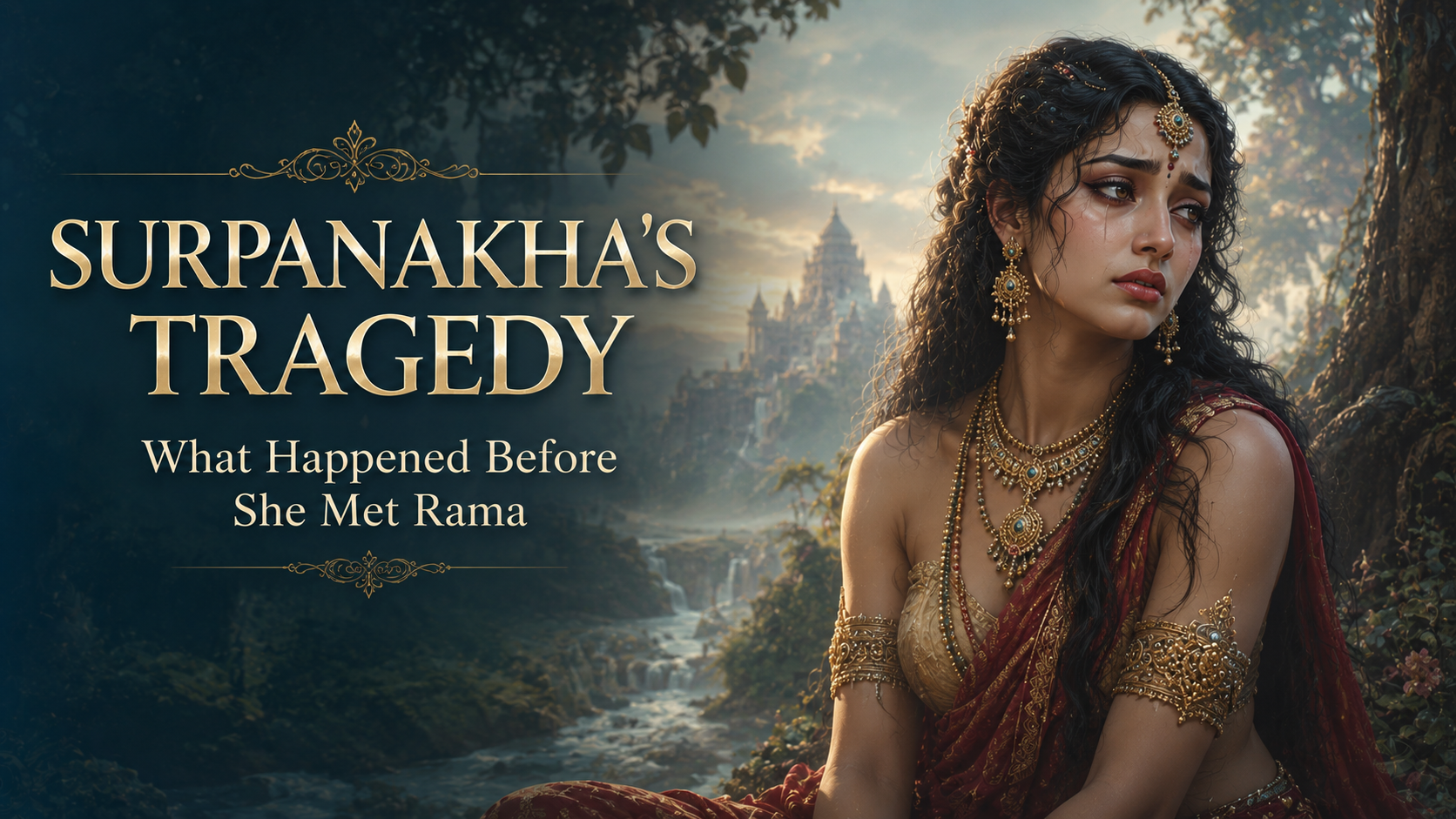
Everyone remembers Surpanakha as the rakshasi who desired Rama in the forests of Panchavati and was mutilated by Lakshmana for it. That single episode has defined her in popular memory for centuries. But few know that Surpanakha’s husband existed at all, or that his death at Ravana’s own hands is one of the quietest, most consequential moments in the entire Ramayana. His name was Vidyujjihva, and his story doesn’t just humanize Surpanakha. It reframes the war that would eventually consume Lanka.
This piece traces that story, from the marriage itself, to the killing, to the chain of choices it set off, all the way to the battlefield where Bhagawan Rama finally faced Ravana.
Who Was Surpanakha Before Panchavati?
Surpanakha was born into one of the most powerful families of the rakshasa lineage. Daughter of the sage Vishrava, sister to Ravana, Kumbhakarna and Vibhishana, she was rakshasa royalty by birth.
What most retellings skip is that she was also a wife and a mother. Her husband was Vidyujjihva, and together they had a son named Shambhukumar.
This detail matters. Popular culture has flattened Surpanakha into a single scene: her infatuation with Rama and the violence that followed. But within the wider Ramayana tradition, particularly the Uttara Ramayana and sections of the Kamba Ramayanam’s Aranya Kandam, her story begins long before she ever set foot in Dandakaranya.
How Ravana Killed His Own Brother-in-Law
Vidyujjihva was connected to the Kalakeyas, a formidable clan that Ravana clashed with during one of his many campaigns of conquest.
The battle that followed was brutal. Ravana’s forces slaughtered the Kalakeyas. When Vidyujjihva learned of his kinsmen’s deaths, he confronted Ravana directly to demand an account.
Ravana killed him too.
There’s a bitter irony sitting at the center of this episode. Ravana, king of Lanka and terror of the three worlds, had killed the husband of his own sister. Not an enemy king. Not a rival warlord. Family.
When Surpanakha learned what had happened, she came to Ravana in grief, mourning the husband his own hand had taken from her.
Ravana’s Promise to His Widowed Sister
What happened next is where the story becomes genuinely strange, and genuinely important for everything that follows.
Ravana, moved by his sister’s grief, tried to console her. He told Surpanakha she was free to travel through the three worlds and choose a new husband for herself. He went further still: if any man she chose ever rejected her, she was to come to him, and he would intervene on her behalf.
Read against what happens later at Panchavati, this promise takes on real weight. Surpanakha was not simply a rakshasi wandering the forest on a whim when she encountered Rama. In this strand of the tradition, she was acting on her brother’s word, actively searching for the husband he had promised to help her secure.
Accompanied by Khara, Dushana and Trishira, she traveled the worlds and eventually arrived at Janasthana, where her path crossed that of three exiles from Ayodhya: Bhagawan Rama, Sita, and Lakshmana.
The Encounter at Panchavati
From here, the story rejoins the Ramayana most readers already know.
Surpanakha sees Rama and desires him. He tells her he is already married and points her toward Lakshmana instead. The exchange sours quickly, especially once Surpanakha turns her frustration toward Sita. Lakshmana mutilates her in response.
Humiliated and enraged, Surpanakha runs to Khara and Dushana, who march on Rama and are destroyed for it. Word finally reaches Ravana himself.
And Ravana makes his choice: he abducts Sita.
Why Vidyujjihva’s Death Matters
It would be easy to treat the Vidyujjihva episode as a footnote, an odd bit of backstory that doesn’t change the main plot. It changes everything about how we read it.
This isn’t about excusing Surpanakha’s actions at Panchavati, and it isn’t about softening Ravana’s decision to abduct another man’s wife. It’s about seeing the pattern the epic is quietly building.
One act of adharma creates the conditions for the next.
- Ravana kills Vidyujjihva in battle.
- Grief and a rash promise send Surpanakha out into the world looking for a husband.
- That search brings her to Rama, and her own choices at Panchavati end in violence.
- Her humiliation pulls Khara and Dushana into a fight they lose.
- Ravana, hearing of his sister’s disfigurement, escalates rather than de-escalates, and abducts Sita.
Each person in this chain retained agency. Nobody was simply a puppet of fate. That’s precisely what makes the pattern so devastating: at every link, someone could have chosen differently, and didn’t.
Ravana’s Greatest Victory Became His Undoing
There’s a real irony sitting underneath this entire chain of events.
Ravana spent his life accumulating power. He conquered kingdoms, challenged the devas, and won extraordinary boons through his tapas. Yet the war that finally destroyed him didn’t begin with an invading army or a rival emperor. It began inside his own household, with a brother’s blade turned against his sister’s husband.
By abducting Sita, Ravana pulled Rama across the ocean to Lanka. What followed was catastrophic for his kingdom: Kumbhakarna fell, Indrajit fell, his armies were broken, and Lanka itself burned. The conqueror who had never lost a war finally stood on a battlefield facing the one thing his power could never touch: the consequences of his own adharma.
Dharma, Adharma, and the Real Architecture of the Ramayana
This is one of the reasons the Ramayana endures as more than a straightforward tale of hero versus villain. It is, at its core, a study of what happens when people are confronted with choices, and what they do with them.
Dharma in the epic is rarely abstract philosophy. It shows up in action, moment by moment, decision by decision. So does its absence.
The story of Vidyujjihva and Surpanakha is a case study in exactly this. Consequences here don’t arrive immediately or obviously. They travel, sometimes across years and generations, through families and kingdoms, before finally returning to the person who set them in motion in the first place.
Ravana killed Vidyujjihva. That single act, made in the heat of conquest, eventually returned to him as the destruction of everything he had built.
The Seeds of Lanka’s Destruction Were Planted Early
We tend to think of Sita’s abduction as the beginning of Ravana’s downfall. It’s more accurate to call it the moment that downfall became unstoppable.
The real seeds were planted earlier, in pride, in conquest, in violence, and in Ravana’s repeated conviction that his power placed him beyond consequence. The story of Surpanakha’s husband is one of the clearest examples of this in the entire epic. A sword raised in battle brought grief into Ravana’s own family first, long before it brought war to his kingdom.
That is one of the enduring truths the Ramayana keeps returning to: adharma doesn’t end when the act itself is over. It leaves something behind. A powerful man may outrun those consequences for a while. A king may believe his armies can shield him. A conqueror may mistake victory for vindication.
But dharma works on a longer timeline than any single battle. And even the mightiest king of Lanka eventually learned that no army, no boon, and no throne could protect him from the weight of his own choices.
Sources: Uttara Ramayana, Kamba Ramayanam (Aranya Kandam)




Leave a Reply